




All It Takes Is $13,000 Invested in Each of These 2 Dividend Kings to Help Generate $1,000 in Passive Income in 2026
Key Points
Procter & Gamble is focusing on increasing sales volumes rather than raising prices.
Give Kimberly-Clark a few years to turn things around.
Procter & Gamble and Kimberly-Clark have attractive valuations.
- 10 stocks we like better than Procter & Gamble ›
No one knows what the stock market will do in 2026. We do know the S&P 500 (SNPINDEX: ^GSPC) is coming off three consecutive years of above-average returns, with a 78.3% gain from the start of 2023 to the end of 2025. By comparison, the consumer staples sector gained less than 5% in that three-year period.
Contrarian investors or folks whose main financial objectives are capital preservation and passive income may want to take a closer look at beaten-down consumer staples stocks. Especially high-yield Dividend Kings -- which are companies that have raised their dividends for at least 50 consecutive years.
Where to invest $1,000 right now? Our analyst team just revealed what they believe are the 10 best stocks to buy right now, when you join Stock Advisor. See the stocks »
By investing $13,000 into Procter & Gamble (NYSE: PG) and $13,000 into Kimberly Clark (NASDAQ: KMB), you can expect to earn more than $1,000 in passive income per year and likely more in the future if both companies continue boosting their payouts. Here's what makes these two Dividend Kings top buys in 2026.
Image source: Getty Images.
1. Procter & Gamble
The world's largest household and personal products company is coming off a terrible 2025 in which the stock lost 14.5% of its value and fell near a three-year low. P&G has recovered slightly so far this year. But second-quarter fiscal 2026 earnings and full-year guidance from Jan. 22 failed to give investors a lot to smile about.
Sales volume declined 1%, and organic sales growth was flat. Restructuring costs weighed on diluted net earnings per share (EPS), which fell 5%. P&G cut its fiscal 2026 diluted net EPS growth to a range of 1% to 6% increase, compared to a 3% to 9% increase in the prior quarter. It also expects organic sales growth to be flat to up 4% -- which is poor.
On the January earnings call, P&G acknowledged that it has been overly reliant on price increases in recent years, which is how it delivered steady earnings growth despite weak demand. I called attention to this problem in early 2023, and consumer spending and cost pressures have worsened since then.
Now under the leadership of new CEO Shailesh Jejurikar, P&G said it will need to make its value proposition more attractive by not raising prices and by focusing on volume growth, which will take time. The good news is that P&G's operating margins are incredibly strong, so it can afford a small decrease in margins in exchange for higher sales volume.
In the meantime, P&G has arguably the best dividend of any U.S. company -- with a 2.9% yield and 69 consecutive years of boosting its payout. P&G continues to generate gobs of free cash flow (FCF), and its valuation is well below average historical levels.
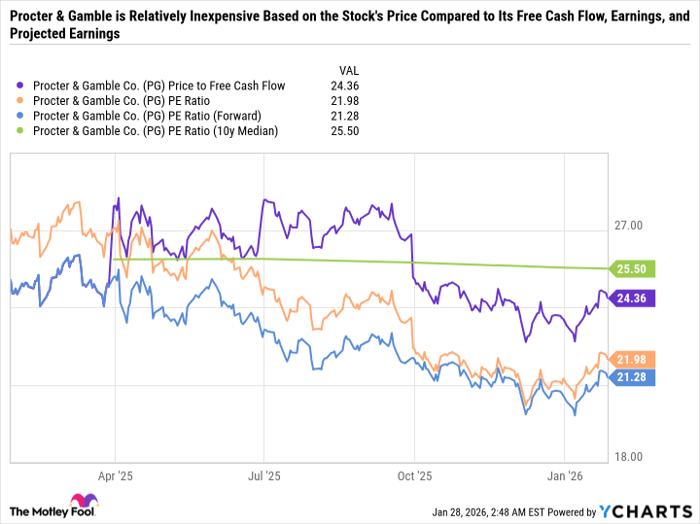
PG Price to Free Cash Flow data by YCharts. PE Ratio = price-to-earnings ratio.
Add it all up, and P&G is a top-tier dividend-paying value stock for income investors to buy in 2026.
2. Kimberly-Clark
Kimberly-Clark just reported another mediocre year -- with 3.2% adjusted earnings-per-share (EPS) growth, flat adjusted operating profit, a 1.7% increase in organic sales, and 2.1% lower net sales growth. 2026 isn't expected to be much better, with Kimberly-Clark forecasting 2% organic sales growth and flat adjusted EPS.
Despite the weak results, now could be an incredible buying opportunity for long-term value investors to scoop up shares of Kimberly-Clark. The company is in the middle of a multiyear downturn and plans to complete its acquisition of Kenvue (NYSE: KVUE) later this year. The idea is to create a more diversified personal care company by combining Kimberly-Clark's strengths in paper towels, toilet paper, diapers, and feminine products with Kenvue's leading consumer health brands like Band-Aid, Aveeno, Neutrogena, Listerine, Benadryl, and Tylenol.
Within two years after the acquisition closes, Kimberly-Clark expects the combined company's EPS to exceed the stand-alone EPS of the two companies separately -- also known as EPS accretion. Within three years, Kimberly-Clark expects to achieve a whopping $2.1 billion in annual cost synergies from the transaction.
Kimberly-Clark is setting the bar very low in the near-term but charting a path toward much better results in the medium to long term. Now is the perfect time for the company to think long term, given that household and personal products are in a downturn due to lower consumer spending and pricing pressure.
In the meantime, Kimberly-Clark yields a juicy 5%, with the company increasing its dividend for the 54th consecutive year on Jan. 27. The stock is hovering around its lowest level in 12 years. And although its growth has slowed down, it is still generating tons of FCF and earnings, with the valuation way below historic levels.
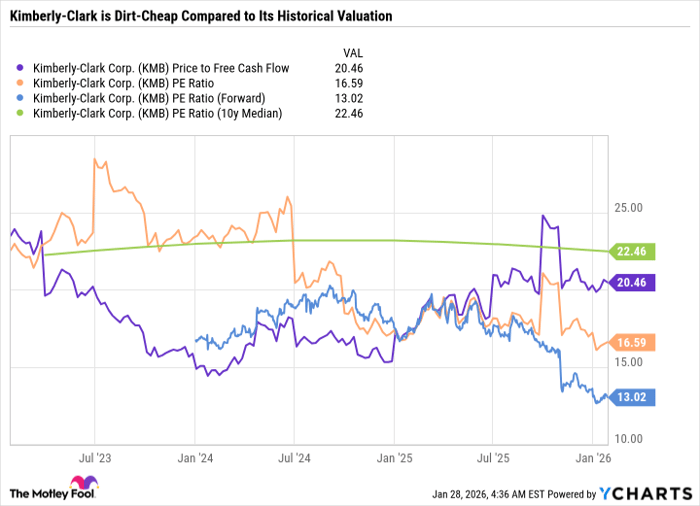
KMB Price to Free Cash Flow data by YCharts. PE Ratio = price-to-earnings ratio.
All told, Kimberly-Clark is a great choice for value investors looking to boost their passive income stream.
Two beaten-down Dividend Kings to buy in 2026
P&G is the higher quality company, with an elite portfolio of brands and better diversification than Kimberly-Clark, both in terms of product categories and geographic exposure. But Kimberly-Clark has a cheaper valuation, a higher yield, and could be a better turnaround play.
Both companies are barely growing right now, highlighting the severity of the consumer spending slowdown. But they still generate plenty of FCF and earnings to cover their dividends.
Overall, P&G is the safer buy of the two, but folks who believe Kimberly-Clark's multiyear plan and acquisition of Kenvue will pay off may prefer that stock instead. Another approach is to buy a 50/50 split of both stocks, which would produce an average yield of 4%.
Should you buy stock in Procter & Gamble right now?
Before you buy stock in Procter & Gamble, consider this:
The Motley Fool Stock Advisor analyst team just identified what they believe are the 10 best stocks for investors to buy now… and Procter & Gamble wasn’t one of them. The 10 stocks that made the cut could produce monster returns in the coming years.
Consider when Netflix made this list on December 17, 2004... if you invested $1,000 at the time of our recommendation, you’d have $450,256!* Or when Nvidia made this list on April 15, 2005... if you invested $1,000 at the time of our recommendation, you’d have $1,171,666!*
Now, it’s worth noting Stock Advisor’s total average return is 942% — a market-crushing outperformance compared to 196% for the S&P 500. Don't miss the latest top 10 list, available with Stock Advisor, and join an investing community built by individual investors for individual investors.
See the 10 stocks »
*Stock Advisor returns as of February 1, 2026.
Daniel Foelber has positions in Kenvue, Kimberly Clark, and Procter & Gamble and has the following options: short February 2026 $150 calls on Procter & Gamble. The Motley Fool has positions in and recommends Kenvue. The Motley Fool recommends Johnson & Johnson. The Motley Fool has a disclosure policy.
Recommended Articles


