




Wall Street Has a Federal Reserve Problem, With a Perfect Storm Brewing in 2026
Key Points
The Federal Reserve is typically viewed as a calming force for the stock market, with the central bank's goals being to maximize employment and stabilize prices.
Jerome Powell's term as Fed chair is coming to a close amid a historic level of division within the Federal Open Market Committee (FOMC).
Historical precedent points to an unpleasant correlation between Fed rate-easing cycles and challenging times for Wall Street.
- 10 stocks we like better than S&P 500 Index ›
For much of the last seven years, optimists have ruled the roost on Wall Street. The benchmark S&P 500 (SNPINDEX: ^GSPC) has had only three periods since 1928 where it's rallied at least 16% annually for three consecutive years, and two of these three periods have occurred over the last seven years (2019-2021 and 2023-2025).
The Dow Jones Industrial Average (DJINDICES: ^DJI) and Nasdaq Composite (NASDAQINDEX: ^IXIC) have followed suit by climbing to several record-closing highs.
Where to invest $1,000 right now? Our analyst team just revealed what they believe are the 10 best stocks to buy right now. Continue »
But while history tells us that the stock market's major indexes tend to meaningfully rise over multidecade periods, getting from Point A to B is often a roller-coaster ride. There are always headwinds threatening to pull the rug out from beneath a bull market rally -- and right now is no exception.
What is outside the norm is the chief catalyst that has the potential to halt Wall Street's bull market rally in its tracks: the Federal Reserve.

Fed Chair Jerome Powell delivering remarks. Image source: Official Federal Reserve Photo.
A perfect storm is brewing on Wall Street, and investors may pay the price
The Federal Reserve is America's premier financial institution and is typically viewed as a calming force for the stock market. The central bank is responsible for overseeing our nation's monetary policy, with the purpose of maximizing employment and stabilizing prices. Although its mission is straightforward, achieving its goals is anything but simple.
The Federal Open Market Committee (FOMC) -- the 12-person body, including Fed Chair Jerome Powell, responsible for establishing U.S. monetary policy -- primarily relies on adjustments to the federal funds target rate to reach these aforementioned goals. The federal funds rate is the overnight lending rate between financial institutions. Adjusting this rate can increase or lower borrowing rates for consumers and businesses.
The FOMC can also use open market operations to influence the U.S. economy. This includes buying or selling U.S. Treasury bonds to impact interest rates.
Since Powell and the other 11 FOMC members are relying on backward-looking economic data for their monetary policy decisions, there's always the potential for the nation's central bank to be behind the curve or to make the wrong move. While investors aren't thrilled when the FOMC makes a wrong move, they can tolerate a unified policymaking approach.
What's rarely been tolerated throughout history is a divided central bank. Although Powell has overseen relatively minimal dissents from other FOMC members during his tenure as Fed chair, this hasn't been the case in recent meetings.
Anna is correct below when she says:
-- Jim Bianco (@biancoresearch) September 17, 2025
"I have not seen a meeting with so much contradictions."
---
This meeting was a mess.
See the labels in the dot plot below.
One member of the FOMC thinks the Fed is going to HIKE rates this year. One (Stephen Miran) thinks it is going to cut... https://t.co/TRUQmD5I2E pic.twitter.com/qPlJGL57ln
Each of the previous four meetings (note: this write-up is prior to the Jan. 28 FOMC meeting) featured at least one member dissenting from the consensus decision on the federal funds target rate. More importantly, the October and December Fed meetings had dissents in opposite directions. This means at least one member favored no rate cut, while another pushed for a 50-basis-point reduction rather than the 25-basis-point cut that was the consensus.
Over the last 36 years, there have been only three FOMC meetings in which dissents have gone in opposite directions. Two of these three meetings have occurred over the last three months.
The Federal Reserve is giving investors little reason to feel confident in its monetary policy approach.
To make matters worse, Jerome Powell's term as Fed chair will come to an end on May 15, 2026. While this end date isn't a surprise, it further clouds a historically divided central bank, given that President Trump's nominee is still unknown as of this writing. Even when Trump's nominee is known, there aren't any guarantees that Wall Street will rally around this individual.

Image source: Getty Images.
But wait -- there's more
Unfortunately, this double whammy of FOMC division and Powell's departure represents just part of the problem for Wall Street and investors. Historical precedent also plays a role in this Federal Reserve perfect storm.
On paper, FOMC fed funds rate decisions would appear to be straightforward. For instance, increasing the fed funds target rate is akin to depressing the brakes on a potentially overheating economy. We often see the nation's central bank raise interest rates to combat a high inflation rate.
Conversely, reducing the fed funds rate is typically viewed as a positive for the U.S. economy and stock market. Doing so makes borrowing less costly, which has the potential to boost hiring, acquisitions, and innovation for businesses.
But things don't always work out the same in the real world as they do on paper.
While rate-easing cycles should, in theory, be an upside catalyst for the Dow Jones Industrial Average, S&P 500, and Nasdaq Composite, historical precedent shows that a dovish Fed has foreshadowed bear markets and/or crashes on Wall Street. This is likely due to the fact that the Fed doesn't begin cutting rates unless it foresees one or more factors amiss with the U.S. economy.
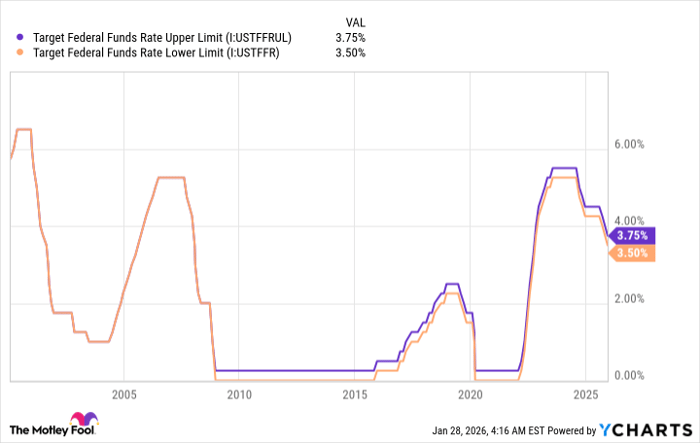
Target Federal Funds Rate Upper Limit data by YCharts.
Excluding the current rate-easing cycle, there have been three completed rate-cutting cycles since the 21st century began. The Dow, S&P 500, and Nasdaq Composite all plunged, at some point or another, after these rate-easing cycles commenced:
- Jan. 3, 2001: During an 11-month period, beginning Jan. 3, 2001, the FOMC slashed the fed funds rate by 475 basis points to 1.75%. But it took 645 calendar days following this first rate cut before the dot-com bubble found its bottom.
- Sept. 18, 2007: Over a 15-month period, beginning Sept. 18, 2007, the FOMC lowered the fed funds rate from 5% to a range of 0% to 0.25%. The time it took for Wall Street's major stock indexes to reach their nadir after this first rate cut was 538 calendar days.
- Aug. 1, 2019: Preceding the short-lived COVID-19 crash, the FOMC reduced the fed funds rate from a range of 2.25% to 2.50% to 0% to 0.25% over approximately 7.5 months. The stock market hit its bottom 236 calendar days after this initial rate cut.
The point being that rate cuts historically coincide with periods of outsize weakness for the Dow Jones Industrial Average, S&P 500, and Nasdaq Composite. When compounded with historic division within the FOMC and the forthcoming Fed chair change, it's the perfect storm for Wall Street.
Although history has conclusively shown that the stock market's major indexes have risen over time, 2026 is shaping up to be a particularly volatile and potentially vulnerable period for equities.
Should you buy stock in S&P 500 Index right now?
Before you buy stock in S&P 500 Index, consider this:
The Motley Fool Stock Advisor analyst team just identified what they believe are the 10 best stocks for investors to buy now… and S&P 500 Index wasn’t one of them. The 10 stocks that made the cut could produce monster returns in the coming years.
Consider when Netflix made this list on December 17, 2004... if you invested $1,000 at the time of our recommendation, you’d have $450,256!* Or when Nvidia made this list on April 15, 2005... if you invested $1,000 at the time of our recommendation, you’d have $1,171,666!*
Now, it’s worth noting Stock Advisor’s total average return is 942% — a market-crushing outperformance compared to 196% for the S&P 500. Don't miss the latest top 10 list, available with Stock Advisor, and join an investing community built by individual investors for individual investors.
See the 10 stocks »
*Stock Advisor returns as of February 1, 2026.
Sean Williams has no position in any of the stocks mentioned. The Motley Fool has no position in any of the stocks mentioned. The Motley Fool has a disclosure policy.
Recommended Articles


