

Intel Just Made a Big Bet on ASML's Next-Gen Technology. Here's Why It Matters in 2026.

Source The Motley Fool

Key Points

  • Intel fell behind TSMC in the process race over the past decade.

  • It plans to reclaim that lead by adopting ASML’s high-NA systems first.

  • That’s a costly effort, but it might pay off in the long run.

  • 10 stocks we like better than Intel ›

Intel (NASDAQ: INTC), the world's top manufacturer of x86 CPUs, was once a reliable tech stock. Yet over the past five years, its stock declined by 13% while the S&P 500 rose by 83%.

Intel lost its luster as it fell behind TSMC (NYSE: TSM) in the "process race" to manufacture smaller, denser chips, and it ceded a massive slice of its PC market to AMD (NASDAQ: AMD). As it faced those existential challenges, it abruptly shifted its strategies under four different CEOs over the past eight years.

Where to invest $1,000 right now? Our analyst team just revealed what they believe are the 10 best stocks to buy right now, when you join Stock Advisor. See the stocks »
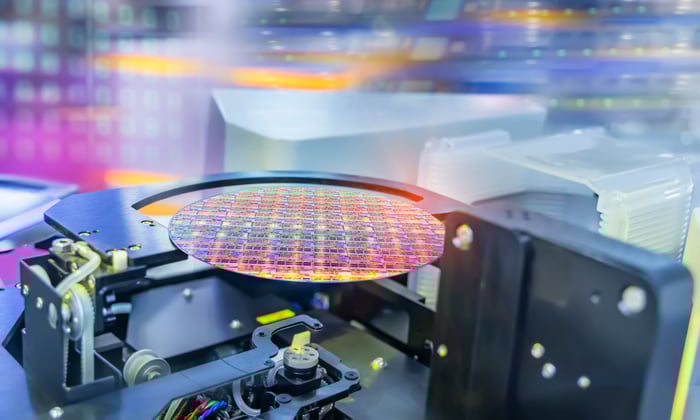
A wafer of chips being manufactured.

Image source: Getty Images.

Intel's newest CEO, Lip Bu-Tan, took the helm in March 2025 and doubled down on its commitment to manufacturing its own chips and reclaiming the process lead from TSMC. It plans to use ASML's (NASDAQ: ASML) newest lithography systems to achieve that goal.

That's why many investors have been closely tracking Intel's investments in ASML's high-NA extreme ultraviolet (EUV) lithography systems. The bulls believe those cutting-edge systems will give it a significant advantage over TSMC. The bears think Intel is plowing too much cash into those pricey systems and prematurely shifting away from its older low-NA EUV systems.

The story thus far...

Intel, TSMC, and other foundries use ASML's lithography systems to optically etch circuit patterns onto silicon wafers. Its older deep ultraviolet (DUV) systems are used to produce older and larger chips. Its newer EUV systems, which require multiple planes and trucks to ship, are used to create the world's smallest, densest, and most power-efficient chips.

ASML is the world's largest producer of DUV systems and the only producer of EUV systems. By installing ASML's EUV systems before Intel, TSMC pulled ahead in the process race with smaller chips from 2018 to 2020. During those three critical years, Intel tried to push its older DUV systems to their limits rather than switching to EUV -- but that cost-conscious strategy backfired, leading to chip shortages and production delays.

As Intel stumbled, AMD (NASDAQ: AMD) outsourced its x86 CPU production to TSMC's superior EUV-equipped foundries. As a result, AMD pulled ahead of Intel with smaller, denser, and cheaper chips.

According to Mercury Research, AMD's share of the desktop x86 CPU market surged from 13% to 33.6% between the third quarters of 2018 and 2025. Intel's share plunged from 87% to 66.4% during the same period. Moreover, AMD's Epyc CPUs -- which were also manufactured by TSMC -- gained ground against Intel's Xeon CPUs in servers.

Is Intel learning from its past mistakes?

Today, TSMC and Intel both use ASML's low-NA EUV systems, which cost about $220 million, to produce their tiniest and most sophisticated chips. TSMC uses those systems to make its 2nm to 3nm chips, while Intel uses them to create its Intel 3 chips (which are comparable to TSMC's 5nm chips).

But to mass-produce even smaller chips, both chipmakers will eventually need to use ASML's high-NA EUV systems, which cost up to $400 million each. Just like the previous jump from DUV to low-NA EUV, the leap to high-NA EUV would require massive investments from TSMC and Intel.

TSMC plans to push its existing low-NA EUV systems to the limit to mass-produce chips up to its A14 (1.4nm) node in 2028. It's only installed a single high-NA EUV system for R&D so far, and it doesn't plan to deploy more systems to mass produce its smaller chips until around 2030.

Meanwhile, Intel has already deployed two high-NA EUV systems for R&D purposes, and it installed its first commercial high-NA EUV system last December. It plans to use those systems to mass produce its 14A chips (comparable to TSMC's A14 chips) in 2027 and 2028.

If Intel successfully launches its 14A chips before TSMC's A14 chips, it can finally claim technological superiority against TSMC in the process race. However, Intel's chips could also be much more expensive to manufacture at scale because they use high-NA EUV rather than low-NA EUV. Those high costs could ultimately nullify Intel's head start if it can't produce enough chips.

Why will 2026 be a crucial year for Intel?

2026 could be a make-or-break year for Intel because it marks the final year it can stabilize its high-NA EUV process to ramp up its risk production of 14A chips in 2027. It also still needs to expand its 20A and 18A nodes (which use a mix of low-NA and high-NA technologies) this year before it can consider challenging TSMC with its 14A chips.

That's why analysts expect Intel's net loss to widen from $267 million in 2025 to $400 million in 2026. That would mark its third straight unprofitable year. However, they also expect it to turn profitable again in 2027 with a net profit of $2.3 billion, and for that figure to surge to $4.1 billion in 2028. That optimistic outlook assumes its big bet on ASML's high-NA EUV systems will pay off -- so investors should carefully track those delicate plans over the next few quarters.

Should you buy stock in Intel right now?

Before you buy stock in Intel, consider this:

The Motley Fool Stock Advisor analyst team just identified what they believe are the 10 best stocks for investors to buy now… and Intel wasn’t one of them. The 10 stocks that made the cut could produce monster returns in the coming years.

Consider when Netflix made this list on December 17, 2004... if you invested $1,000 at the time of our recommendation, you’d have $456,457!* Or when Nvidia made this list on April 15, 2005... if you invested $1,000 at the time of our recommendation, you’d have $1,174,057!*

Now, it’s worth noting Stock Advisor’s total average return is 950% — a market-crushing outperformance compared to 197% for the S&P 500. Don't miss the latest top 10 list, available with Stock Advisor, and join an investing community built by individual investors for individual investors.

See the 10 stocks »

*Stock Advisor returns as of January 30, 2026.

Leo Sun has positions in ASML. The Motley Fool has positions in and recommends ASML, Advanced Micro Devices, Intel, and Taiwan Semiconductor Manufacturing. The Motley Fool has a disclosure policy.

Disclaimer: For information purposes only. Past performance is not indicative of future results.
placeholder
Bitcoin To Anchor America Party—’Fiat Is Hopeless,’ Says Elon MuskMusk Pitches Bitcoin As Pillar Of America Party
Author  Bitcoinist
Jul 07, 2025
Musk Pitches Bitcoin As Pillar Of America Party
placeholder
Bitcoin briefly loses 2025 gains as crypto plunges over the weekend.Bitcoin experienced a sharp decline this weekend, briefly erasing its 2025 gains and dipping below its year-opening value of $93,507. The cryptocurrency fell to a low of $93,029 on Sunday, representing a 25% drop from its all-time high in October. Although it has rebounded slightly to around $94,209, the pressures on the market remain significant. The downturn occurred despite the reopening of the U.S. government on Thursday, which many had hoped would provide essential support for crypto markets. This year initially appeared promising for cryptocurrencies, particularly after the inauguration of President Donald Trump, who has established the most pro-crypto administration thus far. However, ongoing political tensions—including Trump's tariff strategies and the recent government shutdown, lasting a historic 43 days—have contributed to several rapid price pullbacks for Bitcoin throughout the year. Market dynamics are also being influenced by Bitcoin whales—investors holding large amounts of Bitcoin—who have been offloading portions of their assets, consequently stalling price rallies even as positive regulatory developments emerge. Despite these sell-offs, analysts from Glassnode argue that this behavior aligns with typical patterns seen among long-term investors during the concluding stages of bull markets, suggesting it is not indicative of a mass exodus. Notably, Bitcoin is not alone in its struggles, as Ethereum and Solana have also recorded declines of 7.95% and 28.3%, respectively, since the start of the year, while numerous altcoins have faced even steeper losses. Looking ahead, questions linger regarding the viability of the four-year cycle thesis, particularly given the increasing institutional support and regulatory frameworks now in place in the crypto landscape. Matt Hougan, chief investment officer at Bitwise, remains optimistic, suggesting a potential Bitcoin resurgence in 2026 driven by the “debasement trade” thesis and a broader trend toward increased adoption of stablecoins, tokenization, and decentralized finance. Hougan emphasized the soundness of the underlying fundamentals, pointing to a positive outlook for the sector in the longer term.
Author  Mitrade
Nov 17, 2025
Bitcoin experienced a sharp decline this weekend, briefly erasing its 2025 gains and dipping below its year-opening value of $93,507. The cryptocurrency fell to a low of $93,029 on Sunday, representing a 25% drop from its all-time high in October. Although it has rebounded slightly to around $94,209, the pressures on the market remain significant. The downturn occurred despite the reopening of the U.S. government on Thursday, which many had hoped would provide essential support for crypto markets. This year initially appeared promising for cryptocurrencies, particularly after the inauguration of President Donald Trump, who has established the most pro-crypto administration thus far. However, ongoing political tensions—including Trump's tariff strategies and the recent government shutdown, lasting a historic 43 days—have contributed to several rapid price pullbacks for Bitcoin throughout the year. Market dynamics are also being influenced by Bitcoin whales—investors holding large amounts of Bitcoin—who have been offloading portions of their assets, consequently stalling price rallies even as positive regulatory developments emerge. Despite these sell-offs, analysts from Glassnode argue that this behavior aligns with typical patterns seen among long-term investors during the concluding stages of bull markets, suggesting it is not indicative of a mass exodus. Notably, Bitcoin is not alone in its struggles, as Ethereum and Solana have also recorded declines of 7.95% and 28.3%, respectively, since the start of the year, while numerous altcoins have faced even steeper losses. Looking ahead, questions linger regarding the viability of the four-year cycle thesis, particularly given the increasing institutional support and regulatory frameworks now in place in the crypto landscape. Matt Hougan, chief investment officer at Bitwise, remains optimistic, suggesting a potential Bitcoin resurgence in 2026 driven by the “debasement trade” thesis and a broader trend toward increased adoption of stablecoins, tokenization, and decentralized finance. Hougan emphasized the soundness of the underlying fundamentals, pointing to a positive outlook for the sector in the longer term.
placeholder
Gold Price Forecast: XAU/USD opens lower around $4,450 on fears of widening Iran conflictsGold price (XAU/USD) opens over 1% lower to near $4,445.00 on Monday, as oil prices have rallied further on fears of further widening of conflicts in the Middle East. WTI Oil price is up almost 3% above $102.50 in the opening trade, increasing fears of higher inflation expectations globally.
Author  FXStreet
Mar 30, Mon
Gold price (XAU/USD) opens over 1% lower to near $4,445.00 on Monday, as oil prices have rallied further on fears of further widening of conflicts in the Middle East. WTI Oil price is up almost 3% above $102.50 in the opening trade, increasing fears of higher inflation expectations globally.
placeholder
Silver Price Forecast: XAG/USD falls to near $72.00 amid fading safe-haven demandSilver price (XAG/USD) continues to lose ground after registering tiny losses in the previous day, trading around $72.90 during the Asian hours on Thursday. The safe-haven demand for the precious metal fades amid rising optimism over Middle East peace.
Author  FXStreet
Yesterday 08: 19
Silver price (XAG/USD) continues to lose ground after registering tiny losses in the previous day, trading around $72.90 during the Asian hours on Thursday. The safe-haven demand for the precious metal fades amid rising optimism over Middle East peace.
placeholder
Gold retreats sharply from two-week top/$4,800 as Trump’s Iran comments boost USDGold (XAU/USD) witnessed an intraday turnaround from the $4,800 mark, or a fresh two-week high set earlier this Thursday, and for now, seems to have snapped a four-day winning streak amid resurgent US Dollar (USD) demand.
Author  FXStreet
Yesterday 07: 03
Gold (XAU/USD) witnessed an intraday turnaround from the $4,800 mark, or a fresh two-week high set earlier this Thursday, and for now, seems to have snapped a four-day winning streak amid resurgent US Dollar (USD) demand.
goTop
quote