




The Market Is Wrong to Sell Off GE Aerospace Stock After the Latest Update: Here's Why
Key Points
GE Aerospace's margin outlook has been affected by lower spare-engine sales.
Long-term prospects remain strong due to aftermarket and installed engine growth.
The recent stock selloff may be an overreaction, presenting a potential opportunity.
- 10 stocks we like better than GE Aerospace ›
The market aggressively sold off GE Aerospace (NYSE: GE) stock following its fourth-quarter 2025 earnings report, largely due to the company's implied guidance that operating profit margins would be similar to those in 2025. That's a superficially disappointing result for a company set to grow revenue at a low double-digit rate in 2026.
Still, digging deeper reveals a host of reasons why investors should be more optimistic, not more pessimistic, about GE's long-term earnings outlook after these results. Here's why.
Where to invest $1,000 right now? Our analyst team just revealed what they believe are the 10 best stocks to buy right now. Continue »
GE Aerospace and the spare engine ratio
The company's core business is the design and manufacture of commercial aircraft engines, including the CFM56 (used on the legacy Boeing 737 and the Airbus A320 family) and the LEAP (used on the Boeing 737 MAX and the Airbus A320neo). Newly installed engines are usually sold at a loss, at least in the first years of production, only to generate highly lucrative service and aftermarket revenue on long-term service agreements (LTSA) as aircraft engines can run for more than 40 years.
In addition, GE sells highly profitable spare engines to airlines. Given the supply chain crisis following the lockdowns, airlines favored buying more spare engines to ensure they could keep schedules running and meet post-lockdown travel demand. The so-called spare engine ratio is simply the ratio of engines airlines hold as spares compared to those in their fleet.
A lower spare engine ratio and GE Aerospace profit margins
Now that the supply chain crisis is easing, airlines are moving toward lower spare-engine ratios, which is negatively impacting GE's profit outlook. In fact, CFO Rahul Ghai acknowledged that "our margins are expected to be flattish here in 2026" on the earnings call, citing a lower spare engine ratio. As LEAP engine deliveries ramp up and become increasingly for installed engines rather than spares, GE's margins will be hit.
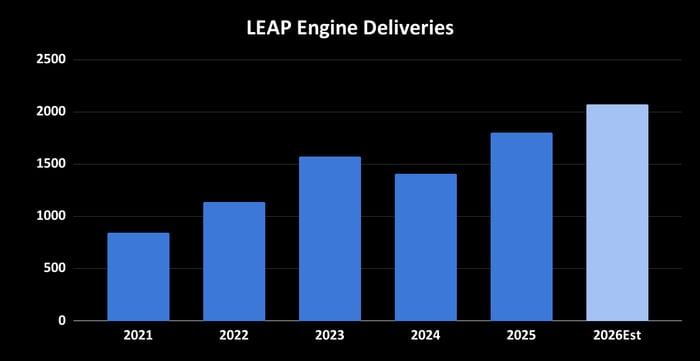
Data source: GE Aerospace presentations. Chart by the author.
Why the market is wrong about GE Aerospace
While no one likes to see a near-term margin hit, there were two things management said that encourage a more bullish long-term outlook.
First, GE engines continue to be heavily utilized with retirement rates in 2025 similar to those of 2024, and Ghai expects them to be at 2% in 2026, a figure at the low end of management's expectation of 2% to 3%. That implies more older planes running longer, and that's usually good news for GE's aftermarket sales.
Second, while relatively more installed engine vs. spare engine sales is bad for near-term margins, it's better for long-term profitability because installed engines are run more than an engine sitting in an aircraft hangar.
As you can see above, GE expects to continue ramping LEAP deliveries as the supply chain eases, and that's a good thing for long-term profitability even if it negatively impacts near-term margins.

Image source: Getty Images.
A stock to buy?
While GE isn't a superficially cheap stock (it trades on just less than 40 times expected earnings for 2026), there's nothing in these results that should make long-term investors feel less positive about the company or the stock. The sell-off makes no sense from that perspective, and the stock deserves a closer look.
Should you buy stock in GE Aerospace right now?
Before you buy stock in GE Aerospace, consider this:
The Motley Fool Stock Advisor analyst team just identified what they believe are the 10 best stocks for investors to buy now… and GE Aerospace wasn’t one of them. The 10 stocks that made the cut could produce monster returns in the coming years.
Consider when Netflix made this list on December 17, 2004... if you invested $1,000 at the time of our recommendation, you’d have $461,527!* Or when Nvidia made this list on April 15, 2005... if you invested $1,000 at the time of our recommendation, you’d have $1,155,666!*
Now, it’s worth noting Stock Advisor’s total average return is 950% — a market-crushing outperformance compared to 197% for the S&P 500. Don't miss the latest top 10 list, available with Stock Advisor, and join an investing community built by individual investors for individual investors.
See the 10 stocks »
*Stock Advisor returns as of January 28, 2026.
Lee Samaha has no position in any of the stocks mentioned. The Motley Fool has positions in and recommends Boeing and GE Aerospace. The Motley Fool has a disclosure policy.
Recommended Articles


