




Ethereum vs Polkadot: Which Is More Likely to Be a Millionaire-Maker?
Key Points
Ethereum remains the top platform for developing decentralized apps.
Polkadot provides developers more flexibility with its parachains.
The blue chip leader might have more upside potential than the tiny underdog.
- 10 stocks we like better than Ethereum ›
Ethereum (CRYPTO: ETH) and Polkadot (CRYPTO: DOT) generally attract different types of cryptocurrency investors. Ether, the native token of the Ethereum blockchain, is the world's second-most-valuable cryptocurrency after Bitcoin (CRYPTO: BTC). It's often considered a "blue chip" token, more stable than smaller altcoins or meme coins. A $10,000 investment in its earliest trade in 2015 would be worth $10.5 million today.
Polkadot is a smaller altcoin created by Ethereum's co-founder, Gavin Wood. A $10,000 investment in its first trade in 2020 would have shrunk to about $6,900. Let's see why Ethereum flourished as Polkadot fizzled out -- and if either coin can deliver more millionaire-making gains.
Where to invest $1,000 right now? Our analyst team just revealed what they believe are the 10 best stocks to buy right now, when you join Stock Advisor. See the stocks »
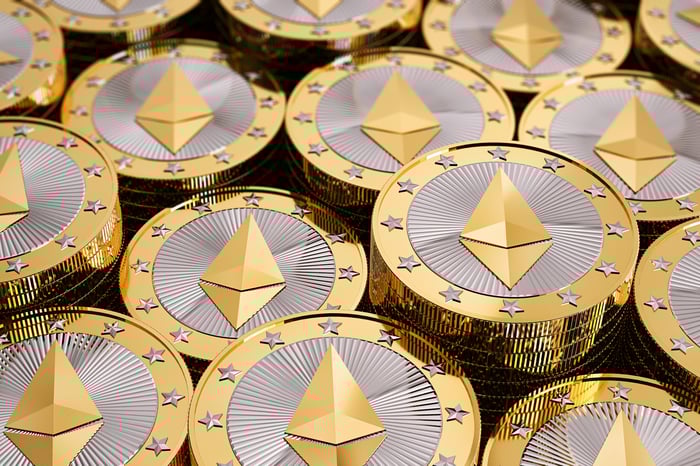
Image source: Getty Images.
The differences between Ethereum and Polkadot
Ethereum was originally a proof-of-work (PoW) blockchain like Bitcoin, but it transitioned to the energy-efficient proof-of-stake (PoS) consensus mechanism in 2022. After that transition, known as "The Merge", Ether could no longer be actively mined like Bitcoin.
Instead, its token could be staked for interest-like rewards. It also gained support for smart contracts, which developers used to create decentralized applications (dApps), non-fungible tokens (NFTs), and other tokenized assets. Today, it's the largest platform for developing dApps, and Ether's value is usually reflected in the growth of its developer ecosystem.
Polkadot's blockchain is built on the PoS consensus mechanism, so it natively supports smart contracts and dApp development. Its core Relay Chain handles all security, validation, and cross-chain communication, while all its apps run across its "parachains" -- which have their own logic, governance, and tokenomics rules.
So if the Relay Chain is the Federal government, then the parachains are comparable to individual states. That structure makes Polkadot's parachains more flexible than Ethereum's Layer-1 (L1) blockchain, which requires all of its smart contracts to follow the same rules. They also tend to process transactions at faster speeds than Ethereum's L1 blockchain.
However, Ethereum allows Layer-2 (L2) blockchains, which can be customized for a wide range of applications, to run on top of its L1 blockchain. By bundling its L1 transactions and processing them on its L2 blockchain, Ethereum can deliver comparable speeds to Polkadot's parachains and other nimbler PoS blockchains like Solana (CRYPTO: SOL).
Neither Ether nor Polkadot are valued by scarcity like Bitcoin, which becomes harder to mine every four years. Ether, which has a circulating supply of 121 million tokens, doesn't have a fixed supply limit like Bitcoin. However, it started "burning" (removing from circulation) a portion of its gas fees to throttle its rising supply in 2021. Polkadot, which originally increased its supply by 10% annually, capped its supply at 2.1 billion tokens last September.
Ether also has stronger institutional investor support. The Securities and Exchange Commission (SEC) approved Ether's first spot price exchange-traded funds (ETFs) in 2024, but it hasn't yet approved Polkadot's first two spot price ETF applications.
Which token has more upside potential?
Ethereum's latest Dencun upgrade, which reduces its L2 transaction costs by more than 90%, could draw more developers and users to its dominant ecosystem. As it expands, it could become the default platform for developing decentralized finance (DeFi) apps and tokenizing real-world assets. It could burn more tokens to stabilize its long-term supply.
Polkadot also recently upgraded its platform by replacing its expensive, long-term parachain slot auctions with on-demand blockspace. Its supporters expect that the "Agile Coretime" update will reduce costs and risks in handling its app-specific chains. Its app-specific parachains, predictable fees, on-chain governance, and compliance-friendly architecture could also make it better suited than Ethereum for certain regulated finance, supply chain, and government clients.
However, Polkadot could still struggle to stand out in the crowded market of smaller PoS blockchains. Its price might eventually stabilize, but I don't expect it to generate millionaire-making gains over the next decade.
Ethereum, on the other hand, still has significant upside if it becomes the default ecosystem for developing dApps. While it might not replicate its massive gains from the past decade, it could still generate millionaire-making gains over the next few decades.
Should you buy stock in Ethereum right now?
Before you buy stock in Ethereum, consider this:
The Motley Fool Stock Advisor analyst team just identified what they believe are the 10 best stocks for investors to buy now… and Ethereum wasn’t one of them. The 10 stocks that made the cut could produce monster returns in the coming years.
Consider when Netflix made this list on December 17, 2004... if you invested $1,000 at the time of our recommendation, you’d have $464,439!* Or when Nvidia made this list on April 15, 2005... if you invested $1,000 at the time of our recommendation, you’d have $1,150,455!*
Now, it’s worth noting Stock Advisor’s total average return is 949% — a market-crushing outperformance compared to 195% for the S&P 500. Don't miss the latest top 10 list, available with Stock Advisor, and join an investing community built by individual investors for individual investors.
See the 10 stocks »
*Stock Advisor returns as of January 26, 2026.
Leo Sun has no position in any of the stocks mentioned. The Motley Fool has positions in and recommends Bitcoin, Ethereum, and Solana. The Motley Fool has a disclosure policy.
Recommended Articles


