




The Stock Market Is Facing a Federal Reserve Double Whammy in 2026 -- and Things May Get Ugly for Wall Street
Key Points
The broad-based S&P 500 is coming off its third consecutive year with a gain of at least 16%.
A historic level of division within the Federal Open Market Committee (FOMC) appears to foreshadow trouble for the stock market.
Furthermore, Jerome Powell's term as Fed chair is up in less than four months, yielding more questions than answers at this point.
- 10 stocks we like better than S&P 500 Index ›
For the better part of the last three years, investors have had plenty to be thankful for. In 2025, the widely followed Dow Jones Industrial Average (DJINDICES: ^DJI), broad-based S&P 500 (SNPINDEX: ^GSPC), and growth stock-dependent Nasdaq Composite (NASDAQINDEX: ^IXIC) rallied by 13%, 16%, and 20%, respectively. This was a continuation of a three-year streak for the S&P 500 where it's delivered annual gains of at least 16%.
Catalysts have been abundant, with the rise of artificial intelligence and the advent of quantum computing spurring innovation and promising to increase the long-term growth potential of many of Wall Street's most influential businesses.
Where to invest $1,000 right now? Our analyst team just revealed what they believe are the 10 best stocks to buy right now. Continue »
A resilient U.S. economy has also provided a boost to equities. Most S&P 500 companies are leapfrogging Wall Street's profit projections. To boot, President Donald Trump's Tax Cuts and Jobs Act, passed during his first term in the White House, has incentivized publicly traded companies to repurchase their own stock, which can have a positive impact on earnings per share.
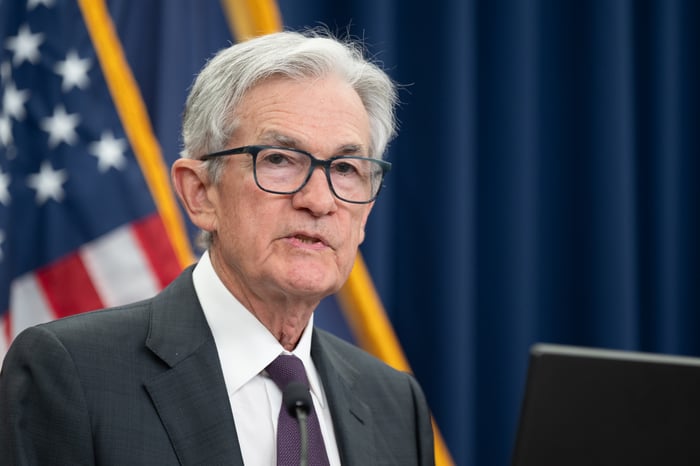
Fed Chair Jerome Powell delivering remarks. Image source: Official Federal Reserve Photo.
Furthermore, investors are excited about the prospect of additional interest rate cuts by the Federal Reserve in 2026. Lower interest rates can encourage businesses to borrow with the purpose of hiring more workers, acquiring other companies, and increasing capital devoted to research and development.
While the Fed is often viewed as a stabilizing force for the stock market, it may represent Wall Street's undoing, with a double whammy expected in the new year.
The stock market has a Federal Reserve problem in the new year
Although the mission of the nation's central bank is straightforward -- maximizing employment and stabilizing prices -- accomplishing this task is complicated.
The primary action taken by the Federal Open Market Committee (FOMC) -- the 12-member body, including Fed Chair Jerome Powell, responsible for making and overseeing our nation's monetary policy -- is adjusting the federal funds target rate. This figure, which represents the overnight lending rate between financial institutions, can be reduced to spur borrowing or increased to pump the brakes on lending activity.
The FOMC also has the ability to direct the nation's central bank to buy and sell long-term U.S. Treasury bonds to influence interest rates. Bond prices and bond yields are inversely related.
While the FOMC is composed of one dozen individuals with an above-average understanding of economics and how monetary policy can influence the U.S. economy, the FOMC doesn't always make the right call. Since FOMC decisions are being formulated from backward-looking economic data, it's not uncommon for the Fed to be behind the curve when making adjustments.
Typically, Wall Street and investors are forgiving of the occasional central bank miscue. Although these miscues can result in temporary turbulence in the stock market, investors take solace in the FOMC's unified approach.
Anna is correct below when she says:
-- Jim Bianco (@biancoresearch) September 17, 2025
"I have not seen a meeting with so much contradictions."
---
This meeting was a mess.
See the labels in the dot plot below.
One member of the FOMC thinks the Fed is going to HIKE rates this year. One (Stephen Miran) thinks it is going to cut... https://t.co/TRUQmD5I2E pic.twitter.com/qPlJGL57ln
However, it's an entirely different ballgame if the members of the FOMC aren't on the same page about monetary policy.
Each of the previous four FOMC meetings has featured a dissenting opinion from at least one member. Moreover, the FOMC's October and December meetings (the FOMC meets about every six weeks) had dissenting opinions in opposite directions! Though 25-basis-point reductions in the fed funds target rate were approved at both meetings, at least one member preferred no cut, while another favored a 50-basis-point reduction.
Since 1990, there have been only three FOMC meetings with dissents in opposite directions, and we've witnessed two of them occur over the last three months. A divided Fed isn't going to inspire confidence in an already expensive stock market.

Fed Chair Jerome Powell and President Donald Trump in discussion. Image source: Official White House Photo by Daniel Torok.
Historic division in the FOMC may be magnified in 2026
But a historically divided FOMC isn't the only issue the stock market will have to contend with in 2026.
On May 15, 2026, Jerome Powell's term as Fed chair will come to an end (albeit his term on the Board of Governors extends through January 2028). Powell's run as Fed chair ending isn't a surprise given that term limits are known in advance, and President Trump has been beefing with Powell over interest rates throughout much of the first year of his second, non-consecutive term.
Trump has repeatedly urged Powell to make aggressive interest rate cuts to fuel economic growth and, presumably, halt the modest uptick we've witnessed in the U.S. unemployment rate.
Meanwhile, Powell has retorted that the nation's central bank will rely on economic data to guide monetary policy decisions. Stubbornly high shelter inflation has been one of a handful of reasons the FOMC has approached its current rate-easing cycle with a degree of caution -- i.e., they don't want the inflation rate, which is already above the Fed's long-term target of 2%, to move higher.
Wall Street and investors favor stability and predictability, but are unlikely to get either with President Trump set to nominate a new Fed chair. Aside from there being no clear consensus as to whom the president will nominate, there's concern that Trump's nominee could further exacerbate division within the FOMC. Presumably, the president wants a Fed chair willing to prioritize lower interest rates, which stands in stark contrast to the majority of the 12-person FOMC at present.
Even if Donald Trump's Fed chair nominee doesn't spark fears of division, there may be backlash from Wall Street and investors concerning the experience of his eventual nominee.
With the stock market entering 2026 with its second priciest valuation in 155 years, according to the S&P 500's Shiller Price-to-Earnings Ratio, there's little margin for error. Historic division within the FOMC and a changing of the guard at Fed chair represent a potential recipe for disaster in the new year.
Should you buy stock in S&P 500 Index right now?
Before you buy stock in S&P 500 Index, consider this:
The Motley Fool Stock Advisor analyst team just identified what they believe are the 10 best stocks for investors to buy now… and S&P 500 Index wasn’t one of them. The 10 stocks that made the cut could produce monster returns in the coming years.
Consider when Netflix made this list on December 17, 2004... if you invested $1,000 at the time of our recommendation, you’d have $464,439!* Or when Nvidia made this list on April 15, 2005... if you invested $1,000 at the time of our recommendation, you’d have $1,150,455!*
Now, it’s worth noting Stock Advisor’s total average return is 949% — a market-crushing outperformance compared to 195% for the S&P 500. Don't miss the latest top 10 list, available with Stock Advisor, and join an investing community built by individual investors for individual investors.
See the 10 stocks »
*Stock Advisor returns as of January 25, 2026.
Sean Williams has no position in any of the stocks mentioned. The Motley Fool has no position in any of the stocks mentioned. The Motley Fool has a disclosure policy.
Recommended Articles


