




This Stock Is Quietly Becoming a Cornerstone of the Artificial Intelligence Boom
Key Points
Micron Technology makes DRAM and HBM memory chips that are essential for AI computations.
The company sold out its entire 2026 inventory of such chips before the end of 2025.
Despite its massive share price jump, Micron is still reasonably valued.
- 10 stocks we like better than Micron Technology ›
When you think of artificial intelligence (AI) semiconductors, you tend to think about the graphics processing units (GPUs) from companies like Nvidia (NASDAQ: NVDA) that perform the actual computations that AI requires.
But not all semiconductor chips are the same, and not all of them are made by Nvidia. In fact, some of the most important resources for Nvidia's GPUs are the memory chips that keep data accessible. And the memory chip company that's quietly becoming a cornerstone of the AI boom is Micron Technology (NASDAQ: MU).
Where to invest $1,000 right now? Our analyst team just revealed what they believe are the 10 best stocks to buy right now. Continue »
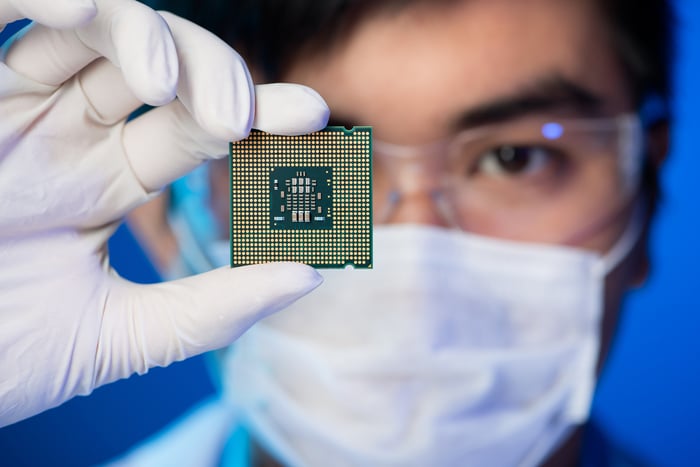
Image source: Getty Images.
Not all memory is the same
Old-school computer users may remember the two basic memory types: Random access memory (RAM) stores data that's currently being used by the processor, while read-only memory (ROM) is for more permanent storage. But within these categories, there are plenty of subtypes.
One important RAM subtype is dynamic random access memory (DRAM). A DRAM chip consists of a series of simple memory cells, each containing just one capacitor. A charged capacitor indicates a one, and a discharged capacitor indicates a zero. Because each memory cell is so simple, DRAM is cheap to produce and can hold large amounts of memory in a single chip. However, capacitors leak charge quickly, so DRAM needs to be recharged every few milliseconds, making it very energy-hungry.
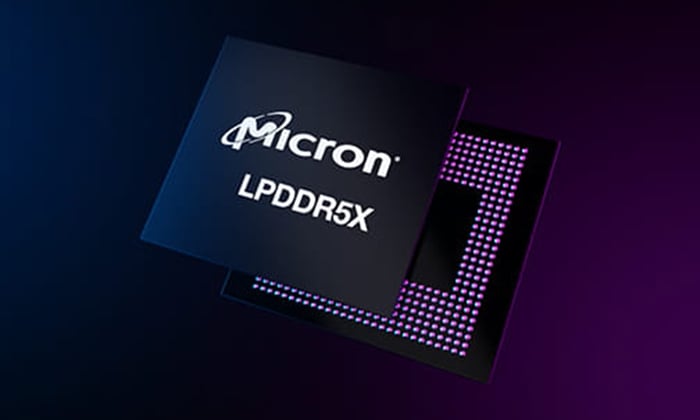
Image source: Micron Technology.
AI computations need fast access to more data than a single DRAM wafer can allow due to their massive data needs and high processor speeds. Luckily, by stacking DRAM wafers vertically and adding some extra electrical connections, you can create high bandwidth memory (HBM), which delivers incredible data retrieval speed for less power.
Only three companies currently manufacture almost the entire global supply of DRAM and HBM: SK Hynix and Samsung, both from South Korea, and Micron.
Limited supply, massive demand
As you might expect from a resource that only three companies can provide, demand for DRAM and HBM far outstrips supply. That's good for Micron Technology in both the short and the long terms.
From a short-term standpoint, the company is already raking in record high revenue, and it announced in December that its entire 2026 calendar year's supply of HBM is already committed, with price and volume contracts complete. That's right: Micron already sold out its entire 2026 supply before the end of 2025.

Image source: Micron Technology.
It wouldn't be quite so good for Micron investors if this situation were permanent and the company were never going to be able to increase its sales volume. Luckily, the company has committed more than $200 billion to increasing its U.S. manufacturing capacity in the coming years by expanding its existing Virginia facility and opening two new fabrication facilities in Idaho and New York. It also just signed a letter of intent to buy a Taiwanese semiconductor fabrication site for $1.8 billion.
Even though Micron's stock soared in 2025 as it cemented its place in the AI ecosystem, its valuation is still quite reasonable at just 5.5 times forward sales and 11 times forward earnings. Micron looks like a long-term AI mainstay and a solid bet on an AI-powered future.
Should you buy stock in Micron Technology right now?
Before you buy stock in Micron Technology, consider this:
The Motley Fool Stock Advisor analyst team just identified what they believe are the 10 best stocks for investors to buy now… and Micron Technology wasn’t one of them. The 10 stocks that made the cut could produce monster returns in the coming years.
Consider when Netflix made this list on December 17, 2004... if you invested $1,000 at the time of our recommendation, you’d have $450,525!* Or when Nvidia made this list on April 15, 2005... if you invested $1,000 at the time of our recommendation, you’d have $1,133,107!*
Now, it’s worth noting Stock Advisor’s total average return is 937% — a market-crushing outperformance compared to 195% for the S&P 500. Don't miss the latest top 10 list, available with Stock Advisor, and join an investing community built by individual investors for individual investors.
See the 10 stocks »
*Stock Advisor returns as of January 24, 2026.
John Bromels has positions in Micron Technology and Nvidia. The Motley Fool has positions in and recommends Micron Technology and Nvidia. The Motley Fool has a disclosure policy.
Recommended Articles


