




I Predicted Nvidia Was a Better Dow Stock Than Amazon in 2025, and I Was Right. But Which Is the Better "Magnificent Seven" Stock for 2026?
Key Points
Amazon Web Services is a high-margin cash cow, but growth is slowing.
Nvidia chip applications could rapidly expand beyond data centers to new frontiers, such as robotics and self-driving cars.
Nvidia is reasonably priced, given its impeccable business model.
- 10 stocks we like better than Nvidia ›
In 2024, Nvidia (NASDAQ: NVDA) and Amazon (NASDAQ: AMZN) were added to the Dow Jones Industrial Average, replacing Intel and Walgreens Boots Alliance.
In December 2024, I predicted that Nvidia would be a better Dow stock to buy than Amazon because of its reasonable valuation and superior business model. The recommendation was intended for long-term investors, not those seeking to make a quick profit on a one-year time horizon.
Where to invest $1,000 right now? Our analyst team just revealed what they believe are the 10 best stocks to buy right now, when you join Stock Advisor. See the stocks »
Still, the call has been right so far, with Nvidia gaining 38.9% in 2025 compared to just 5.2% for Amazon. In fact, Amazon was the worst "Magnificent Seven" stock in 2025 -- underperforming Nvidia, Alphabet, Apple, Microsoft, Meta Platforms, and Tesla.
Even after Nvidia's big 2025 gain, it remains a better buy than Amazon. Here's why.

Image source: Getty Images.
Amazon's success is largely tied to AWS
In its most recent quarter, Amazon achieved an operating margin of just 4.1% on its non-Amazon Web Services (AWS) business, which encompasses its online and physical stores, advertising, subscription services, third-party commissions, fulfillment, and shipping fees, and its miscellaneous "other" category. AWS is so profitable that it made up 60% of Amazon's operating income for the nine months ended Sept. 30, 2025, even though it's less than a fifth of total Amazon sales.
With 35.6% operating margins for the nine months ended Sept. 30, AWS is a high-powered cash cow and the crown jewel in Amazon's crown. But AWS growth has slowed in recent years as it faces mounting competition from Microsoft, Alphabet's Google Cloud, and Oracle.
Rubin could open the door to new revenue streams for Nvidia
While AWS helps fuel Amazon's broader business, Nvidia is more of a pure-play artificial intelligence (AI) company. Its data center sales now make up around 90% of total revenue. And the other 10% of the business is also high margin, with end markets like gaming, professional visualization, automation, and robotics.
Nvidia's presentation at CES earlier this month showcased its new Rubin architecture, which consists of six different chips designed for the next stage of AI advancement -- agentic AI, robotics, and autonomous driving. Nvidia is releasing Rubin ahead of schedule, with deployments to hyperscalers -- including AWS -- on track for the second half of 2026.
Despite its size, the law of large numbers hasn't caught up to Nvidia. It continues to grow earnings at a breakneck pace and defends its high margins thanks to its innovation. Rubin goes beyond the graphics processing unit (GPU) with networking, interconnections, and central processing units (CPUs) for rack-scale readiness. With Nvidia playing a bigger role in AI data centers, there's every reason to believe the stock can keep roaring higher.
Nvidia is a better value for long-term investors
Nvidia's high margins and break-even growth rate justify a higher valuation than Amazon. Amazon has become more affordable because its earnings grew faster than its stock price last year. Amazon is cheaper than Nvidia, with a forward price-to-earnings ratio of just 30.1 compared to 39 for Nvidia.
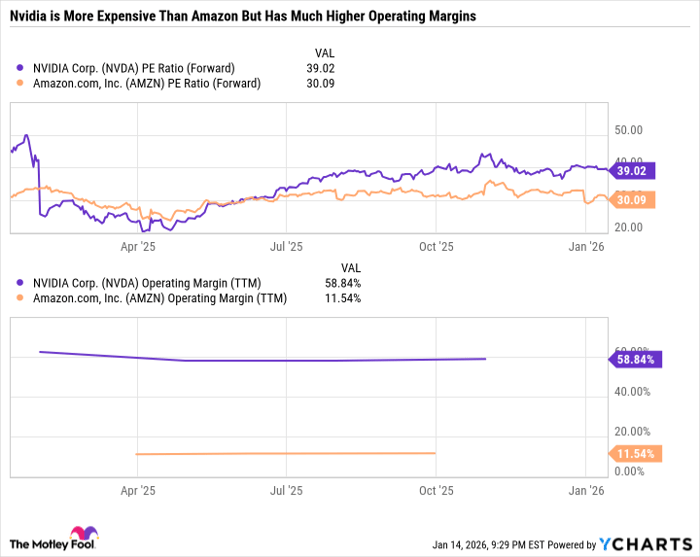
Data by YCharts.
However, I'd still take Nvidia over Amazon because of its growth potential. If Nvidia's data center business does eventually cool off, it could easily more than offset a potential slowdown with new opportunities in other facets of its business. At the same time, Amazon depends heavily on AWS, and there's only so much room for margin expansion in its e-commerce business.
Add it all up, and Nvidia is still the better buy for 2026 -- although Amazon is a better value than it used to be and could be worth a closer look too.
Should you buy stock in Nvidia right now?
Before you buy stock in Nvidia, consider this:
The Motley Fool Stock Advisor analyst team just identified what they believe are the 10 best stocks for investors to buy now… and Nvidia wasn’t one of them. The 10 stocks that made the cut could produce monster returns in the coming years.
Consider when Netflix made this list on December 17, 2004... if you invested $1,000 at the time of our recommendation, you’d have $474,578!* Or when Nvidia made this list on April 15, 2005... if you invested $1,000 at the time of our recommendation, you’d have $1,141,628!*
Now, it’s worth noting Stock Advisor’s total average return is 955% — a market-crushing outperformance compared to 196% for the S&P 500. Don't miss the latest top 10 list, available with Stock Advisor, and join an investing community built by individual investors for individual investors.
See the 10 stocks »
*Stock Advisor returns as of January 18, 2026.
Daniel Foelber has positions in Nvidia and Oracle and has the following options: short March 2026 $240 calls on Oracle. The Motley Fool has positions in and recommends Alphabet, Amazon, Apple, Intel, Meta Platforms, Microsoft, Nvidia, Oracle, and Tesla. The Motley Fool recommends the following options: long January 2026 $395 calls on Microsoft and short January 2026 $405 calls on Microsoft. The Motley Fool has a disclosure policy.
Recommended Articles


