




Where Will Nvidia Stock Be in 10 Years?
Key Points
Over the last few years, Nvidia's data center segment has come to overshadow the rest of its business.
The chipmaker's long-term success could require it to pivot to new opportunities.
- 10 stocks we like better than Nvidia ›
With a market cap of $4.5 trillion, Nvidia (NASDAQ: NVDA) is the largest company in the world. And it got to this point by offering excellent products that outperformed the competition in every vertical it entered, from video game graphics to cryptocurrency mining to generative artificial intelligence (AI).
But while AI has been Nvidia's latest big market, investors shouldn't expect that gravy train to last forever, as it faces increasing competition in the market for cutting-edge computing hardware. Over the next 10 years, Nvidia's future could depend on how well it capitalizes on the next potential technology megatrends when the current boom fades.
Where to invest $1,000 right now? Our analyst team just revealed what they believe are the 10 best stocks to buy right now, when you join Stock Advisor. See the stocks »
Generative AI is still booming
Generative AI has totally transformed Nvidia's business, and it continues to drive its growth. In the third quarter, its revenue jumped 62% year over year to $57 billion, largely due to strength in the company's data center segment, where it sells its most advanced graphics processing unit (GPU) systems for running and training AI models alongside data processing units and various types of networking hardware. The good news for investors is that the near-term outlook remains bright as clients continue to scramble for these products.
Analysts at Goldman Sachs expect major AI and cloud computing companies to spend more than $500 billion on data center hardware in 2026 alone. And Nvidia is positioned to capture a large portion of this spending because it has created an economic moat based not only on the power of its chips but also its associated programming interface, CUDA, which allows developers to get the most out of their Nvidia hardware.
The future might be more challenging
Nvidia's data center segment represented around 90% of the company's third-quarter revenue, which is an alarming lack of diversification. It's generally not a good idea for a company to put all its eggs in one basket, because that leaves it with little cushion against issues that might arise with that core business. To be fair, there are absolutely no signs that Nvidia's data center business is under threat in the near term. But over the next 10 years, that could easily change.
For starters, Nvidia's clients represent some of the most sophisticated tech companies on the planet. Behemoths like Alphabet, Amazon, and Microsoft won't sit idly by while Nvidia sells them pricey GPUs at gross margins of over 70%. These companies have plenty of incentives to develop chips to replace Nvidia's wares in their own operations, and also to attempt to compete with it in the chip market.
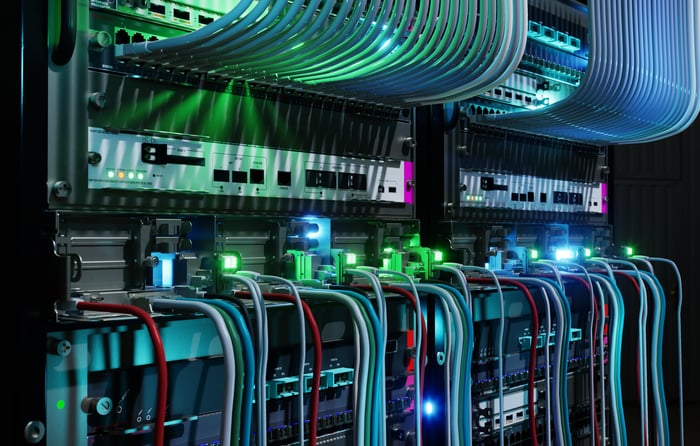
Image source: Getty Images.
The CUDA platform does give Nvidia a moat in some respects, as so much foundational AI code was written on CUDA, and CUDA code only runs on Nvidia chips.
But Nvidia has no true competitive advantage in chip production. It's a fabless semiconductor company, and most of its hardware is made by Taiwan Semiconductor Manufacturing. Nothing stops its largest customers from designing custom chips of their own (perhaps in conjunction with Broadcom) and contracting with a foundry like TSMC to manufacture them. This strategy is picking up steam. In June, ChatGPT creator OpenAI turned to Alphabet's TPU chips to power some of its data centers. ChatGPT rival Anthropic uses a mix of hardware provided by Nvidia, Google, Amazon, and other providers.
How does Nvidia win over the next 10 years?
Nvidia's long-term success may depend on its ability to pivot to new technologies if the generative AI boom runs out of steam or if the AI accelerator market becomes more competitive. With a price-to-earnings (P/E) multiple of just 24, Nvidia stock is cheaper than the Nasdaq-100's average of 26. That relative discount seems to reflect the market's concern about its overreliance on the AI data center business.
Nvidia might have to make some changes to regain a premium valuation and reignite its rally. It is too early to know what comes next, but self-driving cars, robotics, and quantum computing could become make-or-break opportunities for the chipmaker over the next decade. Investors may want to wait for more information before opening a new position in Nvidia.
Should you buy stock in Nvidia right now?
Before you buy stock in Nvidia, consider this:
The Motley Fool Stock Advisor analyst team just identified what they believe are the 10 best stocks for investors to buy now… and Nvidia wasn’t one of them. The 10 stocks that made the cut could produce monster returns in the coming years.
Consider when Netflix made this list on December 17, 2004... if you invested $1,000 at the time of our recommendation, you’d have $474,578!* Or when Nvidia made this list on April 15, 2005... if you invested $1,000 at the time of our recommendation, you’d have $1,141,628!*
Now, it’s worth noting Stock Advisor’s total average return is 955% — a market-crushing outperformance compared to 196% for the S&P 500. Don't miss the latest top 10 list, available with Stock Advisor, and join an investing community built by individual investors for individual investors.
See the 10 stocks »
*Stock Advisor returns as of January 17, 2026.
Will Ebiefung has no position in any of the stocks mentioned. The Motley Fool has positions in and recommends Alphabet, Amazon, Goldman Sachs Group, Nvidia, and Taiwan Semiconductor Manufacturing. The Motley Fool recommends Broadcom. The Motley Fool has a disclosure policy.
Recommended Articles


