




Is a Stock Market Crash Imminent in 2026 Under President Donald Trump? 155 Years of History Weighs In.
Key Points
The Dow Jones Industrial Average, S&P 500, and Nasdaq Composite soared during President Trump's first term and delivered an encore performance in 2025.
History has a way of rhyming on Wall Street, which is particularly worrisome for a historically expensive stock market.
However, stock market cycles aren't linear, which works to the advantage of long-term investors.
- 10 stocks we like better than S&P 500 Index ›
For more than a century, no asset class has come close to rivaling the average annual return of stocks. Though stocks are known for their occasional wild swings, Wall Street has been the superior wealth creator when compared to bonds, commodities, and real estate.
The stock market has performed exceptionally well with President Donald Trump in the Oval Office. During Trump's first term, the widely followed Dow Jones Industrial Average (DJINDICES: ^DJI), broad-based S&P 500 (SNPINDEX: ^GSPC), and innovation-fueled Nasdaq Composite (NASDAQINDEX: ^IXIC) rallied 57%, 70%, and 142%, respectively. This was followed up by respective gains of 13%, 16%, and 20% for the Dow, S&P 500, and Nasdaq in 2025 (Trump's first year of his second term began on Jan. 20, 2025).
Where to invest $1,000 right now? Our analyst team just revealed what they believe are the 10 best stocks to buy right now, when you join Stock Advisor. See the stocks »

President Trump delivering remarks. Image source: Official White House Photo by Molly Riley.
While the evolution of artificial intelligence is undoubtedly responsible for sending the stock market's major indexes to new heights, President Trump's tax policy, which permanently reduced the peak marginal corporate income tax rate to its lowest level since 1939, didn't hurt, either.
However, expecting the good times to continue into the second year of Trump's second term might be asking too much, based on what 155 years of history have to say.
Is a stock market crash imminent in Donald Trump's second year?
Before going any further, let me emphasize that no data point or correlated event exists that can accurately and consistently predict short-term directional movements in the Dow Jones Industrial Average, S&P 500, and Nasdaq Composite. If investors had a tool that could always forecast the future, everyone would be using it.
Nonetheless, there are select data points or historical events that have strongly correlated with directional moves for Wall Street's major indexes. While no one can guarantee what's to come, history does have a way of rhyming on Wall Street.
Arguably, no historical trend speaks louder than the S&P 500's Shiller Price-to-Earnings (P/E) Ratio, which is also referred to as the cyclically adjusted P/E Ratio, or CAPE Ratio.
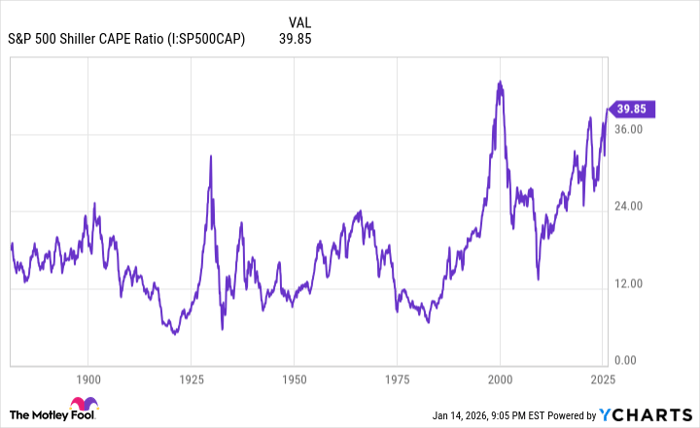
S&P 500 Shiller CAPE Ratio data by YCharts.
Unlike the traditional P/E ratio, which takes into account trailing 12-month earnings per share (EPS) and can be tripped up by U.S. recessions, the Shiller P/E is based on average inflation-adjusted EPS over the previous 10 years. Examining a decade's worth of EPS history ensures this valuation tool doesn't lose its usefulness during economic downturns.
Although the CAPE Ratio wasn't officially introduced until the late 1980s, it's been back-tested by economists to the beginning of 1871. It offers the closest thing investors are going to get to an apples-to-apples stock market valuation comparison over 155 years.
Since January 1871, the S&P 500's Shiller P/E has averaged a multiple of 17.33. But investors are likely to note that it's spent almost the entirety of the last 30 years above this 155-year average. The proliferation of the internet, which broke down information barriers that had existed for more than a century between Wall Street and Main Street, along with lower interest rates, led to a flight to growth stocks and an increased willingness on the part of investors to accept more risk.
However, there's an arbitrary line in the sand where stock market valuations become too extended to the upside, based on what history tells us.
S&P 500 Shiller PE Ratio hits 2nd highest level in history 🚨 The highest was the Dot Com Bubble 🤯 pic.twitter.com/Lx634H7xKa
-- Barchart (@Barchart) December 28, 2025
Over the last 155 years, the CAPE Ratio has surpassed 30 for at least a two-month period on six separate occasions, including the present. As of the closing bell on Jan. 14, the Shiller P/E sat at a multiple of 40.72, which is within striking distance of its all-time high of 44.19, set in December 1999. All five prior instances where the Shiller P/E topped 30 were subsequently followed by declines in the Dow Jones Industrial Average, S&P 500, and/or Nasdaq Composite of between 20% and 89%.
Keep in mind that the Shiller P/E does have its limitations. While it has a phenomenal track record of foreshadowing 20% or greater declines in Wall Street's premier stock indexes, it offers no assistance in determining when the music will stop or how quickly stocks will decline.
For example, stocks remained historically pricey for roughly four years before the dot-com bubble burst. Likewise, the third-priciest stock market in history, which gave way to the 2022 bear market, saw stocks endure a relatively orderly loss of value (i.e., there wasn't an emotion-driven crash event).
History makes it clear that a sizable stock market decline is expected in the presumed not-too-distant future. However, there's nothing in the 155 years of valuation data that suggests a stock market crash is imminent or that one will occur during President Trump's second year.

Image source: Getty Images.
Short-lived pessimism can fuel generational wealth creation
While a stock market crash doesn't appear to be imminent, the short-term forecast for the Dow Jones Industrial Average, S&P 500, and Nasdaq Composite under Donald Trump isn't all that rosy. Although investors don't look forward to the prospect of red arrows in their portfolio, periods of pessimism can lead to generational wealth creation, depending on your investing horizon.
Arguably, the most important thing for investors to understand about stock market cycles is that they aren't linear.
Data from Bespoke Investment Group, posted to X (formerly Twitter), found that the average bear market for the S&P 500 lasted just 286 calendar days (about 9.5 months) between the beginning of the Great Depression (September 1929) and June 2023. Stock market crashes, which are typically driven by emotions, are even shorter-lived. For example, the COVID-19 crash, which saw the S&P 500 lose 34% of its value, occurred in just 33 calendar days.
This compares to the average S&P 500 bull market lasting 1,011 calendar days over a period of nearly 94 years. The typical bull market on Wall Street is 3.5 times longer than bear market downturns.
It's official. A new bull market is confirmed.
-- Bespoke (@bespokeinvest) June 8, 2023
The S&P 500 is now up 20% from its 10/12/22 closing low. The prior bear market saw the index fall 25.4% over 282 days.
Read more at https://t.co/H4p1RcpfIn. pic.twitter.com/tnRz1wdonp
However, what's even more telling is a data set from Crestmont Research that examines the rolling 20-year total returns of the benchmark S&P 500, including dividends, dating back to 1900. Note, the S&P wasn't incepted until 1923, but researchers tracked the total returns of its components in other major indexes back to 1900.
Crestmont Research analyzed 107 rolling 20-year periods (1900-1919, 1901-1920, and so on, to 2006-2025) and found that every single one produced a positive annualized total return. Without the financial jargon, analysts discovered that if an investor had, hypothetically, purchased an S&P 500-tracking index at any point between 1900 and 2006 and simply held it for 20 years, they'd have made money every time. Regardless of whether the stock market has endured corrections, bear markets, crashes, recessions, depressions, wars, or pandemics, it's always delivered for long-term-minded investors.
The disproportionate nature of stock market cycles has the potential to fuel generational wealth creation if patient investors pounce during these short-lived periods of turbulence.
Should you buy stock in S&P 500 Index right now?
Before you buy stock in S&P 500 Index, consider this:
The Motley Fool Stock Advisor analyst team just identified what they believe are the 10 best stocks for investors to buy now… and S&P 500 Index wasn’t one of them. The 10 stocks that made the cut could produce monster returns in the coming years.
Consider when Netflix made this list on December 17, 2004... if you invested $1,000 at the time of our recommendation, you’d have $474,847!* Or when Nvidia made this list on April 15, 2005... if you invested $1,000 at the time of our recommendation, you’d have $1,146,655!*
Now, it’s worth noting Stock Advisor’s total average return is 958% — a market-crushing outperformance compared to 196% for the S&P 500. Don't miss the latest top 10 list, available with Stock Advisor, and join an investing community built by individual investors for individual investors.
See the 10 stocks »
*Stock Advisor returns as of January 17, 2026.
Sean Williams has no position in any of the stocks mentioned. The Motley Fool has no position in any of the stocks mentioned. The Motley Fool has a disclosure policy.
Recommended Articles


