




The Stock Market Has a Serious Federal Reserve Problem -- and It's Not What You Think It Is
Key Points
Although the Dow Jones Industrial Average, S&P 500, and Nasdaq Composite soared in 2025, the stock market may be on shaky ground in the new year.
President Donald Trump and Fed Chair Jerome Powell have publicly disagreed about interest rates over the last year.
However, the nation's central bank has made dubious history in each of the last two Federal Open Market Committee (FOMC) meetings.
- 10 stocks we like better than S&P 500 Index ›
The third year of Wall Street's bull market rally proved what a wealth-creating machine the stock market can be. When the closing bell rang on Dec. 31, the iconic Dow Jones Industrial Average (DJINDICES: ^DJI), benchmark S&P 500 (SNPINDEX: ^GSPC), and growth stock-inspired Nasdaq Composite (NASDAQINDEX: ^IXIC) had rallied by 13%, 16%, and 20%, respectively.
The evolution of artificial intelligence (AI), the advent of quantum computing, and the expectation that interest rates will be further reduced fanned the flames of optimism for investors.
Where to invest $1,000 right now? Our analyst team just revealed what they believe are the 10 best stocks to buy right now. Continue »
However, the stock market may not be as ideally positioned as its leading indexes would indicate. Although headwinds are always threatening to pull the rug out from beneath the Dow, S&P 500, and Nasdaq Composite, one serious problem currently stands head and shoulders above the rest -- the Federal Reserve.

Fed Chair Jerome Powell speaking with President Trump. Image source: Official White House Photo by Daniel Torok.
Fed Chair Jerome Powell and President Donald Trump don't see eye to eye
Wall Street and investors woke up on Monday, Jan. 12, to the unprecedented news that the U.S. Justice Department had opened a criminal investigation into Federal Reserve Chair Jerome Powell concerning his June testimony to Congress covering the $2.5 billion renovation of the central bank's Washington, D.C., headquarters. The investigation focuses on whether Powell told the truth about this pricey renovation project.
Hours later, Powell fired back with an official statement that labeled this criminal probe as "a consequence of the Federal Reserve setting interest rates based on our best assessment of what will serve the public, rather than following the preferences of the President."
While the prospect of never-before-seen criminal charges for a Fed chair is making headlines, this spat between President Trump and Fed Chair Powell concerning interest rates has been ongoing for a year.
Trump has been quite vocal about his calls for the Federal Open Market Committee (FOMC) -- the 12-person body, which includes Powell, that's responsible for setting U.S. monetary policy -- to significantly lower interest rates. A lower interest rate environment would potentially lessen credit burdens on consumers and lower mortgage rates for homeowners.
Furthermore, it would encourage businesses to borrow, with the expectation that this would lead to an increase in hiring, acquisition activity, and boost spending on innovation. Lower interest rates tend to be a recipe for faster economic growth.
However, every action taken by the FOMC has an eventual reaction that becomes apparent in U.S. economic data. Stubbornly high inflation, especially pertaining to shelter, has given the FOMC reason to slow-step its rate-easing cycle. This slow-but-steady course has squarely put Fed Chair Powell at odds with President Trump.
Though this feud is headline news, it's not the reason the Federal Reserve is the stock market's biggest risk factor in 2026.

Fed Chair Jerome Powell delivering remarks. Image source: Official Federal Reserve Photo.
We're witnessing a historic level of dissent at America's foundational financial institution
The job of the nation's central bank is relatively straightforward: maximize employment and stabilize prices. The FOMC attempts to achieve these goals by adjusting the federal funds rate, which is the overnight lending rate that financial institutions charge each other. While the Fed doesn't directly adjust interest rates, making changes to the federal funds target rate leads to economic ripple effects that increase or decrease borrowing rates.
In addition to setting the federal funds target rate, the FOMC oversees open market operations, which may include the purchase and sale of long-term U.S. Treasuries. Since bond yields and bond prices are inversely related, the central bank can buy long-term Treasuries to make borrowing cheaper (known as quantitative easing) and sell Treasuries to make it costlier (known as quantitative tightening).
To be clear, the Federal Reserve doesn't always make the correct move. With the 12 members of the FOMC relying on backward-looking economic data to guide their monetary policy decisions, it's not uncommon for America's foundational financial institution to be behind the proverbial curve.
Although Wall Street and investors have demonstrated a willingness over several decades to tolerate occasional FOMC missteps, the stock market is likely to be far less forgiving of a divided Fed.
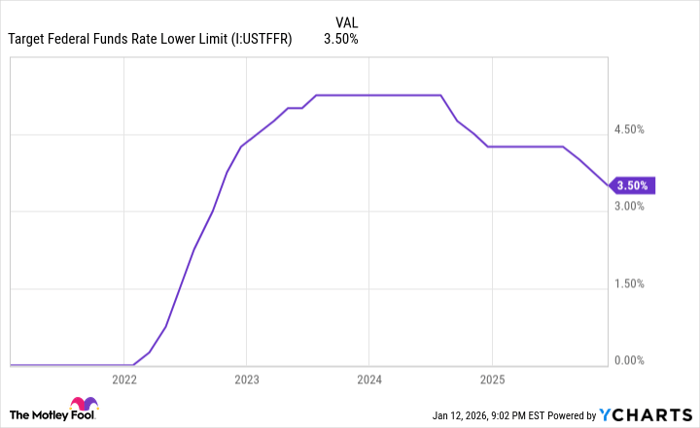
Target Federal Funds Rate Lower Limit data by YCharts.
Looking back more than three decades, all 12 members of the FOMC, including the Fed chair, are usually in unanimous agreement as to the monetary policy path that should be taken. Even if the path taken hasn't always been the right one, the individuals perceived to understand the U.S. economy best being in agreement has been a foundational aspect for Wall Street.
However, each of the previous four FOMC meetings has featured at least one dissenting opinion. Meanwhile, the last two FOMC meetings have had dissenting opinions in opposite directions! In other words, at least one member favored no rate cut -- the FOMC reduced the fed funds target rate by 25 basis points in each of the last three meetings -- while another favored a 50-basis-point reduction. Only three FOMC meetings since 1990 have featured dissents in opposite directions, and two of those three have occurred since late October 2025.
Putting aside the news-making headlines between Trump and Powell, a historically divided Fed is a considerably bigger worry for the stock market. The lack of cohesion from the FOMC runs the risk of undermining the stability that the Federal Reserve is perceived to bring to Wall Street.
Additionally, Powell's term as Fed Chair is set to end in four months, which may further complicate a historically fractured Fed.
Despite all the chatter on Wall Street about the possibility of the AI bubble bursting, the stock market's biggest risk factor in 2026 is broader investor recognition that the Fed is divided -- and there's no easy remedy.
Should you buy stock in S&P 500 Index right now?
Before you buy stock in S&P 500 Index, consider this:
The Motley Fool Stock Advisor analyst team just identified what they believe are the 10 best stocks for investors to buy now… and S&P 500 Index wasn’t one of them. The 10 stocks that made the cut could produce monster returns in the coming years.
Consider when Netflix made this list on December 17, 2004... if you invested $1,000 at the time of our recommendation, you’d have $474,847!* Or when Nvidia made this list on April 15, 2005... if you invested $1,000 at the time of our recommendation, you’d have $1,146,655!*
Now, it’s worth noting Stock Advisor’s total average return is 958% — a market-crushing outperformance compared to 196% for the S&P 500. Don't miss the latest top 10 list, available with Stock Advisor, and join an investing community built by individual investors for individual investors.
See the 10 stocks »
*Stock Advisor returns as of January 17, 2026.
Sean Williams has no position in any of the stocks mentioned. The Motley Fool has no position in any of the stocks mentioned. The Motley Fool has a disclosure policy.
Recommended Articles


