




Will Nvidia Stock Fall Below $100 in 2026? Here's What History Has to Say.
Key Points
The rise of artificial intelligence (AI), led by Nvidia, has fueled the stock market's three-year rally.
Nvidia's superior graphics processing units (GPUs) have led to otherworldly pricing power and mouthwatering margins.
However, history has a way of rhyming on Wall Street -- and that's potentially bad news for the world's most valuable public company.
- 10 stocks we like better than Nvidia ›
The third year of Wall Street's bull market rally didn't disappoint. The Dow Jones Industrial Average, S&P 500, and Nasdaq Composite all rallied by double-digit percentages and achieved several record-closing highs.
The catalyst behind this breakneck optimism is the rise of artificial intelligence (AI), which has been spearheaded by Nvidia (NASDAQ: NVDA). Since the beginning of 2023, Nvidia has added more than $4.1 trillion in market value and briefly became the only public company to ever reach the $5 trillion market cap plateau.
Where to invest $1,000 right now? Our analyst team just revealed what they believe are the 10 best stocks to buy right now. Continue »

Image source: Getty Images.
Empowering software and systems with the ability to make split-second decisions without human intervention is a game-changing technology with a multitrillion-dollar global appeal. Unfortunately, it's also a technology that has to contend with historical headwinds.
Although Nvidia stock finds itself within striking distance of $200 per share, history suggests $100 might be a more realistic expectation in 2026.
Nvidia has set the bar high for the AI revolution
Before making any prognostications about the future, it's imperative to lay the foundation of how Nvidia got to where it is now (i.e., at the top of the pedestal).
The spark that lit Nvidia's fire has everything to do with its superior AI hardware. The company's graphics processing units (GPUs) are the top choice by businesses as the "brains" of AI-accelerated data centers. External competitors have yet to come close to matching the compute capabilities of Hopper (H100), Blackwell, and Blackwell Ultra.
To make matters worse for Nvidia's competitors, CEO Jensen Huang is maintaining an aggressive innovation timeline that intends to bring a new advanced chip to market annually. The successor to Blackwell Ultra, known as Vera Rubin, will run on an all-new processor, with its efficient architecture requiring far fewer GPUs to train large language models (LLMs). These rapid advancements in compute potential have afforded Huang's company exceptional pricing power and a gross margin that's surged into the mid-70% range.
Nvidia's CUDA software platform also deserves its fair share of credit. CUDA is the toolkit developers are using to maximize the compute potential of their Nvidia hardware, including the building and training of LLMs. This platform has been pivotal in keeping customers loyal to Nvidia's umbrella of products and services.
Lastly, it's hard to overlook the laundry list of partnerships Nvidia has forged. In addition to several members of the "Magnificent Seven" spending tens of billions of dollars on Nvidia's hardware to expand their AI data centers, Nvidia announced a strategic partnership with privately held OpenAI in September that'll see the latter deploy at least 10 gigawatts of AI data centers using Nvidia's GPUs. OpenAI will use the Vera Rubin chip in the first of these data centers later this year.
While optimism has been off the charts for the face of the AI revolution, history has a different story to tell.

Image source: Nvidia.
Historical headwinds are mounting for the world's largest publicly traded company
To preface the following discussion, what's happened in the past can't concretely guarantee that something will happen in the future. Nonetheless, history has a way of rhyming on Wall Street, which can offer investors an edge.
To begin with, every game-changing technological advancement for more than three decades has navigated its way through an early innings bubble-bursting event. What the proliferation of the internet, genome decoding, nanotechnology, 3D printing, blockchain technology, and the metaverse all had in common was the propensity for investors to overestimate the early stage adoption, utilization, and optimization rates of new technologies.
Though we've observed ample demand for AI infrastructure and Nvidia's GPUs, we're likely years away from seeing businesses optimize their AI hardware and solutions to maximize their sales and profits. Every game-changing technology has needed time to mature and evolve, and we're just not at this point with artificial intelligence. If an AI bubble forms and bursts, it's hard to imagine any company being hit harder than Nvidia.
Nvidia's valuation is another historical red flag. While valuation is subjective (i.e., what one person finds expensive might be viewed as cheap by another investor), the time-tested price-to-sales (P/S) ratio has left little wiggle room for debate.
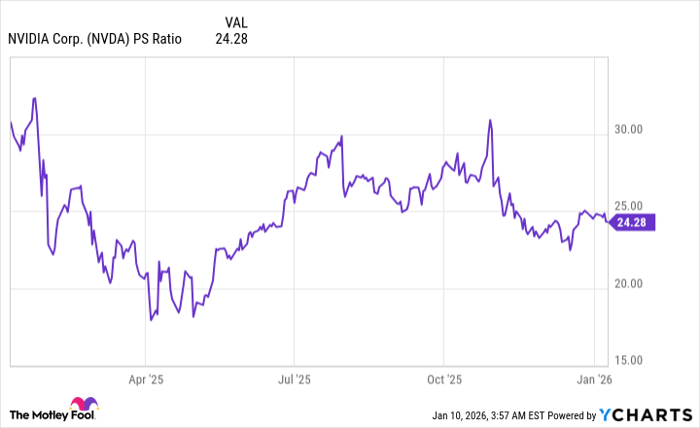
NVDA PS Ratio data by YCharts.
Historically, a P/S ratio of 30 (or above) for a company heralding the charge of a technological innovation has indicated the presence of a bubble. In early November, Nvidia's P/S ratio, once again, tipped the scales above 30. Although its trailing 12-month P/S ratio has declined as sales have climbed, its current P/S ratio of 24.3 remains high.
Compound this historically high individual valuation with the second priciest stock market in history, dating back to January 1871, and you get trouble. If history were to rhyme and the benchmark S&P 500 loses 20% or more of its value in 2026, companies with premium valuations, such as Nvidia, would be expected to suffer outsize declines.
Competition is another issue for the world's largest publicly traded company. While it's effectively run circles around its external competition, Nvidia is at risk of losing valuable data center space to its top customers, based on net sales. Although the internally developed GPUs of some of its leading clients aren't capable of challenging Hopper, Blackwell, or Blackwell Ultra on a compute basis, they are notably cheaper and not backlogged. These latter two factors could cost Nvidia data center real estate and put a serious dent in its GPU pricing power and gross margin moving forward.
While AI has the potential to be a long-term game changer, the short-term risks currently outweigh the rewards. If one or more of these predominantly historical headwinds take shape in the new year, Nvidia stock could fall below $100.
Should you buy stock in Nvidia right now?
Before you buy stock in Nvidia, consider this:
The Motley Fool Stock Advisor analyst team just identified what they believe are the 10 best stocks for investors to buy now… and Nvidia wasn’t one of them. The 10 stocks that made the cut could produce monster returns in the coming years.
Consider when Netflix made this list on December 17, 2004... if you invested $1,000 at the time of our recommendation, you’d have $482,209!* Or when Nvidia made this list on April 15, 2005... if you invested $1,000 at the time of our recommendation, you’d have $1,133,548!*
Now, it’s worth noting Stock Advisor’s total average return is 968% — a market-crushing outperformance compared to 197% for the S&P 500. Don't miss the latest top 10 list, available with Stock Advisor, and join an investing community built by individual investors for individual investors.
See the 10 stocks »
*Stock Advisor returns as of January 14, 2026.
Sean Williams has no position in any of the stocks mentioned. The Motley Fool has positions in and recommends Nvidia. The Motley Fool has a disclosure policy.
Recommended Articles


