




Should You Choose an IRA Over a 401k for Retirement Savings?
Key Points
IRAs offer more flexibility around investments and early withdrawals.
Some people may find the low contribution limit of an IRA to be an issue.
You should take advantage of a 401(k) if you have the option.
- The $23,760 Social Security bonus most retirees completely overlook ›
One of the best things you can do when it comes to saving for retirement is take advantage of retirement accounts because they're a two-for-one: You actively save and invest for retirement while simultaneously getting a tax break for doing so.
There are a handful of retirement accounts to choose from, with the most popular being a 401(k). It's usually what comes to mind when people think of a retirement account. However, another great option is an individual retirement account (IRA), which offers benefits you don't receive from a 401(k).
Where to invest $1,000 right now? Our analyst team just revealed what they believe are the 10 best stocks to buy right now, when you join Stock Advisor. See the stocks »
Given the benefits of an IRA, should you choose it over a 401(k)? Let's take a look.
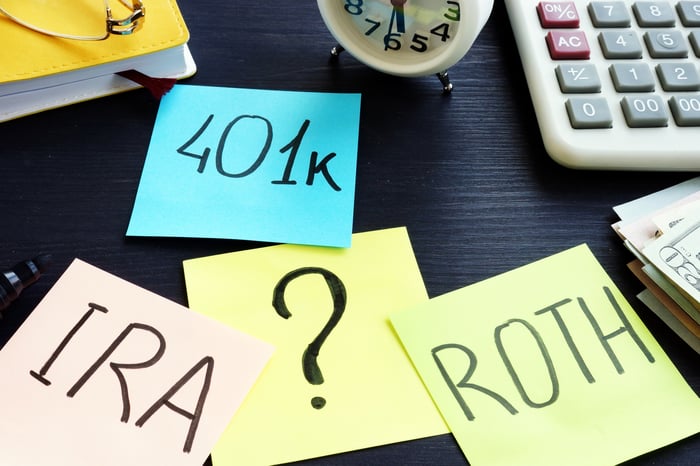
Image source: Getty Images.
Which IRA is right for you?
There are two main types of IRAs: traditional and Roth. A traditional IRA is similar to a 401(k) in that it allows you to deduct your contributions from your taxable income in the year you make them. This is an up-front tax break that will save you money on your tax bill for the year.
A Roth IRA has a unique tax break, allowing you to contribute after-tax money and then take tax-free withdrawals in retirement, as long as you're 59-1/2 years old and made your first contribution at least five years prior. This allows your money and investments to grow and compound without worrying about taxes on the back end.
Choosing between the two generally comes down to when paying taxes makes the most sense for you. If you expect your tax bracket to be lower in or near retirement, it could make sense to go with a traditional IRA so you can save now and then pay taxes at a lower bracket later. If you expect your tax bracket to be higher, it could make sense to go with a Roth IRA so you pay taxes now at a lower tax rate and then have tax-free withdrawals in retirement.
Where an IRA stands out over a 401(k)
IRAs stand out for a few reasons, starting with the fact that they're not tied to an employer, so anyone can open an account and contribute to it as long as the contributions are made with earned income. If you don't have an employer, a standard 401(k) isn't an option.
IRAs also offer more flexibility with your investments because the investment options aren't provided to you like they are in a 401(k). They're essentially brokerage accounts with a tax break.
There's also more flexibility when making early withdrawals from an IRA. With a Roth IRA, you can withdraw your contributions (but not earnings) at any time without facing an early withdrawal penalty. Outside of that, IRAs allow you to make penalty-free withdrawals for things like the purchase of your first home, qualified higher educational expenses, and health insurance premiums while unemployed. None of those apply to a 401(k).
So, should you choose an IRA over a 401(k)?
The short answer to this question is no. And that's because, ideally, you'd take advantage of both accounts. There's a lot to like about IRAs, and I encourage everyone to take advantage of them because of their unique benefits. However, their low contribution limits make it hard for those to be your only retirement account.
In 2026, the most you can contribute to an IRA (traditional and Roth combined) is $7,500, or $8,600 if you're 50 or older. On the other hand, the contribution limit for a 401(k) is $24,500, $32,500 if you're 50 or older, and $35,750 if you're aged 60, 61, 62, or 63.
That's not to say saving $7,500 annually for retirement is frowned upon; any contributions are better than no contributions. However, many people would be better off if they had the opportunity to contribute more. Here's an example of how I'd personally approach the two accounts:
- Contribute enough to your 401(k) to get the maximum amount your employer will match.
- Aim to max out your IRA account.
- Increase your 401(k) contributions to what you can feasibly do.
Now, if you can max out both accounts, by all means do so. Unfortunately, this isn't feasible for most people. Following the above steps allows you to take advantage of the benefits of both account types. You get the passiveness and high contribution limit of a 401(k), along with the flexibility of an IRA.
The $23,760 Social Security bonus most retirees completely overlook
If you're like most Americans, you're a few years (or more) behind on your retirement savings. But a handful of little-known "Social Security secrets" could help ensure a boost in your retirement income.
One easy trick could pay you as much as $23,760 more... each year! Once you learn how to maximize your Social Security benefits, we think you could retire confidently with the peace of mind we're all after. Join Stock Advisor to learn more about these strategies.
View the "Social Security secrets" »
The Motley Fool has a disclosure policy.
Recommended Articles


