

Is the Schwab U.S. Dividend Equity ETF a Buy Now?
Key Points
A handful of dividend-focused exchange-traded funds have logged very different performances of late.
Given the differing nature of these ETFs' underlying indexes, however, this performance disparity shouldn't be surprising.
Much of the reason for these different gains may be on the verge of a reversal.
- 10 stocks we like better than Schwab U.S. Dividend Equity ETF ›
Contrary to a common belief, not all dividend exchange-traded funds (ETFs) are the same. Indeed, they can be remarkably different.
Take the Schwab U.S. Dividend Equity ETF (NYSEMKT: SCHD) as an example. Over the course of the past three years it's produced less than half the net gains achieved by seemingly similar funds like the Vanguard Dividend Appreciation ETF (NYSEMKT: VIG) or iShares Core Dividend Growth ETF (NYSEMKT: DGRO) (when factoring in dividends paid during this stretch).
Where to invest $1,000 right now? Our analyst team just revealed what they believe are the 10 best stocks to buy right now, when you join Stock Advisor. See the stocks »
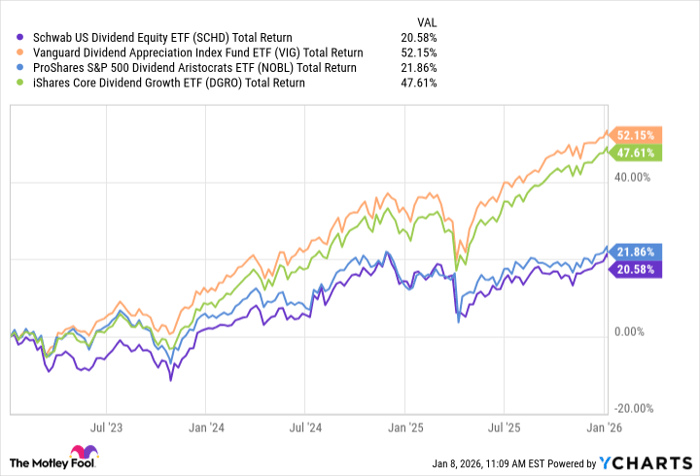
Data by YCharts.
Smart investors aren't jumping to misguided conclusions about this underperformance, though. Rather, they're figuring out if this underperformance is ultimately a buying opportunity. And that starts with figuring out why this performance disparity exists in the first place.
Here's what you need to know.
Little things can make a big difference
So what makes the Vanguard Dividend Appreciation Fund and the iShares Core Dividend Growth ETF so different from Schwab's U.S. Dividend Equity Fund or the comparable ProShares S&P 500 Dividend Aristocrats® ETF (NYSEMKT: NOBL) (The term Dividend Aristocrats® is a registered trademark of Standard & Poor's Financial Services, LLC.)?
It starts -- and also pretty much ends -- with their underlying indexes. Whereas Vanguard's Dividend Appreciation ETF is meant to mirror the S&P U.S. Dividend Growers Index, the Schwab U.S. Dividend Equity ETF is built to reflect the performance of the Dow Jones U.S. Dividend 100™ Index. The former's chief criteria for inclusion is a just minimum of 10 years of consecutive dividend growth (although it also excludes the highest-yielding 25% of otherwise-eligible tickers), while the latter specifically seeks out the stock market's highest-yielding names, with a preference for companies with better cash flow, higher return on equity, and the fastest rates of dividend growth.

Image source: Getty Images.
It still doesn't seem like a huge difference. By making the market's highest-yielding 25% of stocks ineligible for inclusion in the S&P U.S. Dividend Growers Index, Standard & Poor's seems to weed out some of the fundamentally weaker stocks that Dow Jones weeds out differently.
There are clear differences, though, evident in each index's and ETF's current top-five holdings. Vanguard's Dividend Appreciation ETF based on the S&P U.S. Dividend Growers Index currently holds major stakes in Broadcom, Microsoft, Apple, JPMorgan Chase, and Eli Lilly. That's in sharp contrast with Schwab's U.S. Dividend Equity ETF and its underlying Dow Jones U.S. Dividend 100™ Index. Its top positions at this time are Bristol Myers Squibb, Merck, Lockheed Martin, Chevron, and ConocoPhillips.
Vanguard's dividend fund has also effectively been a growth fund, boosted by the recent rapid rise of artificial intelligence (AI) stocks. Schwab's dividend fund, on the other hand, is essentially a value fund in an environment where value stocks have found very little favor with investors.
And for what it's worth, this is the same reason there's been such a big performance disparity between the aforementioned iShares Core Dividend Growth ETF and the ProShares S&P 500 Dividend Aristocrats® ETF. The former holds a lot of growth stocks, while the latter is loaded with value.
So what's the call?
But the question remains: Is the Schwab U.S. Dividend Equity ETF a buy right now? Or asked another way, is the market ripe for a shift from technology-driven leadership from growth names to an environment where value stocks lead the way?
Obviously, nobody owns a functioning, future-telling crystal ball. However, this certainly wouldn't be a bad time to start dialing back some of your exposure to growth stocks in exchange for more dividend-paying value holdings ... for a handful of reasons.
Steep valuations of AI-related stocks are one key reason to start thinking about such a strategic shift. Data from Yardeni Research indicates the so-called "Magnificent Seven" stocks that currently account for more than 30% of the S&P 500's (SNPINDEX: ^GSPC) total value (six of which are heavily involved in the artificial intelligence revolution) are currently priced at a frothy 28 times their projected earnings. Excluding these seven tickers, however, the S&P 500 is priced at a very palatable 20 times its forward-looking earnings. If there is indeed an artificial intelligence bubble that's going to pop soon, it's likely to hurt a small handful of leading technology stocks a lot more than it's going to hurt everything else.
Even without a bursting of an AI bubble, though, now's an attractive time to scoop up value names. The lingering inflation we're seeing at this time tends to work against growth while benefiting companies with real pricing power -- such as consumer staples outfits -- while moderate economic growth is something of a sweet spot for value industries like industrial manufacturing and banking. And, given Q3's surprisingly solid preliminary GDP growth rate of 4.3%, the United States' economy is clearly doing better than most investors and analysts felt like it should be doing at this point.
Then there's the simple fact that value stocks are just undervalued here. As Invesco's Senior Director of U.S. Value Product Management recently reported, value stocks, based on the Russell 1000 Value Index, are at a 30% discount to the S&P 500 index, and a 50% discount to growth stocks, based on the Russell 1000 Growth Index.
Perhaps the simplest reason of all to buy SCHD now is also arguably the best. That is, newcomers will be plugging into it while its forward-looking dividend yield stands right around a solid 4%. You'd be hard-pressed to find better from another basket of high-quality blue chips.
Should you buy stock in Schwab U.S. Dividend Equity ETF right now?
Before you buy stock in Schwab U.S. Dividend Equity ETF, consider this:
The Motley Fool Stock Advisor analyst team just identified what they believe are the 10 best stocks for investors to buy now… and Schwab U.S. Dividend Equity ETF wasn’t one of them. The 10 stocks that made the cut could produce monster returns in the coming years.
Consider when Netflix made this list on December 17, 2004... if you invested $1,000 at the time of our recommendation, you’d have $482,451!* Or when Nvidia made this list on April 15, 2005... if you invested $1,000 at the time of our recommendation, you’d have $1,133,229!*
Now, it’s worth noting Stock Advisor’s total average return is 968% — a market-crushing outperformance compared to 197% for the S&P 500. Don't miss the latest top 10 list, available with Stock Advisor, and join an investing community built by individual investors for individual investors.
See the 10 stocks »
*Stock Advisor returns as of January 11, 2026.
JPMorgan Chase is an advertising partner of Motley Fool Money. James Brumley has no position in any of the stocks mentioned. The Motley Fool has positions in and recommends Apple, Bristol Myers Squibb, Chevron, JPMorgan Chase, Merck, Microsoft, ProShares S&P 500 Dividend Aristocrats ETF, and Vanguard Dividend Appreciation ETF. The Motley Fool recommends Broadcom, ConocoPhillips, and Lockheed Martin and recommends the following options: long January 2026 $395 calls on Microsoft and short January 2026 $405 calls on Microsoft. The Motley Fool has a disclosure policy.
Recommended Articles


