

Prediction: Ethereum Will Hit $4,000 in 2026
Key Points
Ethereum has a pair of upgrades on the way in 2026, just as it did in 2025.
Users probably won't notice anything new or different this time around.
However, it will leave the network well-positioned for big future feature additions.
- 10 stocks we like better than Ethereum ›
Today, Ethereum (CRYPTO: ETH) is priced at about $3,150, considerably lower than its all-time highs, and comfortably above the pits of early 2025. I predict that the cryptocurrency will hit $4,000 in 2026, because all it needs to do that is a couple of basic technical things to go right, and for investors to remember why the chain is still the center of the crypto-financial system.
Let's walk through the catalysts that make this price target plausible, and take a little time to understand what the near term is likely to bring.
Where to invest $1,000 right now? Our analyst team just revealed what they believe are the 10 best stocks to buy right now, when you join Stock Advisor. See the stocks »
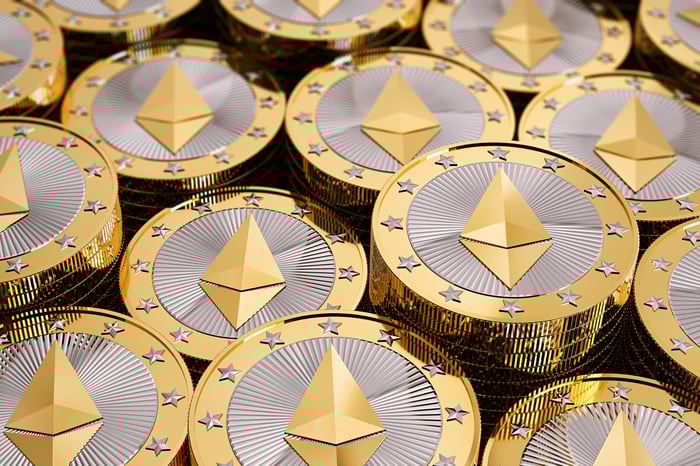
Image source: Getty Images.
The next upgrade will be a catalyst, but it isn't the whole story
Per its development roadmap, Ethereum's 2026 is supposed to be about more of the same stuff that helped the chain to become a lot more formidable and resilient in 2025.
Upgrades are coming to improve the network's scaling capacity even further, with more efficient transaction execution, and, critically, new technical infrastructure to support the later addition of parallel transaction execution, as well as a slew of other fixes and minor improvements which users will probably not notice.
The first update, called Glamsterdam, is positioned as the successor to 2025's major packages, Pectra and Fusaka, both of which focused on improving the chain's ability to handle traffic without letting gas (user) fees get out of control. Glamsterdam should launch sometime in the first half of 2026, and it will be followed by another scaling-focused update called Hegota, which is slated for sometime in the second half of the year.
The optimistic version of this story is that once Glamsterdam goes live, the newly improved basis for faster throughput will attract more usage of decentralized finance (DeFi) services on the chain, which in turn will attract more app developers and financial institutions, and subsequently pull in even more capital. And, on some level, this narrative is almost certainly going to be proven true, as pushing a substantial (if somewhat invisible to users) upgrade less than a year after a pair of fairly meaty upgrades speaks to the quality of the chain's technical leadership, as well as its ability to execute on its stated plans.
But it probably will not, by itself, push the price to $4,000; the point of Glamsterdam is to overhaul a few of Ethereum's under-the-hood systems to create the technical foundations for big upgrades down the line.
Real-world assets will probably be a bigger tailwind
The bigger driver for Ethereum to hit $4,000 or more is its expanding tokenized real-world asset (RWA) base, as well as its expanding base of capital stored in stablecoins.
On that front, Ethereum already has the crypto sector's largest stablecoin base, with about $170.9 billion in stablecoin market cap, alongside $12.6 billion in tradable RWA value. Importantly, Ethereum's most important tokenized assets for attracting institutional investors and financial institutions, like tokenized U.S. Treasuries, are by far the most ample in the entire crypto sector, with a value of $4.6 billion.
As capital continues to migrate to managing assets via blockchain tech, these pools of capital on Ethereum will serve to attract even more inflows, as capital tends to beget more capital. Doing that will require asset managers and other entities to hold some Ethereum coins to pay gas fees and for any DeFi services they might need. So, it will increase demand, and probably send prices a bit higher.
So, that's why I expect the coin to hit $4,000 or more sometime in 2026, assuming broader risk appetite does not collapse. There's no moonshot in the cards here -- just good old-fashioned technical progress on its core platform, and consistent traction leading to more entrenchment and growth in its base of tokenized assets.
If you don't own some Ethereum, it's worth considering buying and holding it as a long-term position -- just appreciate that in 2025, weak market conditions overrode the positive impacts of the tech upgrades on the coin's price.
Should you buy stock in Ethereum right now?
Before you buy stock in Ethereum, consider this:
The Motley Fool Stock Advisor analyst team just identified what they believe are the 10 best stocks for investors to buy now… and Ethereum wasn’t one of them. The 10 stocks that made the cut could produce monster returns in the coming years.
Consider when Netflix made this list on December 17, 2004... if you invested $1,000 at the time of our recommendation, you’d have $489,300!* Or when Nvidia made this list on April 15, 2005... if you invested $1,000 at the time of our recommendation, you’d have $1,159,283!*
Now, it’s worth noting Stock Advisor’s total average return is 974% — a market-crushing outperformance compared to 196% for the S&P 500. Don't miss the latest top 10 list, available with Stock Advisor, and join an investing community built by individual investors for individual investors.
See the 10 stocks »
*Stock Advisor returns as of January 9, 2026.
Alex Carchidi has positions in Ethereum. The Motley Fool has positions in and recommends Ethereum. The Motley Fool has a disclosure policy.
Recommended Articles


