

Want to Be a Better Investor in 2026? Here's the 1 Simple Thing That You Can Do Today That Almost Nobody Is Talking About.
Key Points
Investors need to learn to hold stocks through volatility, but holding is hard to do.
How you feel about a stock can tremendously influence your willingness to keep holding or not.
- 10 stocks we like better than Wingstop ›
Before I explain what investors can do better in 2026, I need to point out where things go wrong in the first place.
If you want to make money in the stock market, you have to be willing to do two important things. First, you need to take a long-term view -- a three-to-five-year holding period is a good starting point. Second, you must commit to holding your stocks through the market's ups and downs.
Where to invest $1,000 right now? Our analyst team just revealed what they believe are the 10 best stocks to buy right now, when you join Stock Advisor. See the stocks »
For investors unwilling to do those two things, research shows that they're almost doomed to fail right from the start.

Image source: Getty Images.
Regarding the first point, a 20-year study from Boston Consulting Group showed that the primary driver of a stock's short-term performance is its valuation. But the primary driver of a stock's long-term performance is its business results. Therefore, to play the short game, all you have to do is figure out how the market will value your stock over the coming weeks and months.
The problem is that a stock's valuation is highly unpredictable, and headline-driven emotions have a disproportionate impact. There aren't repeatable processes to consistently get it right; it's just a matter of luck.
By contrast, predicting business results is a more achievable task. One doesn't need to be perfectly correct with predictions, just directionally correct.
A case study
Regarding the second point, it takes time for business results to manifest, and the stock market is a volatile place. Consider that one of the greatest stocks of the last decade was Nvidia (NASDAQ: NVDA). A $10,000 investment made 10 years ago is now worth almost $2.2 million. But to make this money, investors had to hold through the volatility illustrated in the chart.
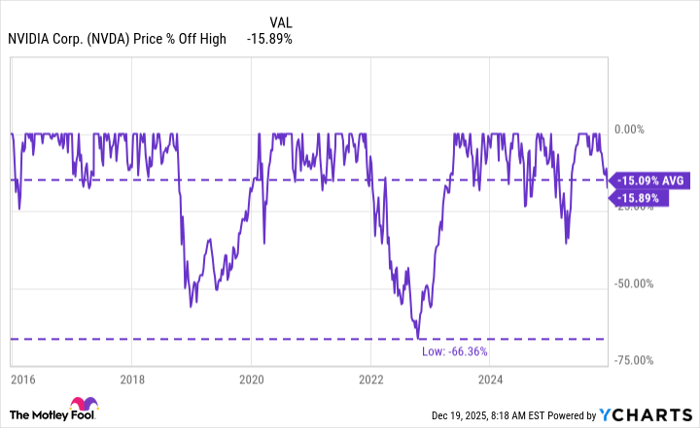
NVDA data by YCharts
On the road to turning $10,000 into $2.2 million, Nvidia shareholders endured a 20% drop four times, a 50% drop twice, and one drop of 66%. In fact, the average drawdown for Nvidia was 15%. For perspective, the S&P 500 (SNPINDEX: ^GSPC) has only been down 15% three times period during these 10 years.
Here's the point: To make the big money, investors had to buy and hold Nvidia for the long term, not jump ship every time that sailing got rough.
Therefore, to become a better investor in 2026, investors need to get better at holding on to stocks. That's it. But how?
There is something that investors can do to make it easier to hold the stocks in their portfolio even when times are tough. It's incredibly simple, and almost nobody is talking about it.
One simple thing investors can do today to improve
In 2025, I made a change that I intend to continue in 2026: I'm prioritizing buying stocks I love, rather than solely focusing on those I think have the highest upside.
On the surface, this is completely illogical. It seems that I'd be financially best off by buying the stocks that are the least risky and have the highest upside. Therefore, shouldn't I prioritize identifying those investments?
Author Morgan Housel notes that there's a distinction between what works in mathematical calculations and what works in the real world. Any stock I buy will experience volatility, as Nvidia did. And psychologically, I'm more likely to sell a stock that I don't really like.
By contrast, I'm more likely to keep holding a stock I love. And remember, to be a better investor in 2026, investors must improve their ability to hold stocks.
In The Psychology of Money, Housel writes:
Invest in a promising company you don't care about, and you might enjoy it when everything's going well. But when the tide inevitably turns, you're suddenly losing money on something you're not interested in. It's a double burden, and the path of least resistance is to move on to something else.
When I reviewed my own portfolio, I could explain why I believed each stock would increase in value -- that's called having an investment thesis. But the portfolio simply bored me because it was filled with companies I didn't really care about.
Not anymore. I've started to prioritize buying stocks I love. With each, I still need to believe they have strong upside potential -- that hasn't changed. However, these are companies that I genuinely enjoy discussing with others and explaining why they're special to me.
Four stocks that I actually love
In 2025, I finally made my first investment in one of my favorite companies, Wingstop (NASDAQ: WING).
Eating out is a treat for my family, meaning that I like restaurant stocks in general. But I love Wingstop's operating model. Most orders are digital, and the menu is simple, meaning restaurants can be run by just a handful of people. This keeps margins high and keeps the company's franchisees begging for the chance to open new locations. It's a restaurant business I love.
I've also increased my investments in Airbnb (NASDAQ: ABNB) and Five Below (NASDAQ: FIVE) to feature both more prominently in my portfolio.
Airbnb is special to me because I was an early adopter, and my family has stayed in incredible places, including a cabin alongside a river in South America and a converted church in the Appalachian mountains. I wouldn't trade those memories for the world. The company's brand moat and incredible free cash flow margins boost my confidence from an investment perspective.
With Five Below, I love the simplicity of the business: It sells cheap merchandise to teens and preteens, including those who live in my own house. New stores have an average payback period of about one year, meaning they pay for themselves and add to the company's overall profitability in short order. Moreover, being a debt-free, cash-rich business, I love that I don't have to worry about this investment.
Finally, I've continued to hold Xometry (NASDAQ: XMTR) even after its incredible recent gains -- I probably would be tempted to "take profits" if I were lukewarm about the company. But I believe that its artificial intelligence (AI)-powered platform is doing something important in small-scale manufacturing that could potentially transform this enormous industry. And I love that I found it when it was still worth less than $1 billion. It makes me feel like I'm a part of its journey.
The risk with buying stocks that you love is that it's possible to look past problems and fail to have a sober assessment of a company's strengths. This is why building a realistic investment thesis is still important. But buying a stock you love can lead to better returns than buying a higher-upside stock you're ambivalent toward.
It can lead to better returns because, when the chips are down, investors are more compelled to hold the stocks they love than the stocks they don't. And holding stocks for the long term can make all the difference.
Should you buy stock in Wingstop right now?
Before you buy stock in Wingstop, consider this:
The Motley Fool Stock Advisor analyst team just identified what they believe are the 10 best stocks for investors to buy now… and Wingstop wasn’t one of them. The 10 stocks that made the cut could produce monster returns in the coming years.
Consider when Netflix made this list on December 17, 2004... if you invested $1,000 at the time of our recommendation, you’d have $509,470!* Or when Nvidia made this list on April 15, 2005... if you invested $1,000 at the time of our recommendation, you’d have $1,167,988!*
Now, it’s worth noting Stock Advisor’s total average return is 991% — a market-crushing outperformance compared to 196% for the S&P 500. Don't miss the latest top 10 list, available with Stock Advisor, and join an investing community built by individual investors for individual investors.
See the 10 stocks »
*Stock Advisor returns as of December 28, 2025.
Jon Quast has positions in Airbnb, Five Below, Wingstop, and Xometry. The Motley Fool has positions in and recommends Airbnb, Nvidia, and Xometry. The Motley Fool recommends Five Below and Wingstop. The Motley Fool has a disclosure policy.
Recommended Articles


