


Vanguard S&P 500 ETF Offers Lower Costs Than SPDR SPY -- But Should You Care?
Key Points
Vanguard S&P 500 ETF charges a lhas a lot in common with SPDR S&P 500 ETF, but there are a couple of notable differences.
Both funds track the S&P 500 and have nearly identical sector exposures and five-year returns.
SPY manages a larger asset portfolio while VOO charges lower annual fees.
- These 10 stocks could mint the next wave of millionaires ›
Vanguard S&P 500 Index Fund ETF (NYSEMKT:VOO) looks more affordable and yields slightly more than SPDR S&P 500 ETF Trust (NYSEMKT:SPY), while sector exposures and long-term risk profiles remain nearly identical.
Both ETFs aim to mirror the S&P 500 Index (SNPINDEX:^GSPC), offering exposure to 500 leading U.S. companies across all major sectors. For investors weighing Vanguard S&P 500 ETF against SPDR S&P 500 ETF Trust, the main distinctions come down to costs and minor yield differences rather than portfolio content or risk.
Snapshot (cost & size)
| Metric | SPY | VOO |
|---|---|---|
| Issuer | State Street SPDR | Vanguard |
| Expense ratio | 0.09% | 0.03% |
| 1-yr return (as of 2025-11-19) | 12.3% | 12.3% |
| Dividend yield | 1.1% | 1.1% |
| Beta | 1.00 | 1.00 |
| AUM | $683.1 billion | $1.5 trillion |
Beta measures price volatility relative to the S&P 500; beta is calculated from five-year weekly returns. The 1-yr return represents total return over the trailing 12 months.
VOO stands out for its lower expense ratio, making it a bit more affordable for long-term holders.
Performance & risk comparison
| Metric | SPY | VOO |
|---|---|---|
| Max drawdown (5 y) | (24.5%) | (25.5%) |
| Growth of $1,000 over 5 years | $1,823 | $1,823 |
What's inside
Vanguard S&P 500 ETF holds 505 stocks and has tracked the S&P 500 for over 15 years, with sector weights of 36% technology, 13% financial services, and 11% consumer cyclical. Its largest positions are NVIDIA (NASDAQ:NVDA), Apple (NASDAQ:AAPL), and Microsoft (NASDAQ:MSFT), each representing less than 0.1% of the portfolio. There are no notable quirks or tracking differences.
SPDR S&P 500 ETF Trust closely mirrors VOO with 503 holdings, similar sector allocations, and top positions including Netflix (NASDAQ:NFLX), Nvidia, and Apple. Both funds follow the S&P 500 index methodology without overlays or special features.
For more advice on ETF investing, check out the full guide at this link.
Foolish take
You've seen the chief differences between SPY and VOO already. The Vanguard fund sports a lower annual management fee, and the State Street (NYSE: STT) SPDR fund manages more than twice as much in assets for its ETF holders.
But I would argue that these differences are completely academic to retail investors like you and me. Beyond a reasonable minimum, I don't really care whose AUM total is higher -- both funds have ample liquidity and long operating histories. And SPDR's fees are three times higher than Vanguard's, but both are essentially rounding errors in the calculation of long-term returns. For all intents and purposes, their performance is identical and a perfect match to the underlying S&P 500 index:
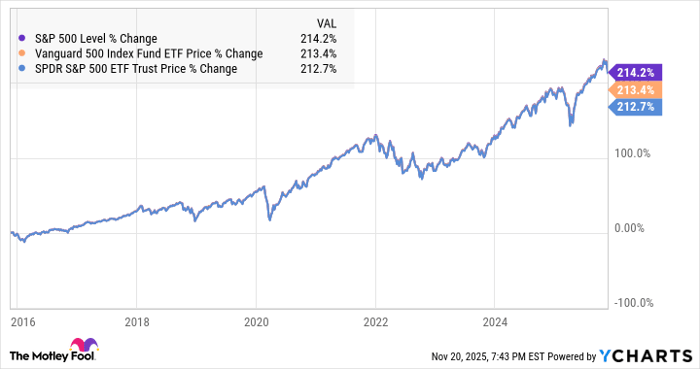
^SPX data by YCharts
In other words, you should feel free to pick one of these funds over the other on any basis you like. If you're optimizing your fund fees, Vanguard's VOO is the natural choice. If you insist on large AUM holdings or the longest possible market histories, you'd go with SPDR's SPY instead. Then again, moon phases and coin flips would be just as reasonable motivations for your final choice.
The primary goal is to invest your money in the market. There are many wrong ways to do it, but I'm not looking at any of those in this comparison. Both VOO and SPY are excellent long-term investments, and you can't go wrong with either one.
Glossary
ETF: Exchange-traded fund; a type of investment fund traded on stock exchanges, holding a basket of assets.
Expense ratio: The annual fee, as a percentage of assets, that a fund charges its investors.
Dividend yield: Annual dividends paid by a fund divided by its current share price, expressed as a percentage.
Beta: A measure of an investment's volatility compared to the overall market; 1.00 means equal volatility to the market.
AUM: Assets under management; the total market value of assets a fund manages on behalf of investors.
Max drawdown: The largest percentage drop from a fund's peak value to its lowest point over a specified period.
Sector exposure: The proportion of a fund's assets invested in specific industry sectors, such as technology or financials.
Tracking difference: The difference between a fund's performance and the performance of its benchmark index.
Portfolio content: The specific assets, such as stocks or bonds, held within an investment fund.
Index methodology: The rules and criteria used to select and weight securities in a benchmark index.
Total return: The investment's price change plus all dividends and distributions, assuming those payouts are reinvested.
Yield: The income generated by an investment, usually expressed as an annual percentage of its market price.
Where to invest $1,000 right now
When our analyst team has a stock tip, it can pay to listen. After all, Stock Advisor’s total average return is 1,013%* — a market-crushing outperformance compared to 188% for the S&P 500.
They just revealed what they believe are the 10 best stocks for investors to buy right now, available when you join Stock Advisor.
See the stocks »
*Stock Advisor returns as of November 17, 2025
Anders Bylund has positions in Netflix, Nvidia, and Vanguard S&P 500 ETF. The Motley Fool has positions in and recommends Apple, Microsoft, Netflix, Nvidia, and Vanguard S&P 500 ETF. The Motley Fool recommends the following options: long January 2026 $395 calls on Microsoft and short January 2026 $405 calls on Microsoft. The Motley Fool has a disclosure policy.
Recommended Articles


