


Will AI Push Up Inflation? Serious Divisions Revealed in Fed’s June Minutes, How Does Wall Street Comment?
TradingKey - On July 8 local time, the Federal Reserve released the minutes of the Federal Open Market Committee (FOMC) monetary policy meeting held on June 16-17.
This was the first meeting minutes released under the chairmanship of the newly appointed Kevin Warsh. It revealed deep divisions within the Federal Reserve regarding the future path of interest rates. Although all members voted unanimously to maintain the target range for the federal funds rate at 3.5% to 3.75%, officials presented differing arguments for both raising and lowering rates.
The length of the minutes was significantly reduced, aligning with Warsh's reform approach of "reducing forward guidance on policy." Despite being only 14 pages long, the document signaled several key messages.
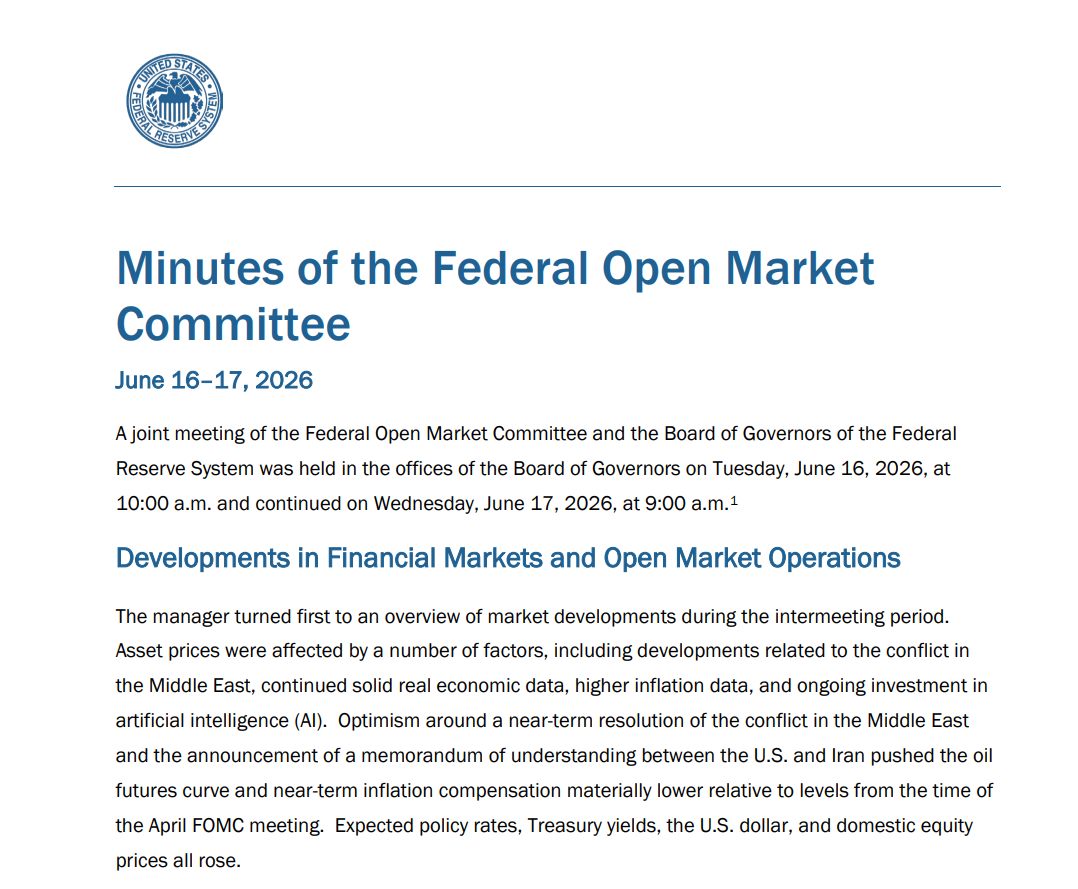
Source: Federal Reserve
Inflation Divergence: The Core Watershed for Rate Hike and Rate Cut Scenarios
The minutes showed that Fed officials held clearly opposing views in their assessment of U.S. inflation potential. Some participants believed inflation could slow further, thereby creating room for rate cuts, while others expected upward price pressures to remain high, which could force the Fed to raise rates.
Among the 18 policymakers who submitted forecasts, half supported raising rates by year-end, while the other half supported keeping them unchanged or cutting them; Warsh himself did not submit a forecast, as he believed that publishing the interest rate path in advance tended to make the decision-making process rigid.
Goldman Sachs ( GS ), Morgan Stanley ( MS ), and Citigroup ( C) quickly released commentary reports after the release of the minutes, with their core judgments highly aligned: the Fed's current reaction function remains data-driven, and the policy direction depends entirely on the performance of inflation data in the coming months.
Goldman Sachs economist Jan Hatzius's team pointed out that the key watershed in the minutes is whether inflation can begin to fall "soon." If it can, "almost all" officials discussing that scenario support "maintaining or eventually lowering" rates; if not, likewise "almost all" officials discussing the high inflation scenario believe that "some degree of policy tightening may be required."
It is worth noting that the minutes mentioned a "minority" of participants believed there was "a case for raising rates" at the June meeting. However, Michael Gapen, chief U.S. economist at Morgan Stanley, clearly pointed out that this is different from "favoring a rate hike," as these "minority" participants stated they are currently satisfied with keeping the policy rate at its current level.
Citigroup economist Andrew Hollenhorst shared the same view, quoting the original minutes to point out that these participants "indicated their support for maintaining the current target range at this meeting." Even if some felt a rate hike was justified, no one actually wanted to press the rate-hike button at this juncture.
New Inflation Variables Spark Concerns
The minutes showed that "many" officials are concerned that the construction of artificial intelligence (AI) infrastructure will push up the prices of semiconductors, computer equipment, and electricity, further driving up inflation.
Data centers require a massive amount of electricity to operate, and robust global demand for AI infrastructure investment will highly likely continue to push up the prices of related products. Previously, Apple Inc. stated that it would raise the prices of its laptops and iPads due to rising memory chip prices, a phenomenon viewed by officials as a concrete manifestation of AI driving up inflation.
In addition to AI factors, inflationary pressures stemming from geopolitical conflicts have also garnered significant attention. The minutes pointed out that, impacted by the previous Trump administration's tariff policies, the conflict in Iran, and supply chain disruptions triggered by the closure of the Strait of Hormuz, U.S. inflation has continued to rise over the past year.
Although energy prices have recently retreated, most participants judged that inflation will remain high in the first half of the year, and the upside risks to the inflation outlook remain prominent.
The Federal Reserve's internal research team raised its inflation forecasts for this year and next. Core inflation, which excludes food and energy, has breached 3%, and core inflation is expected to remain largely elevated and unlikely to decline significantly for the remainder of this year.
However, many committee members also believe that the current high inflation is driven by short-term factors and that such disturbances will eventually dissipate, at which point the FOMC can maintain the current interest rate range or even cut rates.
"A number of participating officials indicated that by the end of this year, an appropriate level for the federal funds rate would be within or slightly below the current target range," the minutes specified. "All members stated that subsequent policy adjustments will depend entirely on the latest incoming economic data."
Probability of rate hikes this year declines, while expectations for rate cuts diverge
Major institutions' forecasts for the Federal Reserve's subsequent policy path show subtle differences, but the overall direction remains consistent.
Morgan Stanley expects that if inflation subsides as it predicts, the Fed will keep interest rates unchanged this year and cut rates twice by 25 basis points each in 2027 or later. It believes that data supporting a July rate hike is insufficient, but if inflation exceeds expectations, a September rate hike is "theoretically possible."
Goldman Sachs expects year-over-year core PCE to fall to 3.0% by the end of 2026 (currently 3.4%) and core CPI to drop to 2.6% (currently 2.9%), with month-over-month readings remaining mild in the coming months; its baseline scenario is for interest rates to remain unchanged throughout 2026, though it acknowledges some risk of rate hikes.
Citi, on the other hand, believes that market pricing for a July rate hike is "too hawkish relative to the Fed's reaction function." It expects that as the unemployment rate rises in the coming months, the balance within the committee will shift from rate hikes to rate cuts, with its baseline scenario being 25-basis-point rate cuts in both October and December of this year, and another 25-basis-point cut in January 2027.
Recommended Articles


