


EUR/USD dips as traders brace for US CPI and geopolitical developments
- EUR/USD down 0.30%, trading at 1.1605 after touching daily high of 1.1675.
- US Dollar bought ahead of US July CPI release; hot print could dampen Fed rate cut bets.
- Italy’s July inflation steady at 1.7% YoY, matching ECB target and June reading.
- Trump–Putin talks may yield Ukraine ceasefire progress, potentially easing EU energy costs.
The EUR/USD edges lower on Monday, down 0.26% as the Greenback is bought by traders ahead of another inflation report in the United States (US) coming Tuesday. This, along with Italy’s revelation that prices reached the European Central Bank’s (ECB) target, justifies the need to hold rates even at the next meeting. The pair trades at 1.1615 after hitting a daily high of 1.1675.
The shared currency halted its advance, even though talks between US President Donald Trump and Russian President Vladimir Putin are expected to show progress on a possible ceasefire in Ukraine. A favorable resolution could unleash the Euro as most European Union (EU) countries are net importers of energy, and a ceasefire or peace plan could push prices lower due to de-escalation of the conflict.
Traders are also eyeing the release of the July Consumer Price Index (CPI) figures in the US. If prices jump, exceeding forecasts, market players could begin to price out the chances of a 25-basis-point rate cut by the Federal Reserve (Fed).
Across the pond, Italy reported that inflation rose by 1.7% YoY in July, which was as expected and unchanged from June’s data.
Ahead, the EU’s docket will feature the EU and Germany ZEW Survey for August, French inflation, and growth data for the bloc. In the US, the economic schedule is expected to announce inflation on the consumer and the producer fronts, Fed speeches, jobless claims, Industrial Production data, Retail Sales, and the University of Michigan Consumer Sentiment for August.
Daily digest market movers: Euro falls on traders booking profits, awaiting inflation data
- The EUR/USD dives as investors brace for the release of July’s CPI data. Estimates suggest that headline prices are expected to accelerate by 2.8% YoY, up from 2.7% in June. Likewise, the core CPI is projected to hit the 3% threshold for the first time since February.
- If indeed US inflation rises, expect further EUR/USD downside due to increased chances that the Fed might hold rates unchanged at the September meeting.
- The US Dollar Index (DXY), which tracks the performance of the buck’s value against a basket of its peers, is up 0.26% at 98.52.
- The Eurozone economic schedule will be light as investors await the release of the EU and Germany’s ZEW Surveys, inflation in Germany, Eurozone employment and growth figures.
- The latest economic data released in the US spurred investor speculation that the Fed might resume its easing cycle at the upcoming September meeting. Odds for a quarter of a percentage cut are at 85%, according to the Prime Market Terminal.
- On the European Central Bank (ECB) front, the easing cycle seems to be on pause for the September meeting, with 91% odds for the ECB to keep rates unchanged and a slim 9% chance of a 25bps rate cut.
Technical outlook: EUR/USD tumbles to 1.1600 as traders eye break of key support level
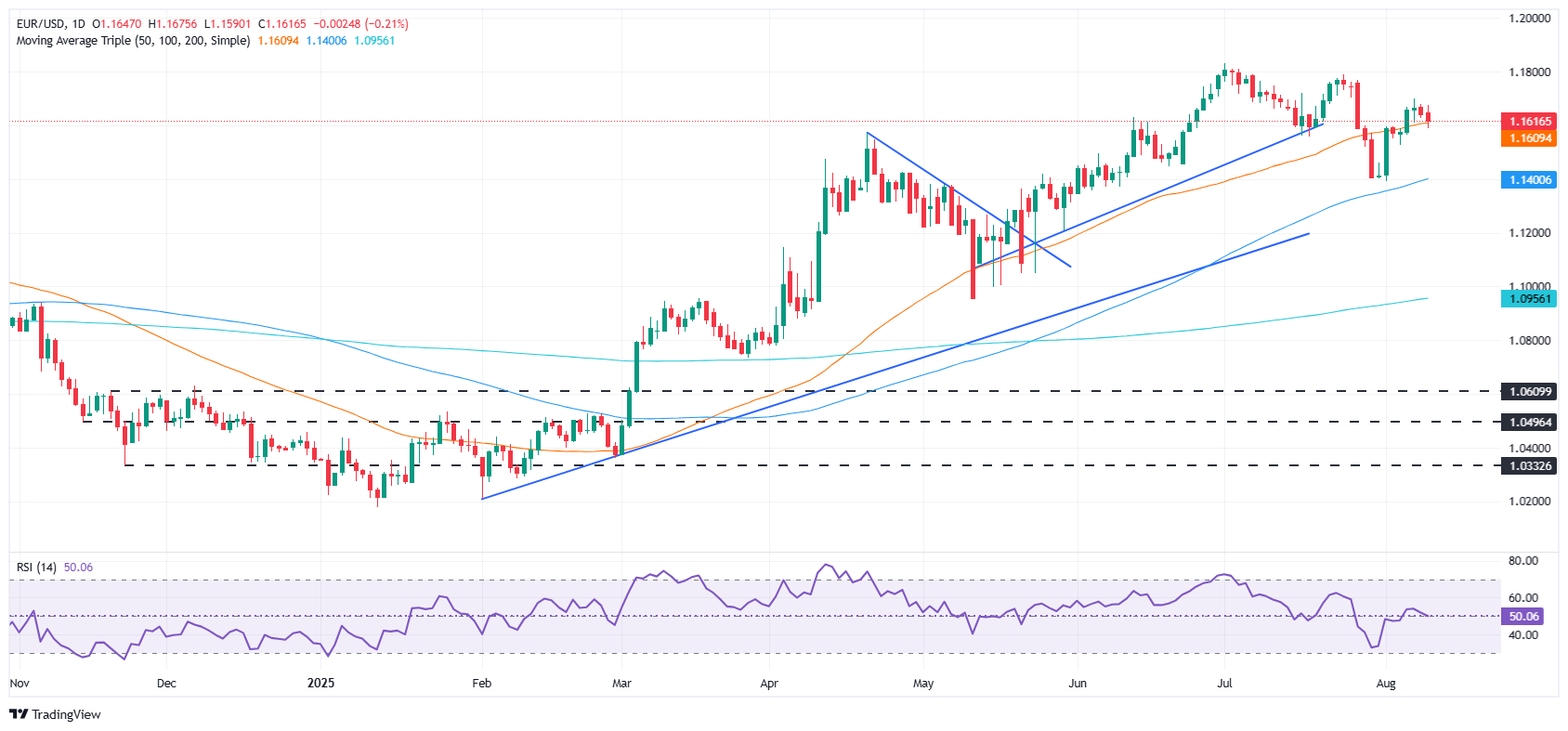
The EUR/USD advance has halted, posting back-to-back bearish candles, though the pair remains above the 1.1600 figure. The Relative Strength Index (RSI) shows that buyers seem to be losing momentum as the index falls below its 50 neutral level, turning bearish.
With that said, sellers need to push the pair below 1.1600 daily. If achieved, the next support would be the August 5 low of 1.1527. A breach of the latter will expose 1.1500. Conversely, if EUR/USD stays above 1.1600, traders would eye 1.1650 ahead of cracking the 1.1700 mark.
Euro FAQs
The Euro is the currency for the 19 European Union countries that belong to the Eurozone. It is the second most heavily traded currency in the world behind the US Dollar. In 2022, it accounted for 31% of all foreign exchange transactions, with an average daily turnover of over $2.2 trillion a day. EUR/USD is the most heavily traded currency pair in the world, accounting for an estimated 30% off all transactions, followed by EUR/JPY (4%), EUR/GBP (3%) and EUR/AUD (2%).
The European Central Bank (ECB) in Frankfurt, Germany, is the reserve bank for the Eurozone. The ECB sets interest rates and manages monetary policy. The ECB’s primary mandate is to maintain price stability, which means either controlling inflation or stimulating growth. Its primary tool is the raising or lowering of interest rates. Relatively high interest rates – or the expectation of higher rates – will usually benefit the Euro and vice versa. The ECB Governing Council makes monetary policy decisions at meetings held eight times a year. Decisions are made by heads of the Eurozone national banks and six permanent members, including the President of the ECB, Christine Lagarde.
Eurozone inflation data, measured by the Harmonized Index of Consumer Prices (HICP), is an important econometric for the Euro. If inflation rises more than expected, especially if above the ECB’s 2% target, it obliges the ECB to raise interest rates to bring it back under control. Relatively high interest rates compared to its counterparts will usually benefit the Euro, as it makes the region more attractive as a place for global investors to park their money.
Data releases gauge the health of the economy and can impact on the Euro. Indicators such as GDP, Manufacturing and Services PMIs, employment, and consumer sentiment surveys can all influence the direction of the single currency. A strong economy is good for the Euro. Not only does it attract more foreign investment but it may encourage the ECB to put up interest rates, which will directly strengthen the Euro. Otherwise, if economic data is weak, the Euro is likely to fall. Economic data for the four largest economies in the euro area (Germany, France, Italy and Spain) are especially significant, as they account for 75% of the Eurozone’s economy.
Another significant data release for the Euro is the Trade Balance. This indicator measures the difference between what a country earns from its exports and what it spends on imports over a given period. If a country produces highly sought after exports then its currency will gain in value purely from the extra demand created from foreign buyers seeking to purchase these goods. Therefore, a positive net Trade Balance strengthens a currency and vice versa for a negative balance.
Recommended Articles


