


US Dollar steadies ahead of US CPI, Powell’s second day at Capitol Hill
- The US Dollar trades fairly flat ahead of the US CPI release on Wednesday.
- All eyes are back on Fed Chairman Jerome Powell, heading into his second day at Capitol Hill.
- The US Dollar Index (DXY) is trading sideways around 108.00, still looking for direction.
The US Dollar Index (DXY), which tracks the performance of the US Dollar (USD) against six major currencies, trades flat around 108.00 after Federal Reserve (Fed) Chairman Jerome Powell kept his cards close to his chest when facing lawmakers on Tuesday at Capitol Hill. Powell did not leave many clues about the timing for another interest rate cut by the central bank, if any. Traders are mulling what to do next, with US yields slowly but surely starting to head higher this week.
The economic calendar shows the Consumer Price Index (CPI) numbers for January are due on Wednesday. Expectations are not very big, with the monthly headline CPI expected to rise 0.3% compared to 0.4% in December. The monthly core CPI gauge is expected to tick up 0.3%, coming from 0.2% in the previous month. Meanwhile, Fed Chairman Jerome Powell will give a speech for the second day in a row at Capitol Hill.
Daily digest market movers: Powell 2.0
- At 13:30 GMT, the US Consumer Price Index data for January will be released:
- The monthly headline CPI measure is expected to rise by 0.3%, coming from 0.4% in the previous month.
- The monthly core inflation gauge is expected to tick up to 0.3%, compared to 0.2% in December.
- Stronger inflation numbers would fuel higher US rates and, in turn, trigger a stronger US Dollar (USD)
- At 15:00 GMT, Fed Chairman Jerome Powell will start his second day of testimony at Capitol Hill.
- At 17:00 GMT, Federal Reserve Bank of Atlanta President Raphael W. Bostic gives remarks at the Atlanta chapter of the National Association of Corporate Directors.
- At 22:05 GMT, Federal Reserve Governor Christopher Waller is set to speak at "A very Stable Conference: Stablecoin Infrastructure for Real World Applications" in San Francisco, California.
- Equities are facing some headwinds after the first day of Fed Chairman Powell’s testimony. Besides the German Dax hitting a fresh alltime high, overall most indices are trading with small gains or losses.
- The CME FedWatch tool projects a 95.5% chance that the Fed will keep interest rates unchanged at its next meeting on March 19.
- The US 10-year yield is trading around 4.54%, ticking up further for a third day in a row and recovering further from its fresh yearly low of 4.40% printed last week.
US Dollar Index Technical Analysis: No clues
The US Dollar Index (DXY) is stuck in a game of Cluedo, and detective Fed Chairman Powell is not giving away much to nearly no clues. With traders left clueless about what or when the Fed will make its next move, slowly but surely, bonds are getting back in the graces of traders as a safe place to be in periods of uncertainty. With this, the US Dollar should solely but surely see some inflow and tick higher.
On the upside, the first barrier at 109.30 (July 14, 2022, high) was briefly surpassed but did not hold last week. Once that level is reclaimed, the next level to hit before advancing further remains at 110.79 (September 7, 2022, high).
On the downside, 107.35 (October 3, 2023, high) is still acting as strong support after several tests last week. In case more downside occurs, look for 106.52 (April 16, 2024, high), 106.21 (100-day Simple Moving Average), or even 105.89 (resistance in June 2024) as better support levels.
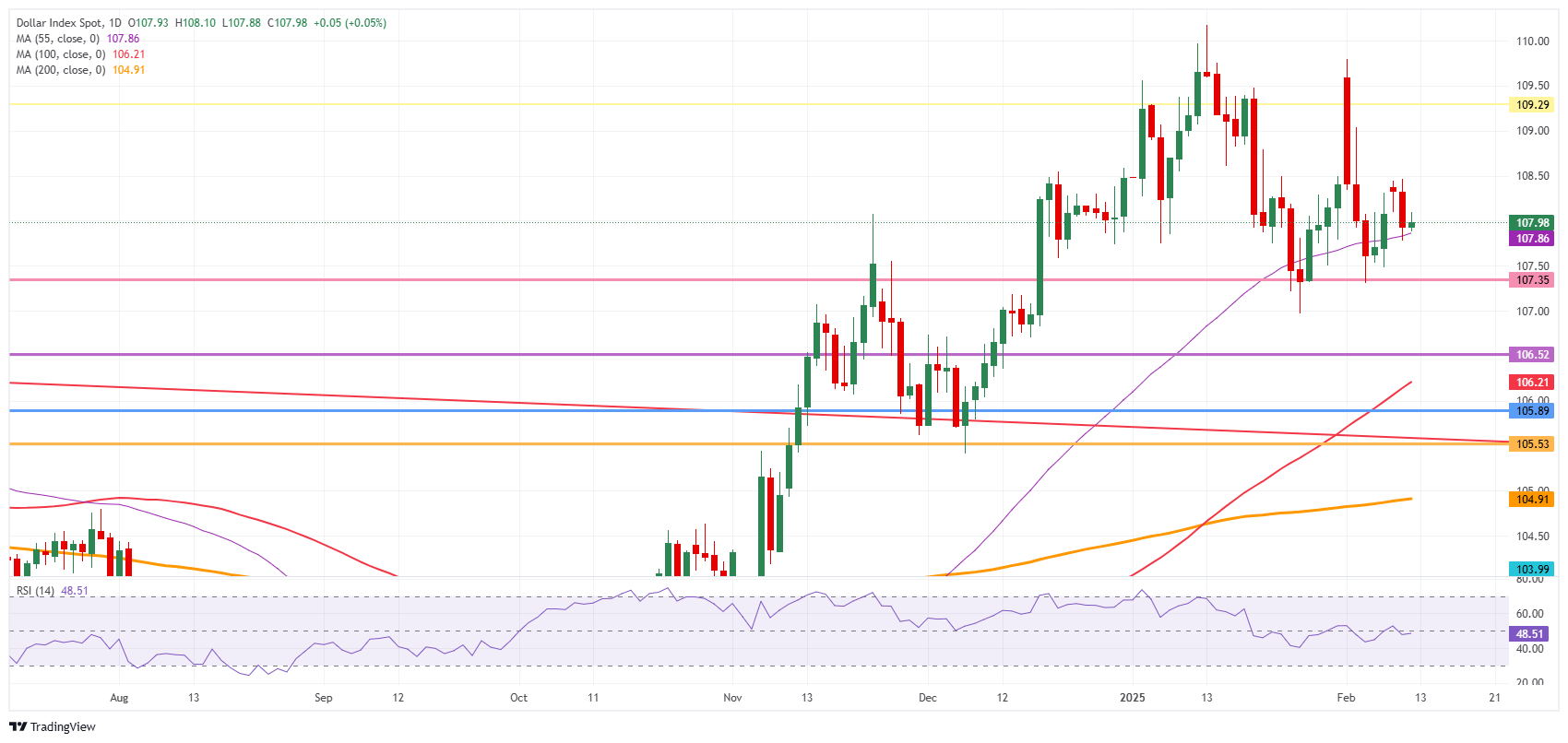
US Dollar Index: Daily Chart
US Dollar FAQs
The US Dollar (USD) is the official currency of the United States of America, and the ‘de facto’ currency of a significant number of other countries where it is found in circulation alongside local notes. It is the most heavily traded currency in the world, accounting for over 88% of all global foreign exchange turnover, or an average of $6.6 trillion in transactions per day, according to data from 2022. Following the second world war, the USD took over from the British Pound as the world’s reserve currency. For most of its history, the US Dollar was backed by Gold, until the Bretton Woods Agreement in 1971 when the Gold Standard went away.
The most important single factor impacting on the value of the US Dollar is monetary policy, which is shaped by the Federal Reserve (Fed). The Fed has two mandates: to achieve price stability (control inflation) and foster full employment. Its primary tool to achieve these two goals is by adjusting interest rates. When prices are rising too quickly and inflation is above the Fed’s 2% target, the Fed will raise rates, which helps the USD value. When inflation falls below 2% or the Unemployment Rate is too high, the Fed may lower interest rates, which weighs on the Greenback.
In extreme situations, the Federal Reserve can also print more Dollars and enact quantitative easing (QE). QE is the process by which the Fed substantially increases the flow of credit in a stuck financial system. It is a non-standard policy measure used when credit has dried up because banks will not lend to each other (out of the fear of counterparty default). It is a last resort when simply lowering interest rates is unlikely to achieve the necessary result. It was the Fed’s weapon of choice to combat the credit crunch that occurred during the Great Financial Crisis in 2008. It involves the Fed printing more Dollars and using them to buy US government bonds predominantly from financial institutions. QE usually leads to a weaker US Dollar.
Quantitative tightening (QT) is the reverse process whereby the Federal Reserve stops buying bonds from financial institutions and does not reinvest the principal from the bonds it holds maturing in new purchases. It is usually positive for the US Dollar.
Recommended Articles


