

Solana broadly steadies as institutional interest expands to the ecosystem’s liquid staking

Source Fxstreet
  • Solana sustains uptrend in an ascending channel, with support at $170 intact.
  • DeFi Development Corp has announced the adoption of liquid staking token technology to diversify its Solana treasury.
  • Canada-listed SOL Strategies has filed a preliminary prospectus to raise $1 billion for investing and building infrastructure within Solana’s ecosystem.

Solana’s (SOL) uptrend is generally steady, rising slightly to trade at $172 at the time of writing on Thursday. Interest in the smart contracts token continues to grow despite the recent delay in approving the related SOL spot Exchange Traded Fund (ETF). Publicly listed institutions, such as DeFi Development Corp and SOL Strategies, have announced major investments in Solana’s ecosystem.

Solana bags two institutional investment initiatives 

Two institutions have announced major investments in the Solana ecosystem, starting with DeFi Development Corp’s liquidity staking initiative and SOL Strategies preliminary prospectus, designed to raise $1 billion toward building the ecosystem’s infrastructure.

DeFi Dev Corp., the first public company to have a strategy built around accumulating and compounding SOL, announced on Wednesday that it would adopt the liquid staking token (LST) technology. The initiative is designed to boost and diversify the company’s SOL treasury using dfdvSOL, an LST representing a stake delegated to DeFi Dev Corp. validators.

LST technology allows users to have flexibility with their staked SOL tokens by receiving an equivalent liquid token in return. This way, holders unlock staking rewards while not foregoing liquidity. DeFi Corp. hopes to enhance its validator operations and treasury management.

“The adoption of dfdvSOL not only creates additional ways to drive stake to our validators and increase SOL holdings, but also advances our role as a long-term participant in the Solana ecosystem,” the Company’s Chief Investment Officer, Parker White, said.

Meanwhile, Canada-listed SOL Strategies recently filed a preliminary short-form basic prospectus with the Canadian Securities Administrators seeking to raise $1 billion over the next two years through the issuance of common shares, warrants and other securities.

SOL Strategies plans to enhance investment opportunities and build infrastructure for Solana’s ecosystem. However, the company has yet to formulate a specific issuance plan.

Institutional interest in the Solana ecosystem and related financial products has not waned despite the US Securities and Exchange Commission (SEC) recently delaying its decision to approve the spot SOL ETF until October.

Technical outlook: SOL sustains bullish structure

Solana’s price hovers at around $172 at the time of writing, holding onto support at $170. The ascending channel mirrors SOL’s broader bullish outlook following the tariff-triggered crash on April 7 to $95.30. 

SOL sits on top of key moving averages, ranging from the 200-day Exponential Moving Average (EMA), which offers support at $163.58, to the confluence between the 100-day EMA and the 50-day EMA at approximately $160.00. Should the moving average continue to trail the SOL price uptrend, trader interest could increase, with eyes on extended gains toward the $200 mark.
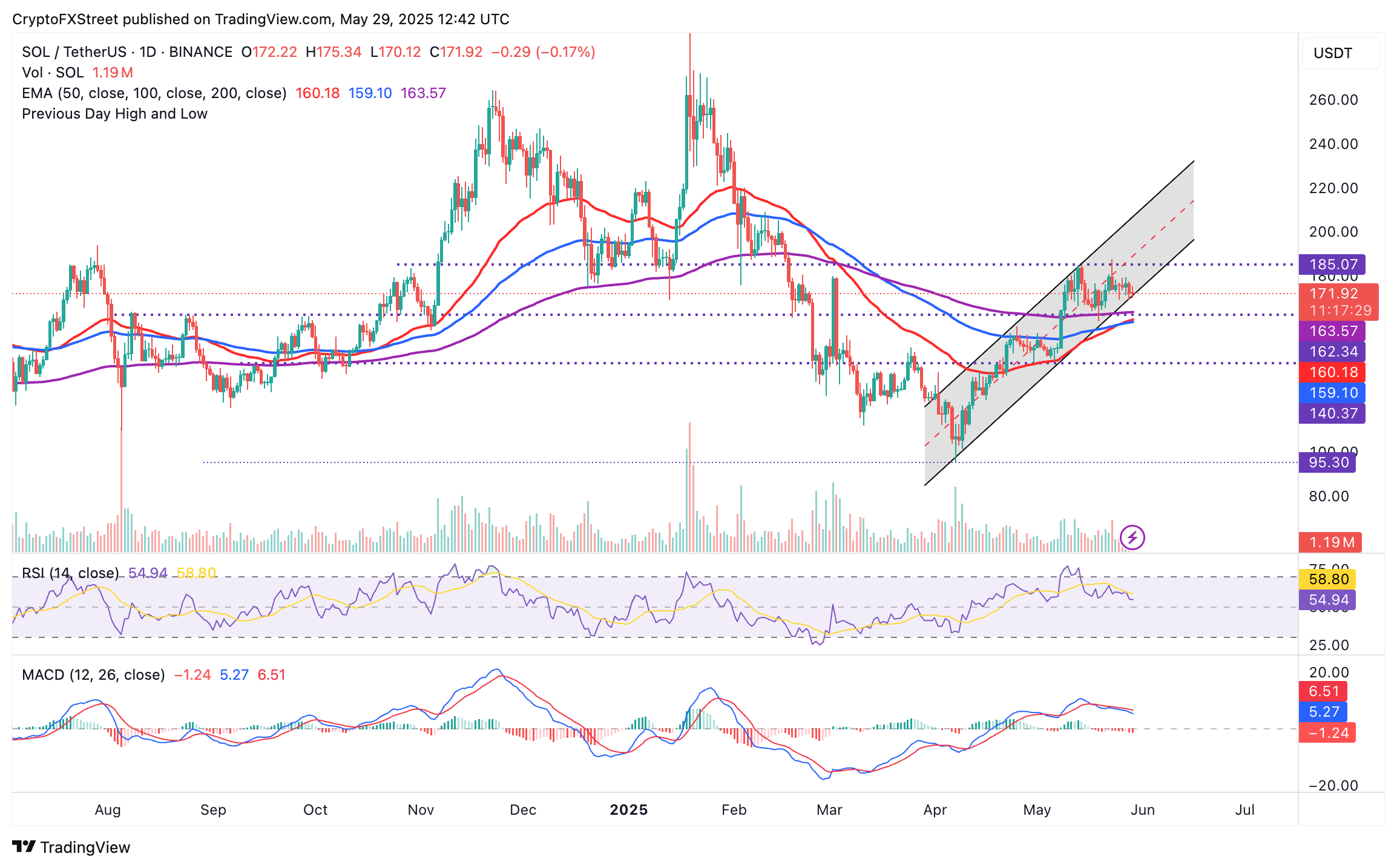
SOL/USDT daily chart

However, key indicators such as the Moving Average Convergence Divergence (MACD) and the Relative Strength Index (RSI) signal bearish momentum.

The MACD indicator confirmed a sell signal on May 18 as the blue MACD line crossed below the red signal line. This bearish bias encourages traders to sell SOL, thus contributing to sell-side pressure.

The RSI downtrend from the overbought region above 70 is approaching the 50 midline, indicating that sellers may have the upper hand in upcoming sessions, especially if the indicator falls below 50. Beyond the moving averages, key areas of interest lie at $140, a zone tested as support in early May and the April 7 low of $95.30.

Cryptocurrency prices FAQs

Token launches influence demand and adoption among market participants. Listings on crypto exchanges deepen the liquidity for an asset and add new participants to an asset’s network. This is typically bullish for a digital asset.

A hack is an event in which an attacker captures a large volume of the asset from a DeFi bridge or hot wallet of an exchange or any other crypto platform via exploits, bugs or other methods. The exploiter then transfers these tokens out of the exchange platforms to ultimately sell or swap the assets for other cryptocurrencies or stablecoins. Such events often involve an en masse panic triggering a sell-off in the affected assets.

Macroeconomic events like the US Federal Reserve’s decision on interest rates influence crypto assets mainly through the direct impact they have on the US Dollar. An increase in interest rate typically negatively influences Bitcoin and altcoin prices, and vice versa. If the US Dollar index declines, risk assets and associated leverage for trading gets cheaper, in turn driving crypto prices higher.

Halvings are typically considered bullish events as they slash the block reward in half for miners, constricting the supply of the asset. At consistent demand if the supply reduces, the asset’s price climbs.

Disclaimer: For information purposes only. Past performance is not indicative of future results.
placeholder
Bitcoin To Anchor America Party—’Fiat Is Hopeless,’ Says Elon MuskMusk Pitches Bitcoin As Pillar Of America Party
Author  Bitcoinist
Jul 07, 2025
Musk Pitches Bitcoin As Pillar Of America Party
placeholder
Bitcoin briefly loses 2025 gains as crypto plunges over the weekend.Bitcoin experienced a sharp decline this weekend, briefly erasing its 2025 gains and dipping below its year-opening value of $93,507. The cryptocurrency fell to a low of $93,029 on Sunday, representing a 25% drop from its all-time high in October. Although it has rebounded slightly to around $94,209, the pressures on the market remain significant. The downturn occurred despite the reopening of the U.S. government on Thursday, which many had hoped would provide essential support for crypto markets. This year initially appeared promising for cryptocurrencies, particularly after the inauguration of President Donald Trump, who has established the most pro-crypto administration thus far. However, ongoing political tensions—including Trump's tariff strategies and the recent government shutdown, lasting a historic 43 days—have contributed to several rapid price pullbacks for Bitcoin throughout the year. Market dynamics are also being influenced by Bitcoin whales—investors holding large amounts of Bitcoin—who have been offloading portions of their assets, consequently stalling price rallies even as positive regulatory developments emerge. Despite these sell-offs, analysts from Glassnode argue that this behavior aligns with typical patterns seen among long-term investors during the concluding stages of bull markets, suggesting it is not indicative of a mass exodus. Notably, Bitcoin is not alone in its struggles, as Ethereum and Solana have also recorded declines of 7.95% and 28.3%, respectively, since the start of the year, while numerous altcoins have faced even steeper losses. Looking ahead, questions linger regarding the viability of the four-year cycle thesis, particularly given the increasing institutional support and regulatory frameworks now in place in the crypto landscape. Matt Hougan, chief investment officer at Bitwise, remains optimistic, suggesting a potential Bitcoin resurgence in 2026 driven by the “debasement trade” thesis and a broader trend toward increased adoption of stablecoins, tokenization, and decentralized finance. Hougan emphasized the soundness of the underlying fundamentals, pointing to a positive outlook for the sector in the longer term.
Author  Mitrade
Nov 17, 2025
Bitcoin experienced a sharp decline this weekend, briefly erasing its 2025 gains and dipping below its year-opening value of $93,507. The cryptocurrency fell to a low of $93,029 on Sunday, representing a 25% drop from its all-time high in October. Although it has rebounded slightly to around $94,209, the pressures on the market remain significant. The downturn occurred despite the reopening of the U.S. government on Thursday, which many had hoped would provide essential support for crypto markets. This year initially appeared promising for cryptocurrencies, particularly after the inauguration of President Donald Trump, who has established the most pro-crypto administration thus far. However, ongoing political tensions—including Trump's tariff strategies and the recent government shutdown, lasting a historic 43 days—have contributed to several rapid price pullbacks for Bitcoin throughout the year. Market dynamics are also being influenced by Bitcoin whales—investors holding large amounts of Bitcoin—who have been offloading portions of their assets, consequently stalling price rallies even as positive regulatory developments emerge. Despite these sell-offs, analysts from Glassnode argue that this behavior aligns with typical patterns seen among long-term investors during the concluding stages of bull markets, suggesting it is not indicative of a mass exodus. Notably, Bitcoin is not alone in its struggles, as Ethereum and Solana have also recorded declines of 7.95% and 28.3%, respectively, since the start of the year, while numerous altcoins have faced even steeper losses. Looking ahead, questions linger regarding the viability of the four-year cycle thesis, particularly given the increasing institutional support and regulatory frameworks now in place in the crypto landscape. Matt Hougan, chief investment officer at Bitwise, remains optimistic, suggesting a potential Bitcoin resurgence in 2026 driven by the “debasement trade” thesis and a broader trend toward increased adoption of stablecoins, tokenization, and decentralized finance. Hougan emphasized the soundness of the underlying fundamentals, pointing to a positive outlook for the sector in the longer term.
placeholder
Gold rises on softer US Dollar, traders await Trump's address on Iran warGold price (XAU/USD) extends the rally to near $4,775 during the early Asian session on Thursday. The precious metal surges amid a weakening US Dollar (USD) and cooling geopolitical tensions in the Middle East.
Author  FXStreet
Yesterday 01: 20
Gold price (XAU/USD) extends the rally to near $4,775 during the early Asian session on Thursday. The precious metal surges amid a weakening US Dollar (USD) and cooling geopolitical tensions in the Middle East.
placeholder
Silver Price Forecast: XAG/USD falls to near $72.00 amid fading safe-haven demandSilver price (XAG/USD) continues to lose ground after registering tiny losses in the previous day, trading around $72.90 during the Asian hours on Thursday. The safe-haven demand for the precious metal fades amid rising optimism over Middle East peace.
Author  FXStreet
Yesterday 08: 19
Silver price (XAG/USD) continues to lose ground after registering tiny losses in the previous day, trading around $72.90 during the Asian hours on Thursday. The safe-haven demand for the precious metal fades amid rising optimism over Middle East peace.
placeholder
Gold retreats sharply from two-week top/$4,800 as Trump’s Iran comments boost USDGold (XAU/USD) witnessed an intraday turnaround from the $4,800 mark, or a fresh two-week high set earlier this Thursday, and for now, seems to have snapped a four-day winning streak amid resurgent US Dollar (USD) demand.
Author  FXStreet
Yesterday 07: 03
Gold (XAU/USD) witnessed an intraday turnaround from the $4,800 mark, or a fresh two-week high set earlier this Thursday, and for now, seems to have snapped a four-day winning streak amid resurgent US Dollar (USD) demand.
Related Instrument
goTop
quote