


What Are the Effects of Interest Rate Cuts? How Do Fed Rate Cuts Shake the Crypto Market?
Introduction
The U.S. is currently embroiled in a trade war, fuelling economic uncertainty and sparking heightened market volatility. These tensions have amplified investor risk aversion and raised expectations that the Federal Reserve (Fed) may cut interest rates.
While the Fed’s policy moves traditionally ripple through equity and bond markets, their influence increasingly extends to the cryptocurrency space. As digital assets become more integrated into the broader financial system, understanding how interest rate decisions affect crypto markets has become essential for investors.
This article examines what interest rate cuts entail, how they shape market dynamics, their specific impact on cryptocurrencies, and strategies to adopt in response to these changes.
What Is an Interest Rate Cut? What Are Its Effects?
An interest rate cut occurs when a central bank lowers its benchmark interest rate. For example, if the current rate is 4.25% and the bank announces a cut of 25 basis points, the new rate becomes 4%. It's important to understand that central banks do not reduce rates arbitrarily. Such decisions are typically made in response to economic challenges.
Rate cuts are often implemented when economic growth slows, unemployment rises, or consumer spending declines. But how exactly does a lower interest rate help address these issues? And what are the broader effects of such a move?
Roles and Specific Effects:
- Stimulate Consumption and Investment: Lower borrowing costs encourage businesses and individuals to take loans for spending and investment, enhancing economic activity.
- Reduce Unemployment Rates: Increased business investment and consumer spending lead to more hiring, which lowers unemployment.
- Influence International Capital Flows: Rate cuts may devalue the domestic currency, attracting foreign investment.
- Trigger Risk Asset Pursuit: In a low-interest environment, investors may favor higher-risk assets, driving up their prices.
- Support Economic Recovery: During economic downturns, rate cuts serve as an effective stimulus tool to facilitate a swift recovery.
How Do Fed Rate Cuts Impact the Crypto Market?
The Fed's decisions are closely monitored, more so than those of other central banks, because the U.S.is the world’s largest economy. Interest rate cuts by the Fed often have a positive impact on the cryptocurrency market, as outlined below:
Impact Channel | Mechanism | Effect on Crypto |
Market liquidity | More USD liquidity enters risk assets. | BTC, ETH, XRP rally. |
Dollar Index (DXY) | DXY typically falls. | Dollar-denominated crypto prices rise. |
Leverage costs | Lower borrowing rates boost mining/trading. | Increased futures open interest. |
Institutional demand | Bonds lose appeal; crypto ETFs see inflows. | More capital into BTC/ETH. |
Regulatory shifts | Loose policy may ease crypto crackdowns. | Faster adoption (e.g., spot ETF approvals). |
How Do Cryptocurrencies Perform During Rate Cut Cycles?
The Fed's rate-cutting cycles generally have a positive impact on the cryptocurrency market, often leading to price increases, rising capital inflows, and improved investor sentiment.
Rate Cut Phase | Policy Changes | Market Characteristics | BTC Performance | ETH Performance |
2015-2018 | Fed pauses rate hikes | 1. Institutions start paying attention 2. ICO boom | +1,200% (200→2,600) | +3,400% (0.9→3) |
2019-2020 | 3 cuts totaling 75bps | 1. Rise of DeFi 2. Futures market launches | +366% (3,000→14,000) | +480% (130→750) |
2020-2021 | Emergency cuts to 0% + QE | 1. Major institutional entry 2. NFT explosion | +1,700% (3,800→69,000) | +1,900% (100→2,000) |
2023-2024 | Anticipated cuts | 1. Spot ETF approval 2. RWA narrative rises | +80% (25K→45K) | +60% (1,500→2,400) |
Although cryptocurrencies often trend upward during rate cut cycles, this is not always the case. For instance, in March 2020, Bitcoin dropped by 50% due to a liquidity trap at the onset of rate-cutting cycle. Additionally, as shown in the table, these cycles coincide with Bitcoin halving events—suggesting that not all price increases can be attributed solely to interest rate cuts.
Future Fed Policy Outlook and Crypto Market Predictions
The latest dot plot from the Fed indicates that it expects the benchmark interest rate to decline to 3.9% by 2025, implying a 50 basis point cut. Rates are projected to fall further to 3.4% in 2026 and 3.1% in 2027. While the timing and scale of these cuts may shift—particularly in response to trade policies—the overall trajectory remains downward, a trend generally seen as favourable for the cryptocurrency market.
In January 2025, Donald Trump officially assumed the presidency of the United States. Bitcoin initially surge on the news but soon pulled back, declining steadily from a peak of around $109,000. On April 2, Trump launched a global tariff war, sparking a fresh wave of sell-offs that drove Bitcoin down to a low of approximately $75,000.
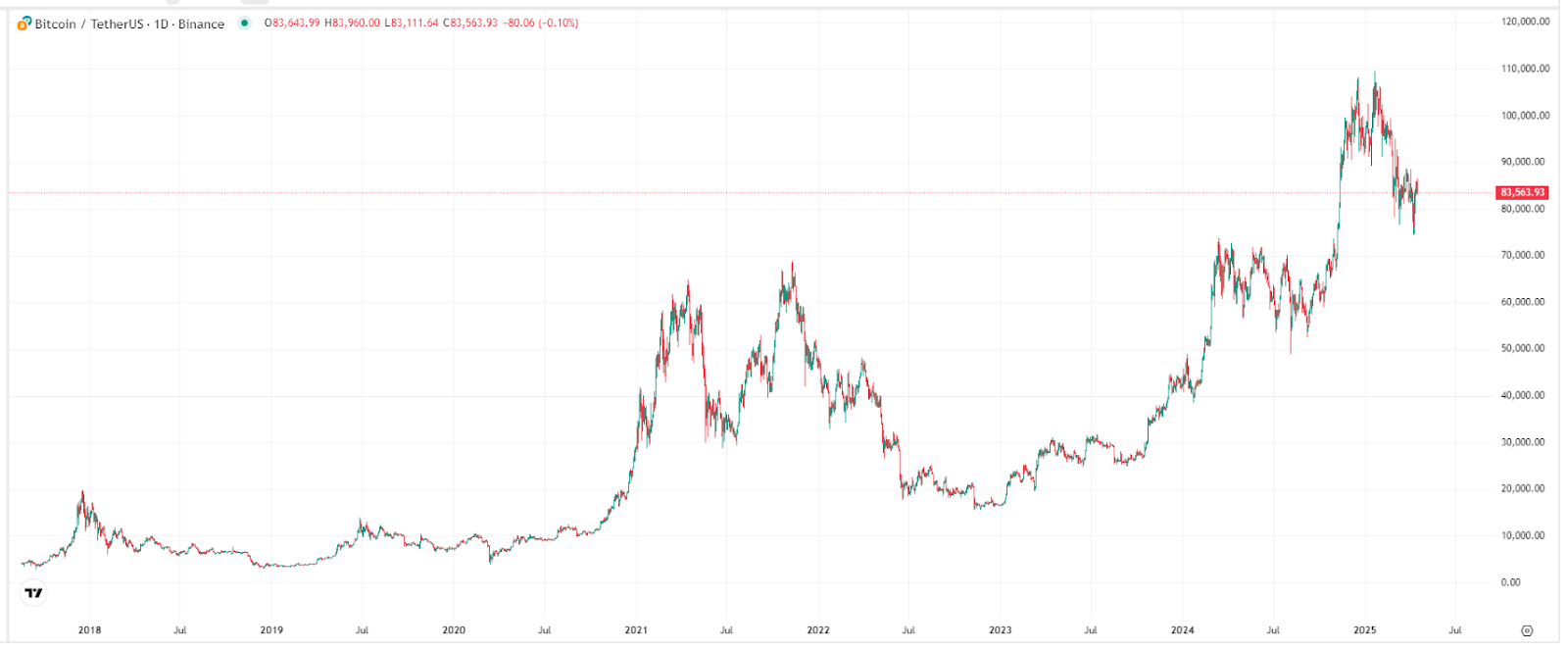
Bitcoin Price Trend Chart, Source: TradingView.
Since its peak, Bitcoin has fallen by 30%, currently trading around $83,000. As of this writing, the Fed has not provided a clear timeline for interest rate cuts, though markets widely anticipate reductions to begin in the second half of the year. Bitcoin is expected to rebound toward previous highs by the end of 2025, with potential for new records levels in 2026, before entering a bear market in 2027.
Geoff Kendrick, Global Head of Digital Asset Research at Standard Chartered, projects a bullish outlook for Bitcoin. He believes the cryptocurrency could surpass its previous highs by the end of 2025, reaching $250,000; rise to $300,000 by the end of 2026; exceed $400,000 by the end of 2027; and hit $500,000 in 2028.
How to Respond to Market Changes from Rate Cuts?
Investors can adopt strategic approaches to navigate potential volatility and opportunities arising from interest rate cuts. It's essential to assess personal risk tolerance, avoid excessive leverage, and remain patient throughout the cycle.
Assess Risk Tolerance
In a low-rate environment, liquidity tends to flow more freely into market, including crypto. Investors should evaluate whether increasing their exposure to crypto assets aligns with their individual risk appetite.
Dynamic Diversification
Investors should consider holding various crypto assets to spread risk. Different cryptocurrencies can perform differently under various market conditions. Ahead of rate cuts, consider gradually accumulating core assets such as BTC, ETH, and stablecoins. Followingthe cuts, investors might increase their exposure to high-beta altcoins. As the rate-cut cycle nears its end, it is prudent to begin taking profits and shifting allocations back into stablecoins to preserve gains.
Focus on Decentralized Finance
Lower interest rates may also stimulate activity in DeFi markets, including lending protocols and yield farming. Investors could explore opportunities in liquidity mining and DeFi applications to generate higher returns during these periods.
Long-Term Perspective
While rate cuts often support rising crypto prices, the exact timing remains uncertain. Patience is crucial. Historically, rate-cutting cycles have lasted one to two years, meaning long-term holding may be necessary to capture meaningful gains . Avoid reacting impulsively to short-term volatility, which can lead to buying at peaks and selling during downturns.
Reduce Leverage Risk
Rate cuts are major market events that can heighten volatility. Investors should use leverage cautiously to prevent significant losses from sudden price swings.
Conclusion
The Fed's decision to cut interest rates can serve as a powerful catalyst for the crypto market—but it also brings risks. Investors must understand the broader economic rationale behind rate adjustments and remain flexible in adapting their strategies. By avoiding blind overconfidence, they can better navigate the complex crypto market.
Recommended Articles


