

Trump’s win boosts El Salvador’s Bitcoin holdings, but hurts president Nayib Bukele’s economic plans

Source Cryptopolitan

President Donald Trump’s victory handed El Salvador’s Bitcoin experiment its first major win. With Bitcoin surging to an all-time high of $100,000, the government’s crypto stash is now worth over $620 million as of press time.

This was a striking reversal of fortune for President Nayib Bukele, who made Bitcoin legal tender in 2021 and faced relentless criticism for it. however, while he’s flexing his profits on X, El Salvador’s economy is facing a grim reckoning.

Trump’s immigration policies could send tens of thousands of Salvadorans back home, threatening remittance flows and straining an already struggling job market. Nayib’s administration is walking a tightrope, balancing the benefits of Bitcoin with the economic realities on the ground.

Screenshot of El Salvdor's Bitcoin holdings
Screenshot of El Salvdor’s Bitcoin holdings. Source: Arkham Intelligence

Nayib has many wins under his belt. For instance, the gangs that preyed on farmers, extorting money or looting supplies, have either been jailed, killed, or fled under his iron-fisted security crackdown. Yet, despite the newfound peace, the economic boom locals hoped for is nowhere to be found.

“We’re not really seeing the peace dividend in terms of a rebound in economic activity,” Mauricio Choussy, a former central bank president, reportedly said. The harsh truth is that even with security improvements, El Salvador’s economy remains one of the weakest in the region.

Bitcoin’s rise amid economic stagnation

El Salvador’s Bitcoin gamble seemed absurd to many when it was launched. Nayib poured millions into buying Bitcoin, built a $200 million trust fund to stabilize its value, and incentivized businesses to accept it. Critics at home and abroad criticized the move, saying it was reckless and would bankrupt the country.

But Trump’s pro-crypto stance and the appointment of a crypto-friendly U.S. securities regulator have turbocharged the market. Bitcoin’s record-breaking rally has been a lifeline for Nayib, whose Bitcoin reserves are now one of the government’s few success stories.

A comparison of El Salvador's economy with Honduras, Guatemala,, and Nicaragua
A comparison of El Salvador’s economy with Honduras, Guatemala, and Nicaragua. Source: IMF

Yet, since he took office in 2019, El Salvador’s GDP growth has lagged behind neighbors, Guatemala and Nicaragua. Honduras, a long-time economic underperformer, surpassed El Salvador’s GDP last year for the first time in more than 30 years.

“The economy is this government’s Achilles’ heel,” said Choussy.

An estimated 750,000 Salvadorans live undocumented in the U.S., and their remittances account for over 20% of El Salvador’s GDP. If Trump follows through on his promises to deport undocumented immigrants, the effects back home would be catastrophic.

Nayib’s economic team is already bracing for impact. An IMF deal worth $1.4 billion, currently in the works, will likely require public-sector layoffs, potentially leaving returning deportees to compete for scarce jobs.

El Salvador’s security facing threats?

Nayib’s iron grip on security has undeniably transformed El Salvador. The country, once dubbed the murder capital of the world, now boasts a homicide rate of just 1.9 per 100,000 people—lower than Canada’s. This has actually brought some wins to the economy.

The IMF said El Salvador’s economy will grow by 3% in 2024. That’s better than the 2% average for Latin America and the Caribbean. The Central Reserve Bank (BCR) agrees and expects growth between 3% and 3.5%. In 2023, the economy grew 3.5%, thanks to public investment, private spending, and stronger exports.
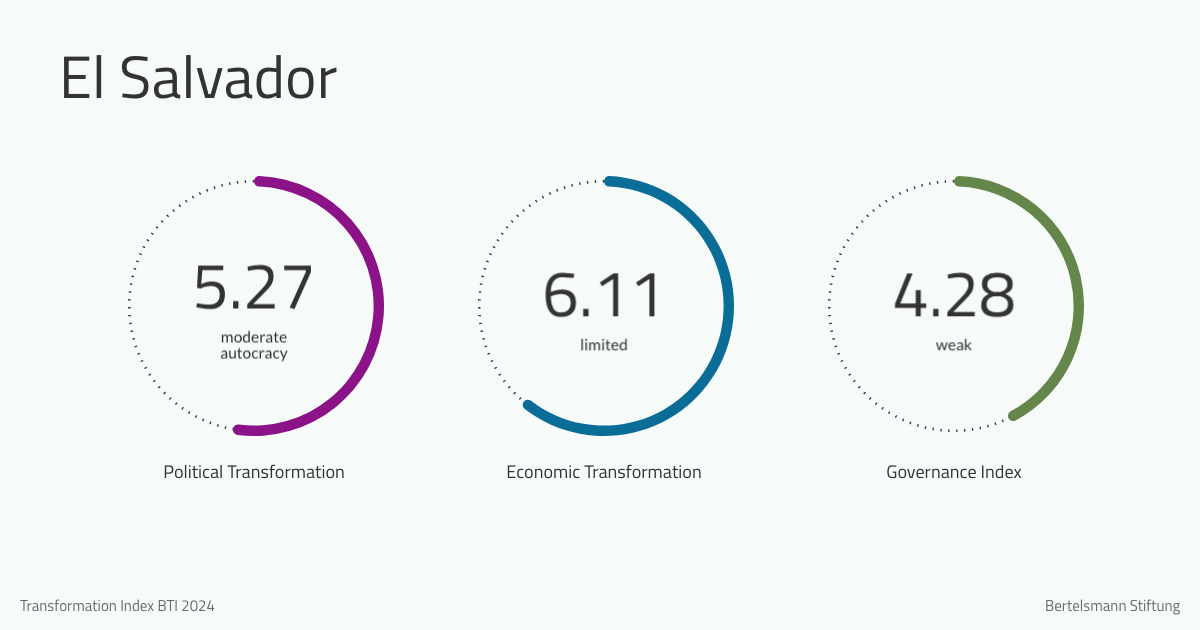
bti-project.org

But his successes mask deep structural problems. In rural areas, roads are unpaved, illiteracy is rampant, and access to credit is almost non-existent. Tropical Storm Sara destroyed much of the coffee harvest in Tepecoyo, forcing farmers to sell at generic prices instead of the premium rates usually fetched by Salvadoran coffee.

The housing market boom, fueled by Salvadorans returning from the U.S., has brought some relief. A four-bedroom apartment with an ocean view costs $385,000—affordable for Salvadorans who built wealth abroad but unattainable for locals.

Construction companies call it the biggest housing boom since the civil war ended in 1992. However, while housing thrives, other industries struggle. The textile and apparel sector, El Salvador’s largest export industry, faces fierce competition from Asia, leaving factories empty and workers jobless.

Land a High-Paying Web3 Job in 90 Days: The Ultimate Roadmap

Disclaimer: For information purposes only. Past performance is not indicative of future results.
placeholder
Bitcoin CME gaps at $35,000, $27,000 and $21,000, which one gets filled first?Prioritize filling the $27,000 gap and even try higher.
Author  FXStreet
Aug 22, 2023
Prioritize filling the $27,000 gap and even try higher.
placeholder
Pinduoduo Earnings Incoming: Morgan Stanley Sees Long-Term Profit Potential​Insights – On November 21, Chinese e-commerce giant Pinduoduo (PDD) will release its Q3 2024 earnings.
Author  Mitrade
Nov 20, 2024
​Insights – On November 21, Chinese e-commerce giant Pinduoduo (PDD) will release its Q3 2024 earnings.
placeholder
Elon Musk’s xAI and Neuralink Launch New Funding Rounds​Billionaire Elon Musk recently raised funds for his two high-profile tech companies, xAI and Neuralink.
Author  Insights
Jun 03, 2025
​Billionaire Elon Musk recently raised funds for his two high-profile tech companies, xAI and Neuralink.
placeholder
Bitcoin briefly loses 2025 gains as crypto plunges over the weekend.Bitcoin experienced a sharp decline this weekend, briefly erasing its 2025 gains and dipping below its year-opening value of $93,507. The cryptocurrency fell to a low of $93,029 on Sunday, representing a 25% drop from its all-time high in October. Although it has rebounded slightly to around $94,209, the pressures on the market remain significant. The downturn occurred despite the reopening of the U.S. government on Thursday, which many had hoped would provide essential support for crypto markets. This year initially appeared promising for cryptocurrencies, particularly after the inauguration of President Donald Trump, who has established the most pro-crypto administration thus far. However, ongoing political tensions—including Trump's tariff strategies and the recent government shutdown, lasting a historic 43 days—have contributed to several rapid price pullbacks for Bitcoin throughout the year. Market dynamics are also being influenced by Bitcoin whales—investors holding large amounts of Bitcoin—who have been offloading portions of their assets, consequently stalling price rallies even as positive regulatory developments emerge. Despite these sell-offs, analysts from Glassnode argue that this behavior aligns with typical patterns seen among long-term investors during the concluding stages of bull markets, suggesting it is not indicative of a mass exodus. Notably, Bitcoin is not alone in its struggles, as Ethereum and Solana have also recorded declines of 7.95% and 28.3%, respectively, since the start of the year, while numerous altcoins have faced even steeper losses. Looking ahead, questions linger regarding the viability of the four-year cycle thesis, particularly given the increasing institutional support and regulatory frameworks now in place in the crypto landscape. Matt Hougan, chief investment officer at Bitwise, remains optimistic, suggesting a potential Bitcoin resurgence in 2026 driven by the “debasement trade” thesis and a broader trend toward increased adoption of stablecoins, tokenization, and decentralized finance. Hougan emphasized the soundness of the underlying fundamentals, pointing to a positive outlook for the sector in the longer term.
Author  Mitrade
Nov 17, 2025
Bitcoin experienced a sharp decline this weekend, briefly erasing its 2025 gains and dipping below its year-opening value of $93,507. The cryptocurrency fell to a low of $93,029 on Sunday, representing a 25% drop from its all-time high in October. Although it has rebounded slightly to around $94,209, the pressures on the market remain significant. The downturn occurred despite the reopening of the U.S. government on Thursday, which many had hoped would provide essential support for crypto markets. This year initially appeared promising for cryptocurrencies, particularly after the inauguration of President Donald Trump, who has established the most pro-crypto administration thus far. However, ongoing political tensions—including Trump's tariff strategies and the recent government shutdown, lasting a historic 43 days—have contributed to several rapid price pullbacks for Bitcoin throughout the year. Market dynamics are also being influenced by Bitcoin whales—investors holding large amounts of Bitcoin—who have been offloading portions of their assets, consequently stalling price rallies even as positive regulatory developments emerge. Despite these sell-offs, analysts from Glassnode argue that this behavior aligns with typical patterns seen among long-term investors during the concluding stages of bull markets, suggesting it is not indicative of a mass exodus. Notably, Bitcoin is not alone in its struggles, as Ethereum and Solana have also recorded declines of 7.95% and 28.3%, respectively, since the start of the year, while numerous altcoins have faced even steeper losses. Looking ahead, questions linger regarding the viability of the four-year cycle thesis, particularly given the increasing institutional support and regulatory frameworks now in place in the crypto landscape. Matt Hougan, chief investment officer at Bitwise, remains optimistic, suggesting a potential Bitcoin resurgence in 2026 driven by the “debasement trade” thesis and a broader trend toward increased adoption of stablecoins, tokenization, and decentralized finance. Hougan emphasized the soundness of the underlying fundamentals, pointing to a positive outlook for the sector in the longer term.
placeholder
WTI holds steady above $92.00 as Strait of Hormuz remains closed; bulls seem hesitant West Texas Intermediate (WTI) – the benchmark US Crude Oil price – trades with a mild positive bias during the Asian session on Friday, though it lacks bullish conviction amid hopes of Iran ceasefire stabilizing.
Author  FXStreet
Apr 10, Fri
West Texas Intermediate (WTI) – the benchmark US Crude Oil price – trades with a mild positive bias during the Asian session on Friday, though it lacks bullish conviction amid hopes of Iran ceasefire stabilizing.
goTop
quote