


Bitcoin Reserves Just Found a New Use on Wall Street, but There’s a Catch
- CFTC staff guidance issued on November 23 says swap execution facilities, designated contract markets and clearinghouses may count Bitcoin, Ether and qualifying payment stablecoins toward certain financial resource requirements.
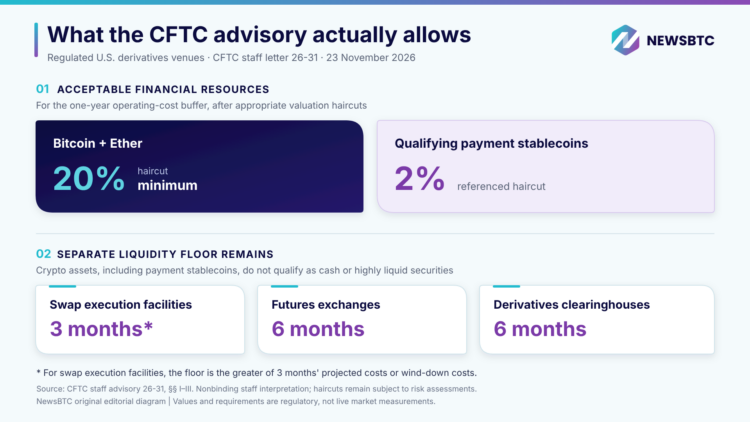
- The advisory references a minimum 20% haircut for Bitcoin and Ethereum, so a $10 million Bitcoin reserve would count as $8 million, and 2% for qualifying payment stablecoins.
- Crypto cannot be used to meet the separate cash and liquid-resources requirement, which covers three months for swap execution facilities and generally six months for the other two types of venue.
- It is a staff advisory, not a binding rule, and nothing in it requires institutions to buy Bitcoin.
Bitcoin reserves have found another potential use within the US financial system. The Commodity Futures Trading Commission (CFTC) has clarified that regulated derivatives exchanges and clearinghouses can count Bitcoin, Ethereum and qualifying payment stablecoins toward certain financial resource requirements. However, the regulator is not prepared to treat those holdings like cash.
The guidance, issued on November 23, could give regulated trading venues greater flexibility in managing their balance sheets. For Bitcoin investors, however, the more interesting question is whether that flexibility will translate into fresh institutional demand.
The answer is not quite as straightforward as it might seem.
CFTC Gives Bitcoin Reserves a New Role in Financial Markets
The CFTC’s latest advisory addresses three types of regulated businesses: swap execution facilities, designated contract markets and derivatives clearing organizations.
These institutions are required to maintain sufficient financial resources to cover at least one year of operating costs. Under the new staff guidance, Bitcoin, Ether and qualifying payment stablecoins may contribute toward those requirements, subject to appropriate valuation discounts.
The announcement follows broader efforts to integrate digital assets into regulated financial infrastructure. NewsBTC previously reported on the CFTC’s guidance concerning tokenized collateral at clearinghouses, another area where traditional financial markets are gradually accommodating blockchain-based assets.
This time, the discussion is not about what traders can post as collateral. It is about the assets that the institutions running those markets can rely on to keep their businesses operating.
For a company that already holds Bitcoin, the clarification could make those holdings more useful from a regulatory standpoint. For businesses considering adding cryptocurrency to their balance sheets, it removes some uncertainty surrounding how those assets would be recognized.
But that recognition comes at a discount!
A $10 Million Bitcoin Reserve Is Worth $8 Million on Paper
The CFTC advisory references a minimum 20% valuation haircut for Bitcoin and Ethereum, consistent with earlier staff treatment of proprietary cryptocurrency positions held by futures commission merchants.
Qualifying payment stablecoins receive considerably more favorable treatment, with a referenced haircut of 2%.
An exchange holding $10 million in Bitcoin, for example, would be able to count $8 million toward the relevant financial resource requirement if it applied a 20% haircut and no further deductions were necessary.
The remaining $2 million is not a realized loss. It is a regulatory adjustment intended to account for the risk associated with holding a volatile asset.
Crypto assets that are neither readily marketable nor qualifying payment stablecoins would generally face a 100% haircut, effectively excluding them from the calculation.
Perhaps the most revealing part of the advisory is the regulator’s warning about what it calls wrong-way risk.
The CFTC staff specifically states:
“A DCM should consider potential wrong-way risk
CFTC staff · November 23 advisory
For a cryptocurrency-focused exchange, that risk is particularly relevant. A prolonged Bitcoin sell-off could put pressure on trading revenues while simultaneously reducing the value of the assets the exchange relies on to support its operations.
The problem is not simply that Bitcoin is volatile. It is that its value could deteriorate at precisely the moment a crypto business finds itself under financial pressure.
A 20% valuation discount provides some protection against that scenario, but it is hardly a guarantee.
The CFTC Is Still Drawing a Line Between Bitcoin and Cash
Despite allowing digital assets to contribute toward broader operating resources, the CFTC has maintained a separate requirement for cash and highly liquid securities.
Bitcoin, Ethereum and even qualifying payment stablecoins cannot be used to satisfy that particular obligation under the advisory.
Swap execution facilities must maintain qualifying liquid resources sufficient to cover at least three months of projected operating expenses or the cost of winding down their operations, whichever is greater.
For designated contract markets and derivatives clearing organizations, the operating-cost liquidity requirement generally covers at least six months.
The distinction matters because an institution can have substantial assets on its balance sheet without necessarily having the cash available to meet immediate obligations.
It is also worth noting that the guidance does not address whether cryptocurrencies can satisfy the separate financial resources that clearinghouses must maintain to cover clearing-member defaults.
In effect, the CFTC is recognizing Bitcoin as an asset that can contribute to an institution’s financial strength without giving it the same regulatory standing as cash.
That is a more cautious approach than some Bitcoin advocates might have hoped for, but arguably a more sustainable one for integrating cryptocurrency into financial infrastructure.
Could the Decision Trigger More Institutional Bitcoin Buying?
The bullish interpretation is relatively simple. If regulated financial institutions can derive greater utility from holding Bitcoin, more of them may eventually consider allocating capital to the cryptocurrency.
There is some merit to that argument.
The expansion of regulated crypto infrastructure has already brought digital assets closer to traditional financial markets. Earlier, NewsBTC reported on Coinbase’s CFTC registration for its USDC-focused derivatives clearinghouse, illustrating how cryptocurrency businesses are increasingly operating within established regulatory frameworks.
The latest advisory gives relevant institutions another reason to evaluate how digital assets fit into their balance sheets.
Still, there is a considerable difference between allowing an institution to hold Bitcoin for regulatory purposes and giving it an economic incentive to buy more.
An exchange that already owns Bitcoin could benefit from the clarification without purchasing a single additional coin. Another might conclude that holding conventional securities remains more efficient, particularly given the valuation discounts and separate liquidity requirements.
Nothing in the advisory requires institutions to acquire Bitcoin, and no purchase commitments were disclosed alongside the announcement.
Investors should therefore resist the temptation to translate this development directly into a bullish price forecast.
The longer-term significance may be greater than the immediate market impact. Every additional recognized use for Bitcoin within regulated financial markets strengthens the case for its utility beyond speculative trading.
However, the November 23 document remains a staff advisory rather than a binding rule adopted by the full Commission. It does not amend existing regulations or create enforceable rights.
The next meaningful development will be evidence that regulated institutions are actually changing their reserve allocations in response.
Until then, Bitcoin has gained another form of regulatory recognition. Whether it gains another source of sustained buying pressure is a different question entirely.
Recommended Articles


