


OpenAI and Anthropic bankers chase top credit ratings to open the bond market
Bankers steering OpenAI and Anthropic toward stock-market listings are pushing for both companies to secure investment-grade credit ratings soon after they go public, according to the Financial Times.
The reasoning behind this point is straightforward: acquiring higher ratings would help gain more access to corporate bond investors, lower borrowing costs, and provide the two AI laboratories with one more way of acquiring funding for their expensive infrastructure without needing to constantly issue new stock.
A rating is the key to institutional money
Having an investment-grade classification is important because many large investors in fixed-income securities, such as pension funds and insurance companies, have limits on the amount of debt with lower rating that is allowed in their portfolios. Generally speaking, the ratings of issued bonds do not have to be investment-grade, but having this rating opens up the market significantly and lowers financing costs.
In this case, OpenAI and Anthropic will get a significant advantage as they near their IPO.
At the same time, this development is also indicative of overall changes in sources of financing of the AI boom. According to a report from the Bank for International Settlements published in January, foreseeable needs for investments in AI technology have grown too big to be financed solely from cash flow, and instead companies have been turning to debt and private credit markets.
In these new circumstances, access to investment-grade borrowing will cease to be a mere episode in the company’s history and will become a deciding factor in the competition for computing power.
The buildout is turning to borrowed money
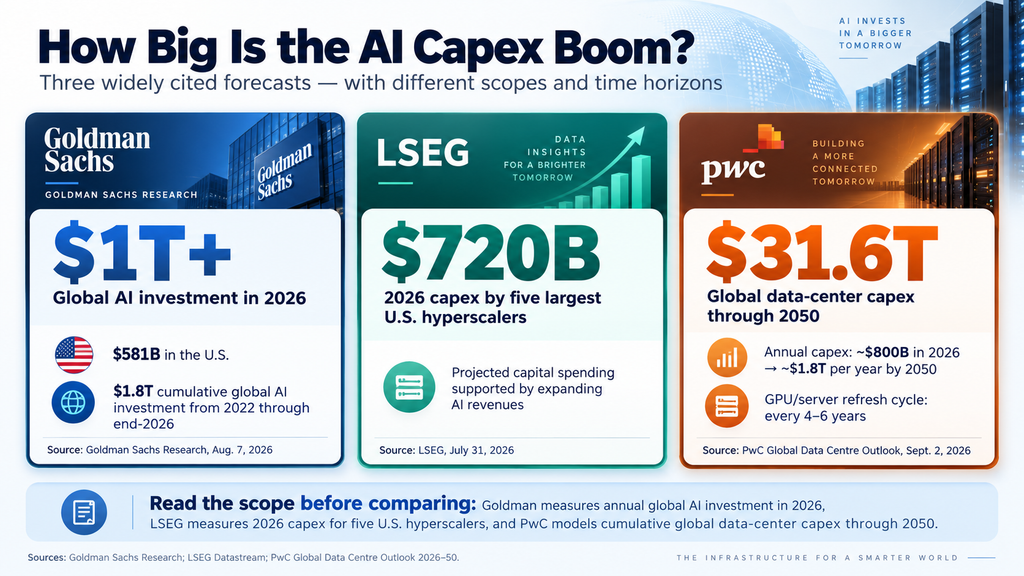
The magnitude of the AI race is quite impressive, although various forecasts look into different segments of the market.
Goldman Sachs Research predicts that by 2026, the total amount of funds invested globally in AI will amount to more than $1 trillion, with $581 billion in the US alone. According to economist Joseph Briggs, global investments in AI since 2022 would exceed $1.8 trillion by the end of 2026.
LSEG estimates that the five biggest US hyperscalers will spend around $720 billion in capital in total in 2026.
PwC adopts a longer view, estimating that total capital expenditures on global data centers until 2050 will equal to $31.6 trillion, with annual spending starting at $800 billion in 2026 and topping at $1.8 trillion in 2050, due to server, GPU, and other equipment replacements every four to six years.
This provides context for the importance of bond-market access. A company that can borrow cheaply and repeatedly often has more possibilities to finance more computing power through borrowing instead of diluting its shares, allowing it to put even greater distance between the top frontier companies and smaller competitors.
Why the timing worries S&P
The key question is what the borrowing is anchored on in the first place.
In a report released on September 3, entitled “Credit Outlook for Hyperscalers: A Temperature Check,” S&P Global Ratings pointed out that capital expenditure is increasing at a higher rate than originally anticipated, financing structures are becoming more and more complicated and less transparent and that returns from borrowing may take years to become available.
S&P estimates the six largest U.S. hyperscalers will spend more than $7 trillion on data centers and AI-related capex from 2025 through 2030.
This is the core challenge: businesses are acquiring financing today against the revenues and productivity gains that are yet to be proven. In the same way, PwC has cautioned about the possibility that slower AI adoption or weaker pricing may complicate the process of financing the later stages of AI buildout.
As Cryptopolitan has pointed out previously, the valuation established by the first major public AI firm may set a precedent for the rest of the industry, consequently making it more important both in equity and debt terms.
Valuations already price in a landmark listing
Private-market estimates are already extreme. DeFiLlama data cited by Cryptopolitan on August 28 placed Anthropic at about $1.38 trillion and OpenAI at roughly $900 billion.
Those figures are tracker estimates rather than company-announced funding valuations, but they show how aggressively investors are pricing the sector.
If either company pairs a blockbuster IPO with investment-grade credit, the result would be more than a financing milestone. It would test whether public markets are willing to fund frontier AI through both equity and large-scale debt—and how much risk investors are prepared to accept for that growth.
The smartest crypto minds already read our newsletter. Want in? Join them.
Recommended Articles


