


Huawei’s new chip shows China’s plan to route around the lithography gap
Huawei introduced a new smartphone chip, claiming it uses no technology from the United States, showcasing the company’s strategy to close the gap between China and the rest of the world in chip production, despite limited access to the industry’s most advanced technologies. The introduction of the Kirin 950 Pro is important not so much for its current market performance as for what it reveals about Huawei’s plans regarding companies like Nvidia, TSMC, and ASML.
A chip Huawei calls entirely its own
Huawei has installed the Kirin 9050 Pro in its Mate XT2 tri-fold smartphone priced at $2,979. According to reports, Huawei has developed the LinxiCore CPU cores, GPU, and NPU used in the Kirin 9050 Pro, and it has achieved a performance increase of 42% over the previous year’s tri-fold phone. The launch also underlines Huawei’s drive towards creating its own technology ecosystem. HarmonyOS, Huawei’s proprietary operating system that is an alternative to Android, has appeared on 85 million devices since it was launched in October 2024.
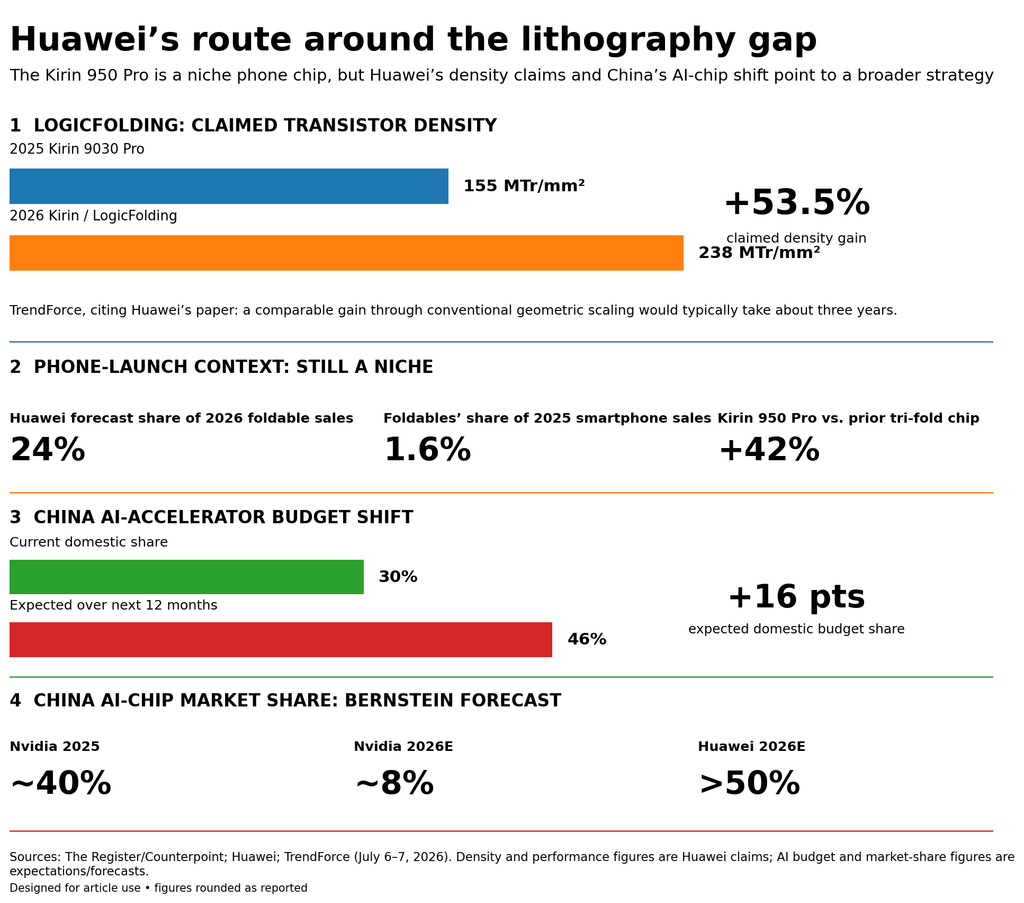
The smartphone is still a niche product, as per reports from Counterpoint that predict Huawei will own 24% of the foldable phones market by 2026, while foldable handhelds made up only 1.6% of the smartphone market share last year. That makes the launch more important as a technology showcase than as a volume threat.
Time instead of smaller transistors
On May 25, Huawei unveiled its Tau Scaling Law at the IEEE ISCAS event in Shanghai. As opposed to focusing mainly on the miniaturization of transistors, the new technology is based on minimizing the signal propagation time between devices, circuits, chips, and systems. Huawei’s announcement reveals that LogicFolding is the circuit-level implementation of the technology involving active stacked layers and the use of shorter connecting wires.
According to TrendForce, referring to Huawei’s updated article, the transistor density has increased from 155 million to 238 million transistors per square millimeter, which equals an increase of 53.5%. The results from traditional geometric scaling would require approximately three years of development, according to Huawei. The company claims that 381 chips were developed and mass-produced using the Tau principles for over six years.
“I can confidently say in the coming 10 years our solutions for mobile computing and AI computing will be competitive,” He Tingbo said.
Betting around ASML’s machines
Huawei’s 2031 target is not a promise to fabricate a true 1.4nm process. The company says future high-end chips could reach transistor density equivalent to a 1.4nm process. TSMC plans 1.4nm mass production in 2028, while China’s most advanced proven manufacturing capability is still widely viewed as about 7nm.
Nor has Huawei abandoned lithography. The company is reportedly investing in domestic producers for advanced DUV technology and other equipment. Therefore, architecture is just one route to filling the tool gap, not a substitute for manufacturing progress.
Why Nvidia should be watching
AI represents a larger opportunity. Huawei is set to expand its LogicFolding technology into its Ascend accelerators, with the Ascend 990 anticipated to be available in 2030. According to a survey, Chinese executives expect local brands to account for 46% of the total AI-accelerator budget in the upcoming year, an increase from 30%. According to Bernstein, Nvidia’s share in the AI chip market in China is expected to drop from around 40% in 2025 to approximately 8% in 2026, while Huawei’s share will rise to over 50%.
The transition is being promoted by policy. According to CSIS, export controls by the US and allied powers have accelerated China’s localization efforts despite limiting the reach of sophisticated technologies. Cryptopolitan has also noted that Nvidia’s H200 return to China comes as local players are gaining more market share.
The impact will also affect much more than phones. The Semiconductor Industry Association predicts that $4 trillion or more will be spent on AI data-center infrastructure before 2028, with semiconductors accounting for as much as $2.8 trillion. If more of this money is spent on Chinese chips, that could hit the global accelerator market before China is able to close its manufacturing gap completely.
The gap that architecture can’t close yet
Huawei needs to show that it’s capable of yield, heat management, cost, and volume. Its new Kirin demonstrates that good design can help overcome some of its manufacturing limitations, but it still does not prove that it can compete with TSMC’s cutting-edge process.
The key takeaway here is strategic. China is trying to use limited access to foreign tools to create demand as well as leverage capital and engineering expertise for developing its own semiconductor industry. If China succeeds in achieving this, all the foreign suppliers, including Nvidia, will experience the consequences before China can improve lithography.
The smartest crypto minds already read our newsletter. Want in? Join them.
Recommended Articles


