


Originality.ai flags 1,272 of 2,034 Amazon religious titles as machine-written
Detection firm Originality[.]ai scanned religious books on Amazon and found that about two-thirds of them were probably written by AI.
The discovery impacts millions of readers who buy faith and spirituality titles sight unseen. Cheap, machine-made books are pouring into Amazon’s store faster than the retailer can review them.
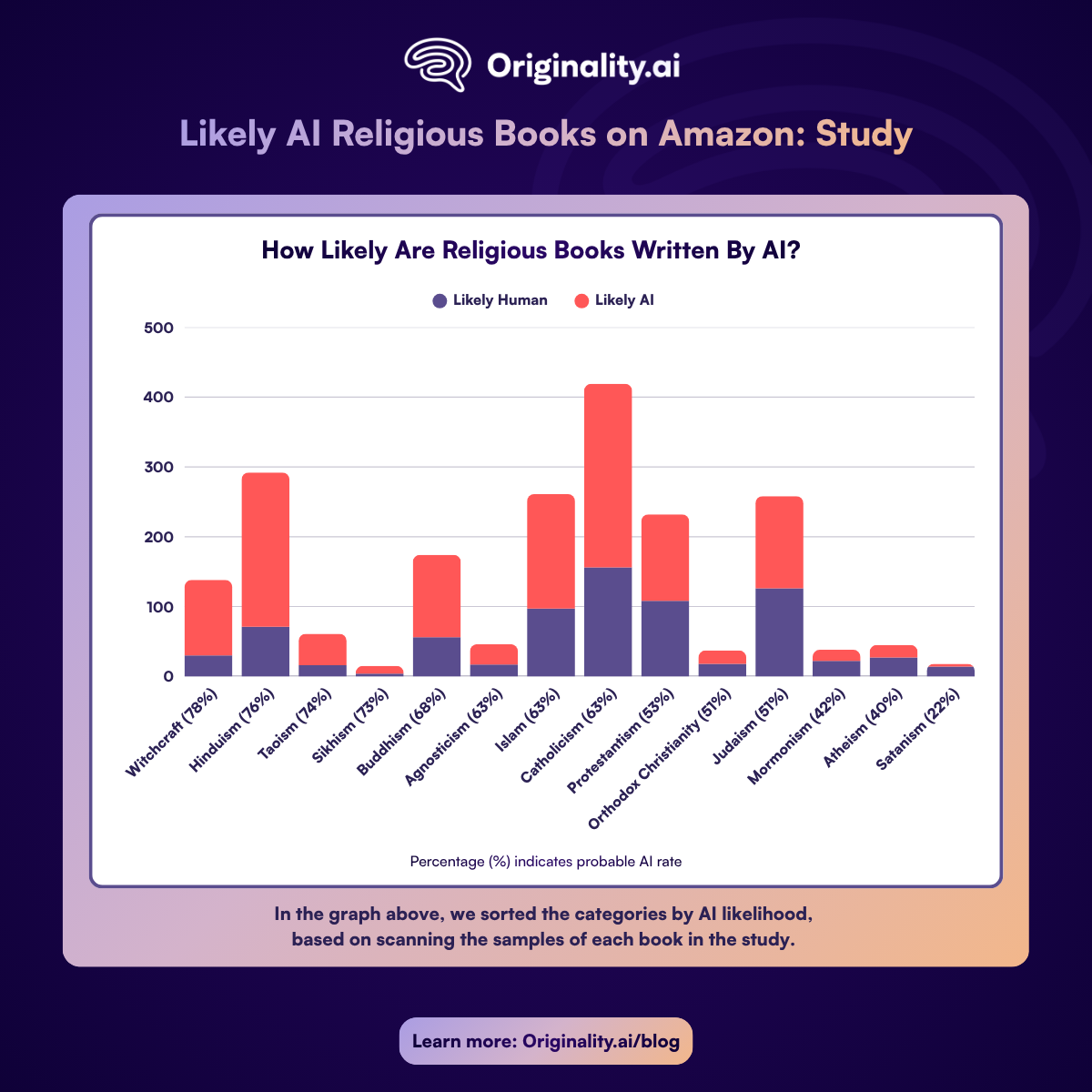
Originality.ai flagged 1,272 of 2,034 titles it scanned.
The firm found that 78% of the titles in the Wicca, Witchcraft, and Paganism category were likely written by AI, the highest share of any category.
Hinduism followed at 76% and Taoism at 74%. At the other end, Satanism was lowest at 22%. Atheism was 40%, and Mormonism was 42%.
Those three categories had far fewer titles to draw from, so their percentages are based on thinner samples. The report’s author, Michael Fraiman, noted that authors pumping out AI books chase the busiest categories, which may explain why the small subgenres show less of it.
Witchcraft relied on crystals, herbal remedies, and cleansing “negative energies,” the kind of stuff that sells without having to clear any scientific bar.
“One can picture the ideal customer as someone looking for solutions to heal themselves, improve their mental health, or ‘detox’ from commonplace chemicals and drugs,” said Fraiman.
Originality.ai analyzed 2,034 English-language paperbacks across 14 categories of faith and belief. Each had an average four-star rating or better.
Most were published in the first six months of 2026. The firm flagged 1,272, or 63%, as likely AI-written. The scan looked at the summary, the author bio, and a sample from inside the book.
The sample was weighted the most, since it’s from inside the book itself. Any score of 50 or higher was labeled “Likely AI.”
“We don’t make claims to certainty about whether books are definitively AI-written,” Fraiman said. “Our model determines the likelihood that something was AI-written to a degree of certainty.”
The authors of the study suggested that the high rates across Eastern religions could be explained by non-native English speakers using AI to gain a foothold in the English-language market.
AI books run $2 cheaper and 38 pages shorter
Likely AI books averaged $16.84 and 170 pages, versus $18.96 and 208 pages for those deemed to be human-written.
The study portrays the practice as exploitation and contends that AI books “pull at the heart of a religious person’s beliefs” while charging them for the trouble.
In titles about witchcraft, 53% of the fact-checkable claims were flagged as potentially false. Four other categories passed the halfway mark on false claims. Atheism hit 58%, agnosticism 53%, Satanism 52%, and Buddhism 52%.
Amazon does not prohibit AI writing. A company spokesperson pointed to content guidelines. The retailer takes “proactive and reactive measures to prevent, detect, and remove content that violates those guidelines, whether AI-generated or not,” the spokesperson said.
Amazon has already limited the number of books an author can publish to three a day in reaction to the deluge of listings written by machines.
According to Cryptopolitan, one study found that up to 22% of computer science papers showed signs of language-model use. AI writing in general has spread across the web.
If you're reading this, you’re already ahead. Stay there with our newsletter.
Recommended Articles


