


US Treasury Proposes GENIUS Act Rules to Establish Federal Regulatory Framework for Payment Stablecoins
Tradingkey - On August 17 ET, the U.S. Department of the Treasury issued proposed rules seeking public comment on implementing the GENIUS Act, aiming to establish a federal regulatory framework for payment stablecoins, with a 60-day public comment period.
The proposed rules focus on defining two categories of activities: what constitutes "issuing payment stablecoins in the United States" and what constitutes offering or selling stablecoins to "U.S. persons." These definitions will directly affect when issuers must obtain federal or state licenses and clarify the conditions under which foreign-issued stablecoins can continue to be offered to U.S. users.
According to the Treasury, the GENIUS Act is expected to take effect on January 18, 2027. At that time, no entity may, in principle, issue payment stablecoins in the U.S. without obtaining the appropriate federal or state license. For foreign-issued stablecoins, digital asset service providers will also need to confirm that the issuer possesses the technical capability to execute lawful U.S. orders and complies with reciprocal arrangements between the U.S. and the issuer's jurisdiction.
Another stricter restriction will take effect on July 18, 2028. At that point, digital asset service providers may not, in principle, offer or sell any payment stablecoin issued by a non-licensed issuer to U.S. users. This rule will impact cryptocurrency exchanges, wallet providers, and other digital asset businesses.
U.S. Treasury Secretary Scott Bessent stated that through rulemaking, the Treasury aims to provide businesses with clearer regulatory expectations to foster innovation and business growth, while bolstering the U.S. dollar's position as the global reserve currency.
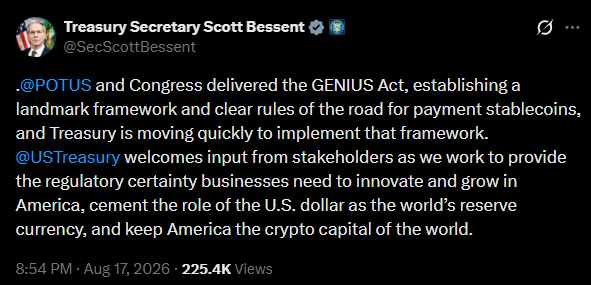
Source: X
The release of these rules comes as U.S. crypto policy enters an intensive phase. The White House plans to meet with executives from companies including Coinbase, Ripple, Polymarket, and Gemini, while another digital asset market regulation bill is expected to resume consideration after Congress returns from recess. However, what the Treasury has issued is still a proposed rule, and final regulatory requirements may still be adjusted based on public comments.
Recommended Articles


