


Circle wins New York trust charter from NYDFS
The firm behind the leading USDC stablecoin, Circle (NYSE: CRCL), opened Friday with news that the New York Department of Financial Services (NYDFS) has granted it a limited purpose trust charter for its USDC stablecoin business.
On the surface, the approval adds a new notch to the regulatory belt that Circle is stretching across the United States.
Upon closer examination, it represents an operational green light from one of the financial regulators that many consider the strictest state-level regulator and a benchmark among banks and rival issuers alike.
Circle has its global headquarters in New York.
Which NYDFS licenses does Circle hold?
Circle’s trust charter certification is not the first license that the New York regulator has issued to the Jeremy Allaire-led firm. As Circle also referred to in its official press release, it was the first company to receive the NYDFS’BitLicense in 2015.
Allaire, who serves as the firm’s co-founder, chairman and chief executive, also brought up the decade-old relationship in his comments about the July 31 approval.
“This charter reflects over a decade of regulatory commitment and positions USDC within a strong, respected framework as digital dollars become central to the global financial system,” Allaire said in the statement.
The executive continued by calling NYDFS “an international standard setter for digital asset regulation.”
How hard is it to receive an NYDFS license?
As the regulator responsible for Wall Street and different global markets, the NYDFS bar is regarded as one of the highest in TradFi and crypto circles. The regulator also does its part to maintain its reputation.
As Cryptopolitan reported in June, the agency added an extra reserve cap requirement for custodians when it proposed new rules to sync its own rules with the GENIUS Act that President Trump signed in 2025.
The federally approved stablecoin bill allows issuers that don’t meet a $10 billion minimum outstanding supply benchmark to operate under state-level authorization as long as the state’s rules are substantially similar to federal provision, as interpreted by the Treasury Department. Acting NYDFS Superintendent Kaitlin Asrow said in June that the state’s rules “have protected New Yorkers and facilitated a stable market.”
Which license does Circle hold now?
The New York charter is the latest in a string of approvals and deals. On July 10, the Office of the Comptroller of the Currency gave final sign-off for Circle to run a national trust bank, Circle National Trust, which will custody digital assets, according to Cryptopolitan’s reporting on the USDC issuer’s separate purchase of IBM’s blockchain patents.
Circle has also been widening USDC’s institutional reach. BNY made USDC the first stablecoin on its digital asset custody platform in June, letting clients mint and redeem the token through the bank. USDC’s market capitalization stands near $73.7 billion, second among stablecoins behind Tether’s roughly $186 billion.
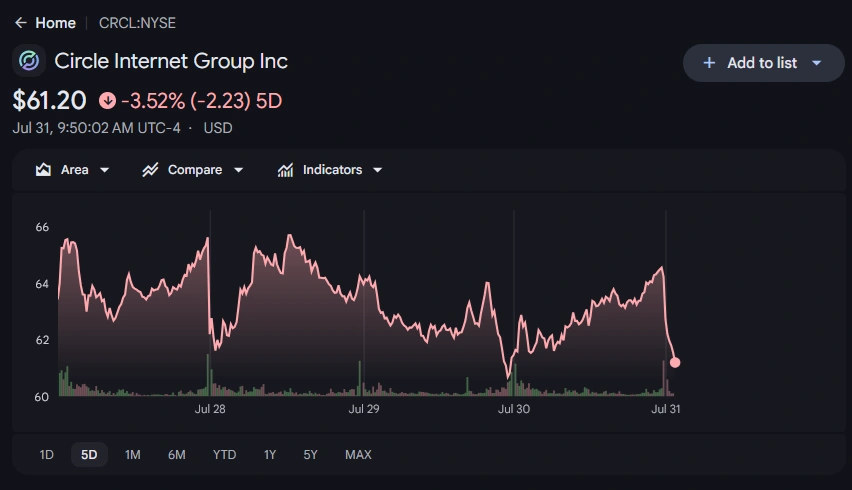
The regulatory momentum has not translated into a smooth ride for Circle’s stock. Google Finance data showed CRCL trading around $61 on July 31, well inside a 52-week range of $49.90 to $189.92, after a volatile year for the newly public company.
The smartest crypto minds already read our newsletter. Want in? Join them.
Recommended Articles


