


Ethereum chosen as Wall Street’s on-chain treasury with $8B locked
BlackRock, Franklin Templeton, Fidelity, and WisdomTree doubled the US government bond market on Ethereum to $8 billion in just six months.
Token Terminal posted a chart on X showing the market increased from about $4 billion in November 2025 to $8 billion in May 2026 (a 100% increase in 6 months).
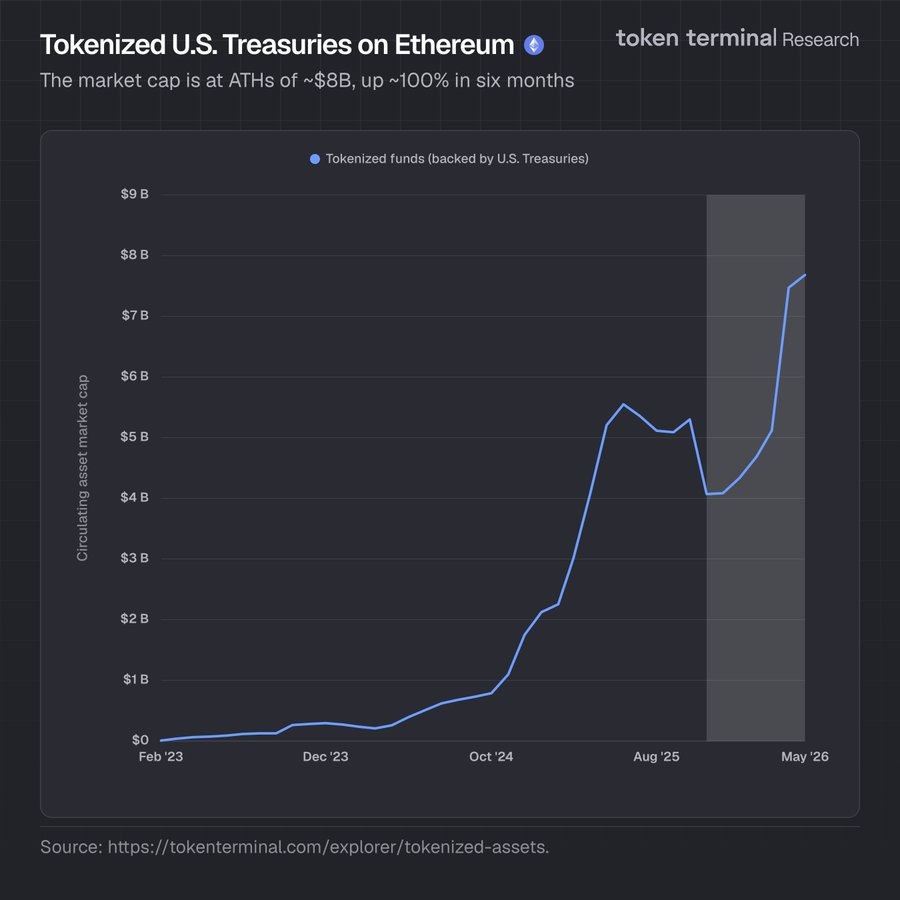
What is a tokenized Treasury, and why does putting one on a blockchain matter?
A US Treasury is a loan you give the US government, which promises to pay you back with interest after a set period.
Banks, pension funds, insurance companies, and governments worldwide hold trillions of dollars’ worth of them because governments have never defaulted on loans.
In that case, tokenized treasuries work like a US treasury, but using tokens that represent ownership instead of a paper certificate or digital record at a traditional bank.
Adding tokenized treasuries to a blockchain makes sense because they settle in seconds, at any time of the day, and any day of the week, including weekends and holidays. In comparison, a traditional Treasury bond settles in one to two business days.
On top of that, users do not need a brokerage account, a US bank account, or even to be in the United States to hold a tokenized Treasury. As long as you have a crypto wallet and the right compliance details, you are good to go.
Unlike a traditional treasury, users can program tokenized Treasuries to automatically pay yield into a DeFi lending pool. Users can also use them as collateral to borrow stablecoins or move them between wallets instantly.
Finally, anyone can verify fund movements and balances because the system records every transaction on a public blockchain.
Who are the biggest influencers, and how much does each one hold?
BlackRock’s BUIDL fund, managed by Securitize, holds the largest share, at about $2.63 billion in tokenized Treasury value. The USDY token by Ondo Finance comes in second with roughly $2.14 billion, while Franklin Templeton’s iBENJI is third with around $2.1 billion.
Other products also made a noticeable impact, including Centrifuge’s JTRSY at $1.14 billion, WisdomTree’s WTGXX at $978 million, Superstate’s USTB at $850 million, and Ondo’s OUSG at $682 million.
Why Ethereum instead of Bitcoin or Solana?
Ethereum leads because it is a programmable blockchain that runs smart contracts that automatically pay interest to every wallet that holds a tokenized Treasury token, without supervision.
According to rwa.xyz data, all big tokenized Treasury products either run on Ethereum or use it as their primary chain, even when they also support other networks.
Bitcoin lacks smart contracts, so users can’t program it to handle tasks automatically.
Solana, on the other hand, supports smart contracts and processes transactions faster and more cheaply than Ethereum, but it’s technically a newer system with a small track record.
Ethereum has a longer history and a bigger pool of audited code, so most large financial institutions choose the blockchain first.
Data from rwa.xyz shows Ethereum holds $8 billion in tokenized Treasuries, as BNB Chain follows suit with around $3.4 billion. Solana, Stellar, and XRP Ledger each hold under $1 billion, making Ethereum the biggest holder among all other blockchains combined.
Similarly, Ethereum provides a well-documented history that allows a bank’s legal team to better explain to regulators how a product works because regulators are familiar with the blockchain’s smart contract standards.
Why did the market double in only six months?
Interest rates remained high enough to make Treasuries attractive; each token could yield around 5% to 10% per year.
Major institutions also launched products and expanded into new chains, exposing the products to more users and attracting fresh capital.
Similarly, the price of Ethereum increased from $1,748 in February 2026 to around $2,464 in May, a gain of more than 40%. This growth attracts investments from institutions that are confident their collateral will also increase in value.
Will this growth continue?
No, there is nothing in financial markets that is a guarantee. The risks, however, are real.
One reason Ethereum went from $4 to $8 was that the US Treasury raised interest rates to fight inflation. That meant the yield on US Treasury bonds also went up, but money might flow elsewhere if the US Federal Reserve cuts interest rates sharply.
The US also hasn’t passed clear laws on tokenized securities. Many large institutions have already developed products that comply with the new laws, but if these laws change, the same companies will face setbacks.
If you're reading this, you’re already ahead. Stay there with our newsletter.
Recommended Articles


