

Strait of Hormuz Closure: Bitcoin Falls Into Liquidity Trap, or Heads Toward $100,000 Mark?

Source Tradingkey

TradingKey - The closure of the Strait of Hormuz has led to a liquidity shortage for Bitcoin, but it remains a long-term positive for the asset.

On April 3, Bitcoin ( BTC) saw a weak rebound in price, fluctuating around $66,000, with the current price at $66,735. Recently, signals of a troop withdrawal from the U.S. President boosted Bitcoin prices above $69,000; however, the subsequent announcement of intensified crackdowns on Iran caused Bitcoin to briefly drop below $66,000.bitcoin-btc-price-08439843be614edd9eab579dbca74645 Bitcoin price chart, Source: TradingView
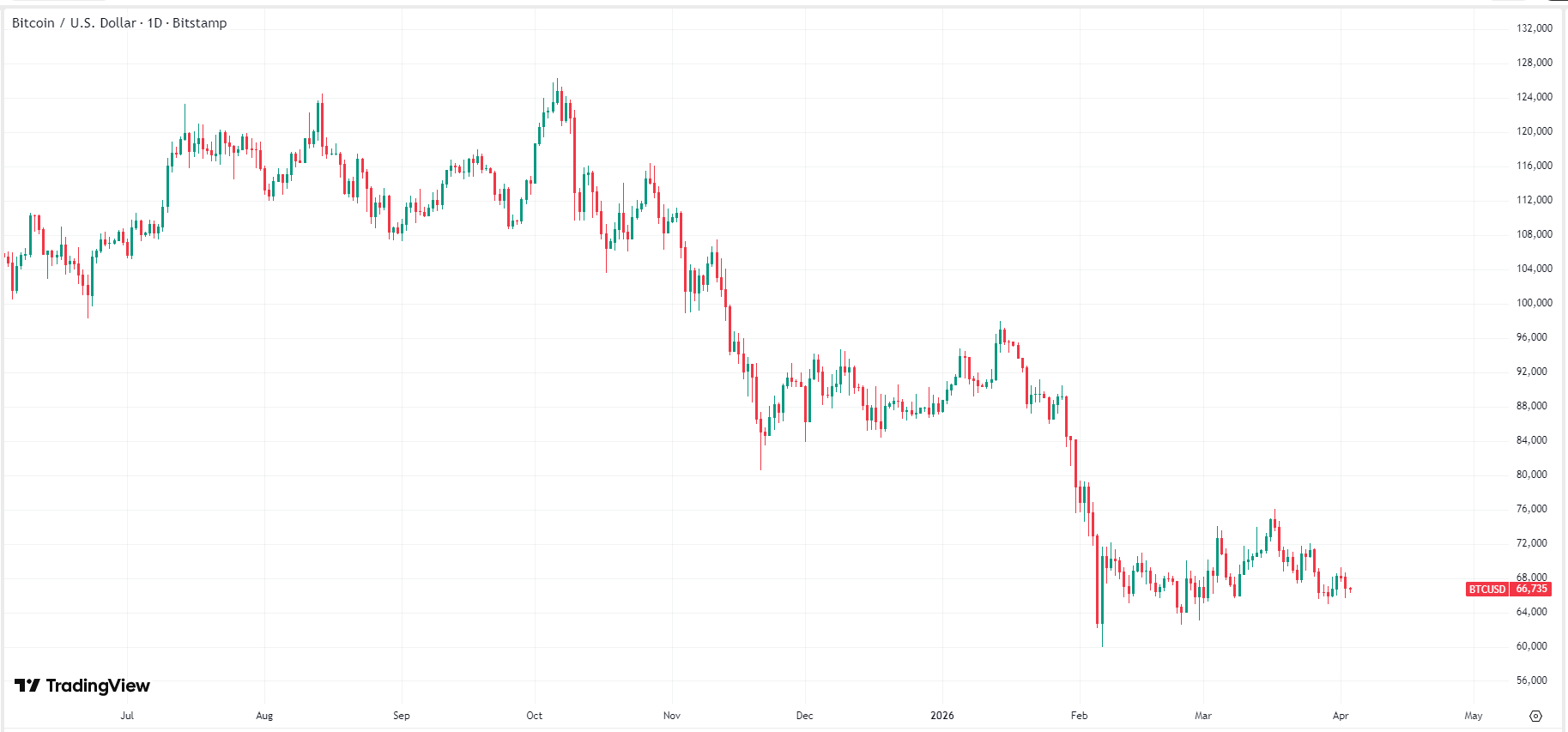
Since the U.S.-Iran conflict began, Iran has maintained firm control over the Strait of Hormuz, and Bitcoin has faced the ongoing threat of a "liquidity trap." During the initial stages of the strait's closure, investors sold Bitcoin—a high-volatility asset—for cash to hedge against uncertainty. Meanwhile, many institutional investors were forced to liquidate Bitcoin, which has relatively high liquidity, to meet margin calls for their equity positions. For instance, when the conflict escalated in early March 2026, Bitcoin plummeted from $74,000 to approximately $65,000.

Currently, the strait remains closed, with crude oil prices holding at $110 per barrel. Rising energy costs will eventually permeate various sectors, triggering global inflation. To combat this secondary inflation driven by oil prices, the Federal Reserve (Fed) may delay its original rate-cut plans or even reconsider raising interest rates. This would lead to a stronger U.S. dollar, typically putting pressure on Bitcoin, a "non-monetary asset," in a high-interest-rate and strong-dollar environment.

However, once the initial liquidity shock subsides, Bitcoin's "decentralized" and "censorship-resistant" attributes will gradually emerge. In other words, a long-term closure of the Strait of Hormuz could actually benefit Bitcoin. Specifically, under threats of war or sanctions, the traditional banking system may face restrictions, making Bitcoin the sole channel for real-time global safe-haven capital and cross-border transfers. Furthermore, if the conflict triggers global financial instability or the devaluation of sovereign currencies, capital will flow into assets with "hard scarcity," potentially pushing Bitcoin back toward the $100,000 milestone.

Another noteworthy development is that the situation in the Strait of Hormuz is bolstering Bitcoin. According to Bloomberg, the Islamic Revolutionary Guard Corps is charging ships passing through the strait in RMB or cryptocurrency. This means shipowners must purchase large quantities of cryptocurrency (including BTC) as "transit fees" to move hundreds of millions of dollars in cargo. In effect, this inelastic demand from the real economy provides Bitcoin with a level of support independent of the financial markets.

Disclaimer: For information purposes only. Past performance is not indicative of future results.
placeholder
Elon Musk’s xAI and Neuralink Launch New Funding Rounds​Billionaire Elon Musk recently raised funds for his two high-profile tech companies, xAI and Neuralink.
Author  Insights
Jun 03, 2025
​Billionaire Elon Musk recently raised funds for his two high-profile tech companies, xAI and Neuralink.
placeholder
Bitcoin briefly loses 2025 gains as crypto plunges over the weekend.Bitcoin experienced a sharp decline this weekend, briefly erasing its 2025 gains and dipping below its year-opening value of $93,507. The cryptocurrency fell to a low of $93,029 on Sunday, representing a 25% drop from its all-time high in October. Although it has rebounded slightly to around $94,209, the pressures on the market remain significant. The downturn occurred despite the reopening of the U.S. government on Thursday, which many had hoped would provide essential support for crypto markets. This year initially appeared promising for cryptocurrencies, particularly after the inauguration of President Donald Trump, who has established the most pro-crypto administration thus far. However, ongoing political tensions—including Trump's tariff strategies and the recent government shutdown, lasting a historic 43 days—have contributed to several rapid price pullbacks for Bitcoin throughout the year. Market dynamics are also being influenced by Bitcoin whales—investors holding large amounts of Bitcoin—who have been offloading portions of their assets, consequently stalling price rallies even as positive regulatory developments emerge. Despite these sell-offs, analysts from Glassnode argue that this behavior aligns with typical patterns seen among long-term investors during the concluding stages of bull markets, suggesting it is not indicative of a mass exodus. Notably, Bitcoin is not alone in its struggles, as Ethereum and Solana have also recorded declines of 7.95% and 28.3%, respectively, since the start of the year, while numerous altcoins have faced even steeper losses. Looking ahead, questions linger regarding the viability of the four-year cycle thesis, particularly given the increasing institutional support and regulatory frameworks now in place in the crypto landscape. Matt Hougan, chief investment officer at Bitwise, remains optimistic, suggesting a potential Bitcoin resurgence in 2026 driven by the “debasement trade” thesis and a broader trend toward increased adoption of stablecoins, tokenization, and decentralized finance. Hougan emphasized the soundness of the underlying fundamentals, pointing to a positive outlook for the sector in the longer term.
Author  Mitrade
Nov 17, 2025
Bitcoin experienced a sharp decline this weekend, briefly erasing its 2025 gains and dipping below its year-opening value of $93,507. The cryptocurrency fell to a low of $93,029 on Sunday, representing a 25% drop from its all-time high in October. Although it has rebounded slightly to around $94,209, the pressures on the market remain significant. The downturn occurred despite the reopening of the U.S. government on Thursday, which many had hoped would provide essential support for crypto markets. This year initially appeared promising for cryptocurrencies, particularly after the inauguration of President Donald Trump, who has established the most pro-crypto administration thus far. However, ongoing political tensions—including Trump's tariff strategies and the recent government shutdown, lasting a historic 43 days—have contributed to several rapid price pullbacks for Bitcoin throughout the year. Market dynamics are also being influenced by Bitcoin whales—investors holding large amounts of Bitcoin—who have been offloading portions of their assets, consequently stalling price rallies even as positive regulatory developments emerge. Despite these sell-offs, analysts from Glassnode argue that this behavior aligns with typical patterns seen among long-term investors during the concluding stages of bull markets, suggesting it is not indicative of a mass exodus. Notably, Bitcoin is not alone in its struggles, as Ethereum and Solana have also recorded declines of 7.95% and 28.3%, respectively, since the start of the year, while numerous altcoins have faced even steeper losses. Looking ahead, questions linger regarding the viability of the four-year cycle thesis, particularly given the increasing institutional support and regulatory frameworks now in place in the crypto landscape. Matt Hougan, chief investment officer at Bitwise, remains optimistic, suggesting a potential Bitcoin resurgence in 2026 driven by the “debasement trade” thesis and a broader trend toward increased adoption of stablecoins, tokenization, and decentralized finance. Hougan emphasized the soundness of the underlying fundamentals, pointing to a positive outlook for the sector in the longer term.
placeholder
Gold Price Forecast: XAU/USD opens lower around $4,450 on fears of widening Iran conflictsGold price (XAU/USD) opens over 1% lower to near $4,445.00 on Monday, as oil prices have rallied further on fears of further widening of conflicts in the Middle East. WTI Oil price is up almost 3% above $102.50 in the opening trade, increasing fears of higher inflation expectations globally.
Author  FXStreet
Mar 30, Mon
Gold price (XAU/USD) opens over 1% lower to near $4,445.00 on Monday, as oil prices have rallied further on fears of further widening of conflicts in the Middle East. WTI Oil price is up almost 3% above $102.50 in the opening trade, increasing fears of higher inflation expectations globally.
placeholder
Silver Price Forecast: XAG/USD falls to near $72.00 amid fading safe-haven demandSilver price (XAG/USD) continues to lose ground after registering tiny losses in the previous day, trading around $72.90 during the Asian hours on Thursday. The safe-haven demand for the precious metal fades amid rising optimism over Middle East peace.
Author  FXStreet
Yesterday 08: 19
Silver price (XAG/USD) continues to lose ground after registering tiny losses in the previous day, trading around $72.90 during the Asian hours on Thursday. The safe-haven demand for the precious metal fades amid rising optimism over Middle East peace.
placeholder
Gold retreats sharply from two-week top/$4,800 as Trump’s Iran comments boost USDGold (XAU/USD) witnessed an intraday turnaround from the $4,800 mark, or a fresh two-week high set earlier this Thursday, and for now, seems to have snapped a four-day winning streak amid resurgent US Dollar (USD) demand.
Author  FXStreet
Yesterday 07: 03
Gold (XAU/USD) witnessed an intraday turnaround from the $4,800 mark, or a fresh two-week high set earlier this Thursday, and for now, seems to have snapped a four-day winning streak amid resurgent US Dollar (USD) demand.
goTop
quote