




KBank Files Trademark Apps for Stablecoin Wallets as LIQUID Pumps
Thailand’s second-largest lender, Kasikornbank (KBank), has made its intentions clear: it wants to dominate the Southeast Asian digital asset market.
New trademark filings reveal the banking giant is prepping a proprietary stablecoin wallet ecosystem, a logical next step after acquiring the Satang Pro exchange (now Orbix). This goes beyond simple corporate branding; it marks a fundamental shift in how traditional finance (TradFi) approaches blockchain infrastructure.
They aren’t just experimenting anymore. They’re deploying.
The strategy is fairly transparent. By locking down IP rights for custodial and non-custodial interfaces, KBank is effectively constructing a “walled garden” for digital Thai Baht and tokenized assets. It mirrors a wider trend where banks issue stablecoins to bypass SWIFT friction for instant, on-chain settlement. But there’s a catch.
As institutions build these private ledgers, liquidity gets trapped in incompatible networks.
We are seeing a distinct shift from ‘asset speculation’ to ‘infrastructure wars,’ where the value lies in who owns the rails, not just the coins.
This institutional fragmentation creates a massive efficiency gap. While KBank optimizes for local compliance, the broader DeFi market is desperate for interoperability. Smart money is already rotating out of isolated Layer 1 plays and into infrastructure capable of bridging these expanding islands of liquidity.
That specific dynamic, connecting institutional capital with public chain yield, is driving serious attention toward LiquidChain ($LIQUID), a Layer 3 protocol built to unify these fractured execution environments.
You can buy $LIQUID here.
Unified Liquidity Layer Breaks Down Asset Silos
Speed isn’t the bottleneck anymore (Solana fixed that years ago). The real friction is the headache of moving value between sovereign chains. When heavyweights like KBank enter the fray, they bring billions in liquidity, yet that capital often remains stuck in specific compliant zones.
LiquidChain ($LIQUID) tackles this by fusing Bitcoin, Ethereum, and Solana liquidity into a single execution environment.
Why does this matter? Because current bridging solutions are often high-risk ‘wrapped’ asset models, basically honeypots for hackers. LiquidChain uses a Cross-Chain Virtual Machine (VM) that enables native asset usage without the clunky user flows of traditional bridges. By operating as a Layer 3, it sits above the base layers, aggregating liquidity rather than fighting for it.
For developers, the ‘Deploy-Once Architecture’ is the real draw. Instead of writing separate smart contracts for the EVM (Ethereum) and SVM (Solana), developers can deploy on LiquidChain and reach users across all connected chains instantly. It reduces technical overhead and, crucially, lowers the barrier for institutional apps to tap into deep public liquidity.
Explore the Unified Layer at LiquidChain.
L3 Infrastructure Enables Single-Step Execution For Institutions
The buzzword for this cycle is ‘abstraction’, making the tech invisible. KBank’s wallet initiative aims to do this for retail banking, but LiquidChain ($LIQUID) is executing it at the protocol level. The project’s Single-Step Execution allows complex cross-chain swaps (like trading native $BTC directly for a Solana token) to happen in one click. No gas fee juggling, no chain switching.
Frankly, this level of interoperability is non-negotiable for institutional adoption. Banks won’t rely on users managing three different gas tokens to complete a payment. LiquidChain’s model uses verifiable settlement to ensure transactions are final and secure across chains, a prerequisite for high-value DeFi operations.
While the team hasn’t released specific whale data yet, the architecture clearly targets high-volume throughput, the kind of ‘transaction fuel’ needed for future stablecoin economies. The $LIQUID token acts as the economic engine here, used for liquidity staking and processing fees.
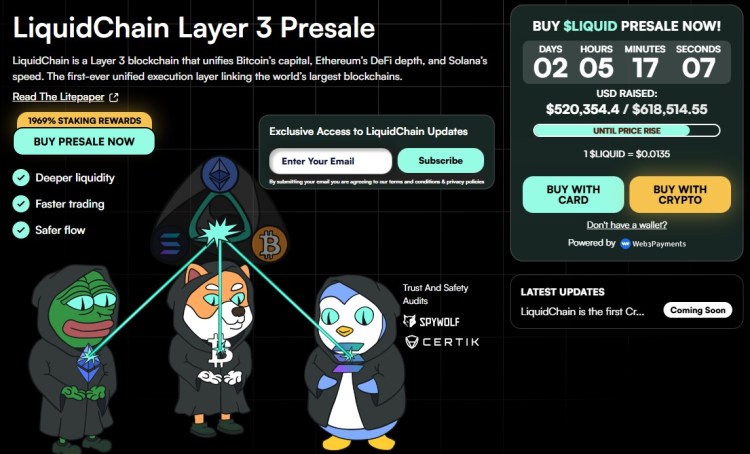
The project has already raised over $520K during presale with a token price of $0.0135.
As entities like KBank bring real-world assets on-chain, protocols that can route that liquidity without friction stand to capture significant value.
Get started with LiquidChain here.
The content provided in this article is for informational purposes only and does not constitute financial advice. Cryptocurrency investments, including presales and new protocols, carry inherent risks, including high volatility and potential loss of capital. Always conduct your own due diligence.
Recommended Articles


