

Ripple Price Forecast: XRP downside risks escalate as low retail activity clashes with steady ETF inflows

Source Fxstreet
  • XRP edges lower below $1.90 amid technical weakness and increasing macroeconomic uncertainty.
  • Retail interest in XRP stalls, with futures Open Interest holding steady at $3.43 billion on Thursday.
  • XRP ETFs extend their inflow streak to six consecutive days, with assets under management reaching $1.39 billion.

Ripple (XRP) is trading below the $1.90 mark at the time of writing on Thursday, extending its recent decline as bearish technical signals converge with broader macroeconomic headwinds.

The Federal Reserve (Fed) left interest rates unchanged in the range of 3.50%-3.75% at the end of its monetary policy meeting on Wednesday, potentially limiting liquidity into high-risk assets like XRP.

Mixed signals as retail interest slows while XRP ETFs extend inflows

The cross-border remittance token faces increasing pressure from diminishing retail participation, evidenced by stagnant futures Open Interest (OI). CoinGlass data shows OI averaging $3.43 billion on Thursday, down from $3.45 billion the previous day.
OI tracks the notional value of outstanding futures contracts; hence, low retail activity indicates that investors lack confidence in the token’s ability to sustain an uptrend. Investors are closing positions rather than opening new ones, depriving XRP of the tailwind to keep its uptrend intact.
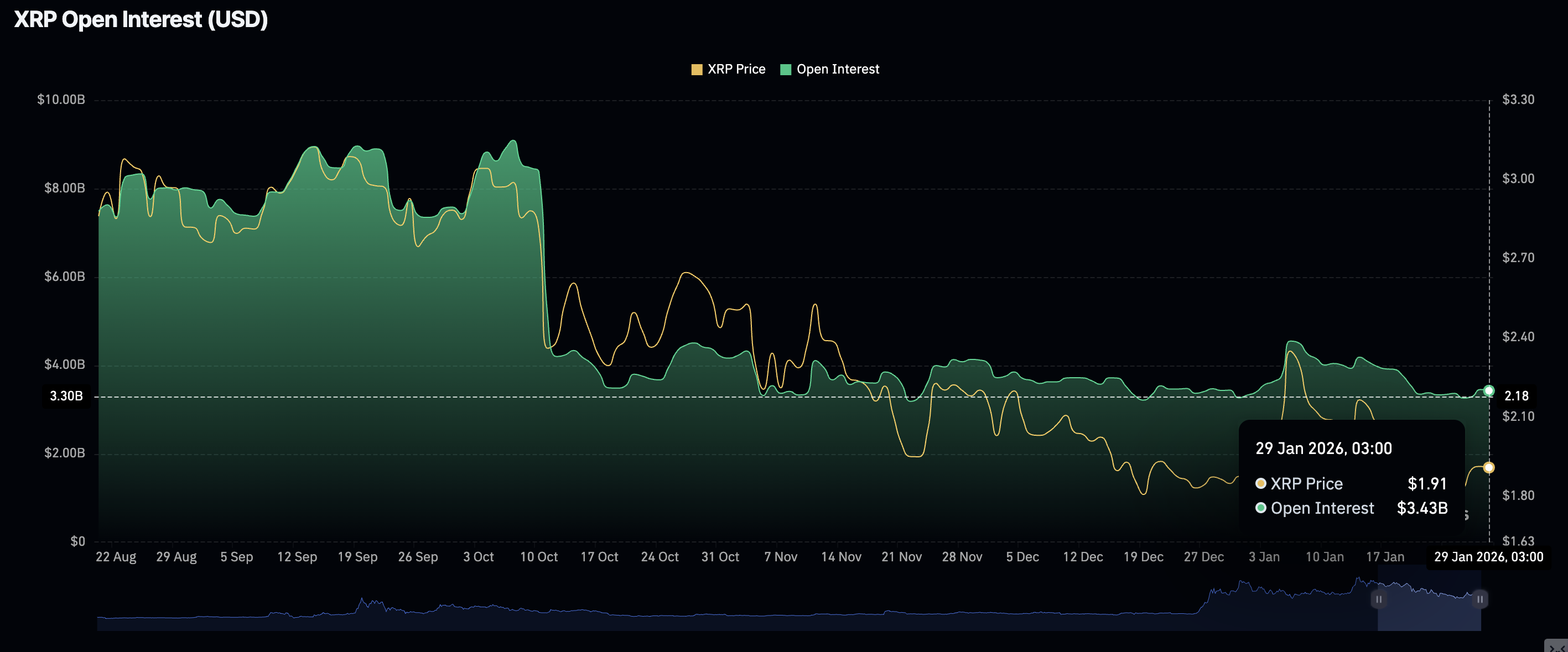
XRP Open Interest | Source: CoinGlass

Meanwhile, XRP boasts unwavering institutional support through US-listed Exchange-Traded Funds (ETFs), which recorded nearly $7 million in inflows on Wednesday. The cumulative total inflow stands at $1.26 billion, and assets under management at $1.39 billion.

XRP has sustained six consecutive days of inflows, underscoring the growing demand for altcoin-based ETFs. This stands in stark contrast to broader crypto market weakness, which saw Bitcoin (BTC) ETFs record nearly $20 million in outflows on Wednesday.
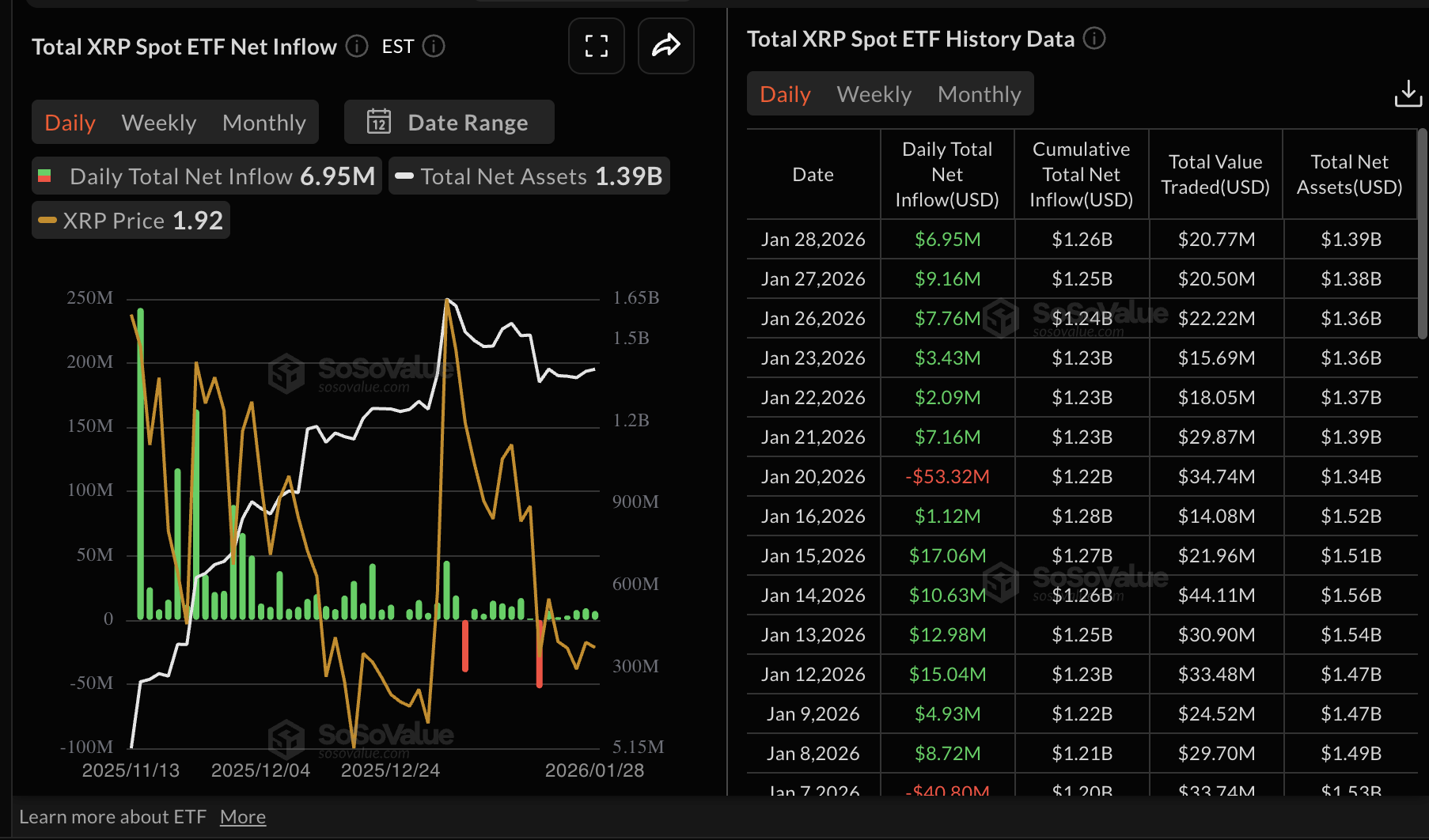
XRP ETF flows | Source: SoSoValue

Technical outlook: XRP struggles as bearish signals weigh on price outlook

XRP is trading amid increasing downside risks, macroeconomic uncertainty and risk-off sentiment in the broader cryptocurrency market. The token remains below the 50-day Exponential Moving Average (EMA) at $2.01, the 100-day EMA at $2.14 and the 200-day EMA at $2.28, underpinning the overall bearish outlook.

Meanwhile, the Relative Strength Index (RSI) is falling to 40 on the daily chart, pointing to a buildup of bearish momentum. Further decline toward oversold territory would trigger an accelerated drop, targeting Sunday’s low at $1.81 and April’s support at $1.61.

The Moving Average Convergence Divergence (MACD) remains below its signal line on the daily chart, prompting traders to sell XRP to protect capital amid headwinds.
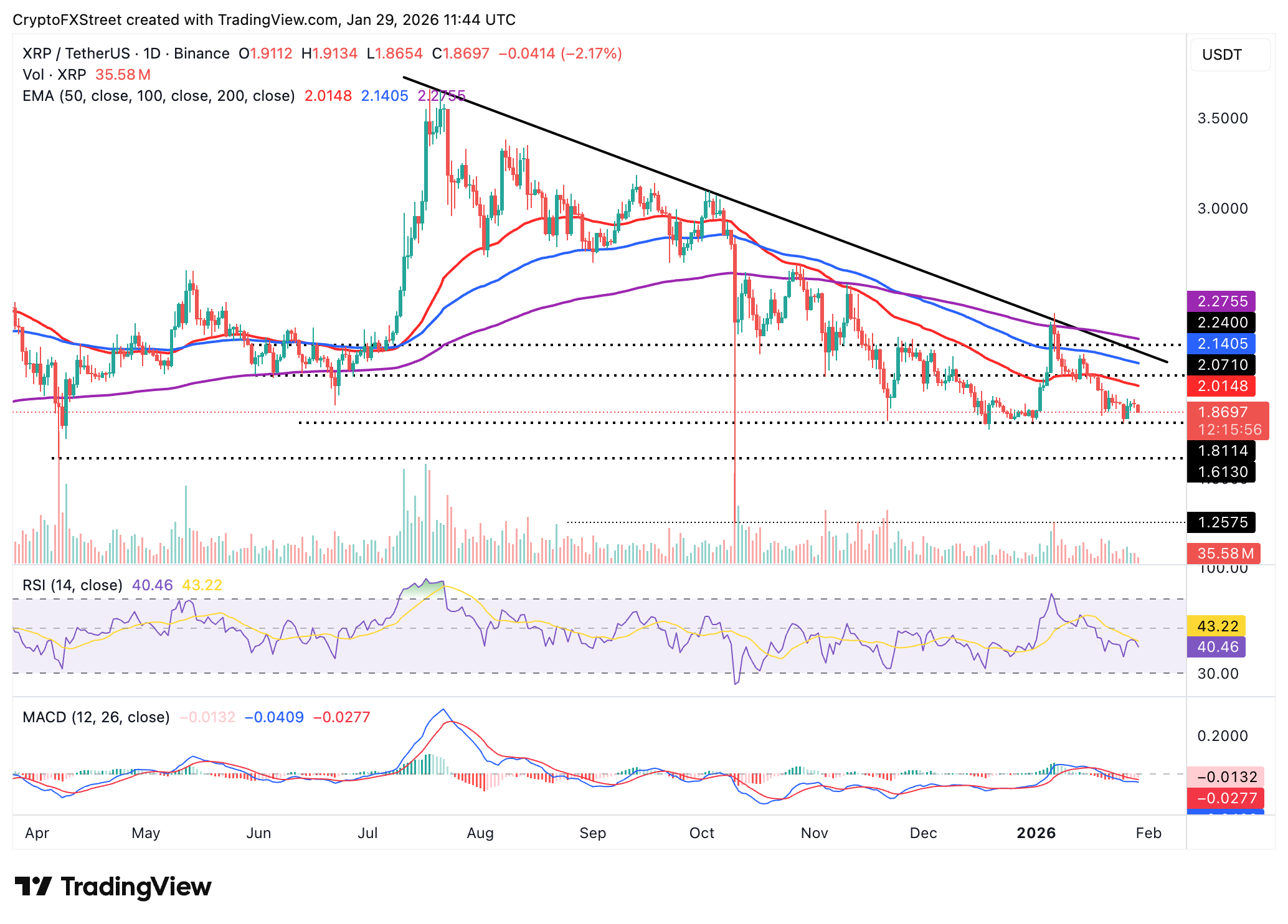
XRP/USDT daily chart

Any attempt to reverse the trend should be accompanied by high trading volume and push above the 50-day EMA resistance at $2.01. Even so, XRP could remain in bearish hands until bulls reclaim the 100-day EMA at $2.14 and the 200-day EMA at $2.28, thereby opening the door for a breakout toward $3.00.

Crypto ETF FAQs

An Exchange-Traded Fund (ETF) is an investment vehicle or an index that tracks the price of an underlying asset. ETFs can not only track a single asset, but a group of assets and sectors. For example, a Bitcoin ETF tracks Bitcoin’s price. ETF is a tool used by investors to gain exposure to a certain asset.

Yes. The first Bitcoin futures ETF in the US was approved by the US Securities & Exchange Commission in October 2021. A total of seven Bitcoin futures ETFs have been approved, with more than 20 still waiting for the regulator’s permission. The SEC says that the cryptocurrency industry is new and subject to manipulation, which is why it has been delaying crypto-related futures ETFs for the last few years.

Yes. The SEC approved in January 2024 the listing and trading of several Bitcoin spot Exchange-Traded Funds, opening the door to institutional capital and mainstream investors to trade the main crypto currency. The decision was hailed by the industry as a game changer.

The main advantage of crypto ETFs is the possibility of gaining exposure to a cryptocurrency without ownership, reducing the risk and cost of holding the asset. Other pros are a lower learning curve and higher security for investors since ETFs take charge of securing the underlying asset holdings. As for the main drawbacks, the main one is that as an investor you can’t have direct ownership of the asset, or, as they say in crypto, “not your keys, not your coins.” Other disadvantages are higher costs associated with holding crypto since ETFs charge fees for active management. Finally, even though investing in ETFs reduces the risk of holding an asset, price swings in the underlying cryptocurrency are likely to be reflected in the investment vehicle too.

Disclaimer: For information purposes only. Past performance is not indicative of future results.
placeholder
Natural Gas sinks to pivotal level as China’s demand slumpsNatural Gas price (XNG/USD) edges lower and sinks to $2.56 on Monday, extending its losing streak for the fifth day in a row. The move comes on the back of China cutting its Liquified Natural Gas (LNG) imports after prices rose above $3.0 in June. It
Author  FXStreet
Jul 01, 2024
Natural Gas price (XNG/USD) edges lower and sinks to $2.56 on Monday, extending its losing streak for the fifth day in a row. The move comes on the back of China cutting its Liquified Natural Gas (LNG) imports after prices rose above $3.0 in June. It
placeholder
Bitcoin briefly loses 2025 gains as crypto plunges over the weekend.Bitcoin experienced a sharp decline this weekend, briefly erasing its 2025 gains and dipping below its year-opening value of $93,507. The cryptocurrency fell to a low of $93,029 on Sunday, representing a 25% drop from its all-time high in October. Although it has rebounded slightly to around $94,209, the pressures on the market remain significant. The downturn occurred despite the reopening of the U.S. government on Thursday, which many had hoped would provide essential support for crypto markets. This year initially appeared promising for cryptocurrencies, particularly after the inauguration of President Donald Trump, who has established the most pro-crypto administration thus far. However, ongoing political tensions—including Trump's tariff strategies and the recent government shutdown, lasting a historic 43 days—have contributed to several rapid price pullbacks for Bitcoin throughout the year. Market dynamics are also being influenced by Bitcoin whales—investors holding large amounts of Bitcoin—who have been offloading portions of their assets, consequently stalling price rallies even as positive regulatory developments emerge. Despite these sell-offs, analysts from Glassnode argue that this behavior aligns with typical patterns seen among long-term investors during the concluding stages of bull markets, suggesting it is not indicative of a mass exodus. Notably, Bitcoin is not alone in its struggles, as Ethereum and Solana have also recorded declines of 7.95% and 28.3%, respectively, since the start of the year, while numerous altcoins have faced even steeper losses. Looking ahead, questions linger regarding the viability of the four-year cycle thesis, particularly given the increasing institutional support and regulatory frameworks now in place in the crypto landscape. Matt Hougan, chief investment officer at Bitwise, remains optimistic, suggesting a potential Bitcoin resurgence in 2026 driven by the “debasement trade” thesis and a broader trend toward increased adoption of stablecoins, tokenization, and decentralized finance. Hougan emphasized the soundness of the underlying fundamentals, pointing to a positive outlook for the sector in the longer term.
Author  Mitrade
Nov 17, 2025
Bitcoin experienced a sharp decline this weekend, briefly erasing its 2025 gains and dipping below its year-opening value of $93,507. The cryptocurrency fell to a low of $93,029 on Sunday, representing a 25% drop from its all-time high in October. Although it has rebounded slightly to around $94,209, the pressures on the market remain significant. The downturn occurred despite the reopening of the U.S. government on Thursday, which many had hoped would provide essential support for crypto markets. This year initially appeared promising for cryptocurrencies, particularly after the inauguration of President Donald Trump, who has established the most pro-crypto administration thus far. However, ongoing political tensions—including Trump's tariff strategies and the recent government shutdown, lasting a historic 43 days—have contributed to several rapid price pullbacks for Bitcoin throughout the year. Market dynamics are also being influenced by Bitcoin whales—investors holding large amounts of Bitcoin—who have been offloading portions of their assets, consequently stalling price rallies even as positive regulatory developments emerge. Despite these sell-offs, analysts from Glassnode argue that this behavior aligns with typical patterns seen among long-term investors during the concluding stages of bull markets, suggesting it is not indicative of a mass exodus. Notably, Bitcoin is not alone in its struggles, as Ethereum and Solana have also recorded declines of 7.95% and 28.3%, respectively, since the start of the year, while numerous altcoins have faced even steeper losses. Looking ahead, questions linger regarding the viability of the four-year cycle thesis, particularly given the increasing institutional support and regulatory frameworks now in place in the crypto landscape. Matt Hougan, chief investment officer at Bitwise, remains optimistic, suggesting a potential Bitcoin resurgence in 2026 driven by the “debasement trade” thesis and a broader trend toward increased adoption of stablecoins, tokenization, and decentralized finance. Hougan emphasized the soundness of the underlying fundamentals, pointing to a positive outlook for the sector in the longer term.
placeholder
When is the BoJ rate decision and how could it affect USD/JPY?The Bank of Japan (BoJ) will announce its interest rate decision between 03.30 and 05.00 GMT, followed by Governor Kazuo Ueda's press conference at 06.30 GMT.
Author  FXStreet
Dec 19, 2025
The Bank of Japan (BoJ) will announce its interest rate decision between 03.30 and 05.00 GMT, followed by Governor Kazuo Ueda's press conference at 06.30 GMT.
placeholder
ECB Policy Outlook for 2026: What It Could Mean for the Euro’s Next MoveWith the ECB likely holding rates steady at 2.15% and the Fed potentially extending cuts into 2026, EUR/USD may test 1.20 if Eurozone growth proves resilient, but weaker growth and an ECB pivot could pull the pair back toward 1.13 and potentially 1.10.
Author  Mitrade
Dec 26, 2025
With the ECB likely holding rates steady at 2.15% and the Fed potentially extending cuts into 2026, EUR/USD may test 1.20 if Eurozone growth proves resilient, but weaker growth and an ECB pivot could pull the pair back toward 1.13 and potentially 1.10.
placeholder
Gold Price Forecast: Oil Price Breaking $100 Fuels Inflation Concerns, Will Gold Prices Fall Further?As of the Asian session on July 24, gold prices ( XAUUSD) fell continuously during intraday trading, briefly approaching the $4,000 mark. Looking at the chart, gold prices rebounded this
Author  TradingKey
Jul 24, Fri
As of the Asian session on July 24, gold prices ( XAUUSD) fell continuously during intraday trading, briefly approaching the $4,000 mark. Looking at the chart, gold prices rebounded this
Related Instrument
goTop
quote