

Bitcoin falls to $108K, dropping 3.6% in 24 hours and nearly 7% over the week

Source Cryptopolitan

Bitcoin fell to $108,000 on Thursday, dropping 3.6% in 24 hours, and nearly 7% for the week, according to data from CoinGecko.

The decline triggered widespread losses across crypto markets, sending Ethereum down 8% to $3,887 and bringing Ether’s four-week loss to 23%.

The sell-off came with a spike in liquidations, wiping out more than $1.1 billion in trades over a 24-hour period. The majority of that, over $1 billion, were long bets that prices would rise.

Dogecoin fell 7.6%, trading near $0.23, while Solana dropped 7.7% to $197.52. Both tokens are now down 21% over the last seven days, ranking them as the week’s worst performers in the top 100.

The pullback also lined up with weakness in U.S. equities. The S&P 500, Nasdaq, and Dow Jones Industrial Average all ended Thursday in the red.

Long-term holders dumped Bitcoin while ETFs went silent

Bitcoin’s latest rally, which hit a post-FOMC high of $117,000, has reversed into what analysts describe as a classic “buy the rumour, sell the news” pattern. Glassnode analysts said Thursday that Bitcoin is now “showing signs of exhaustion” as ETF demand stalled and long-term investors began locking in profits.

The current drop, from $124,000 down to $113,700, equals an 8% decline. That’s mild compared to this cycle’s 28% drawdown or the 60% drops seen in previous ones. But analysts also noted that Bitcoin’s volatility has been shrinking over time, now resembling the slow climb seen between 2015 and 2017. There’s been no blow-off top yet.
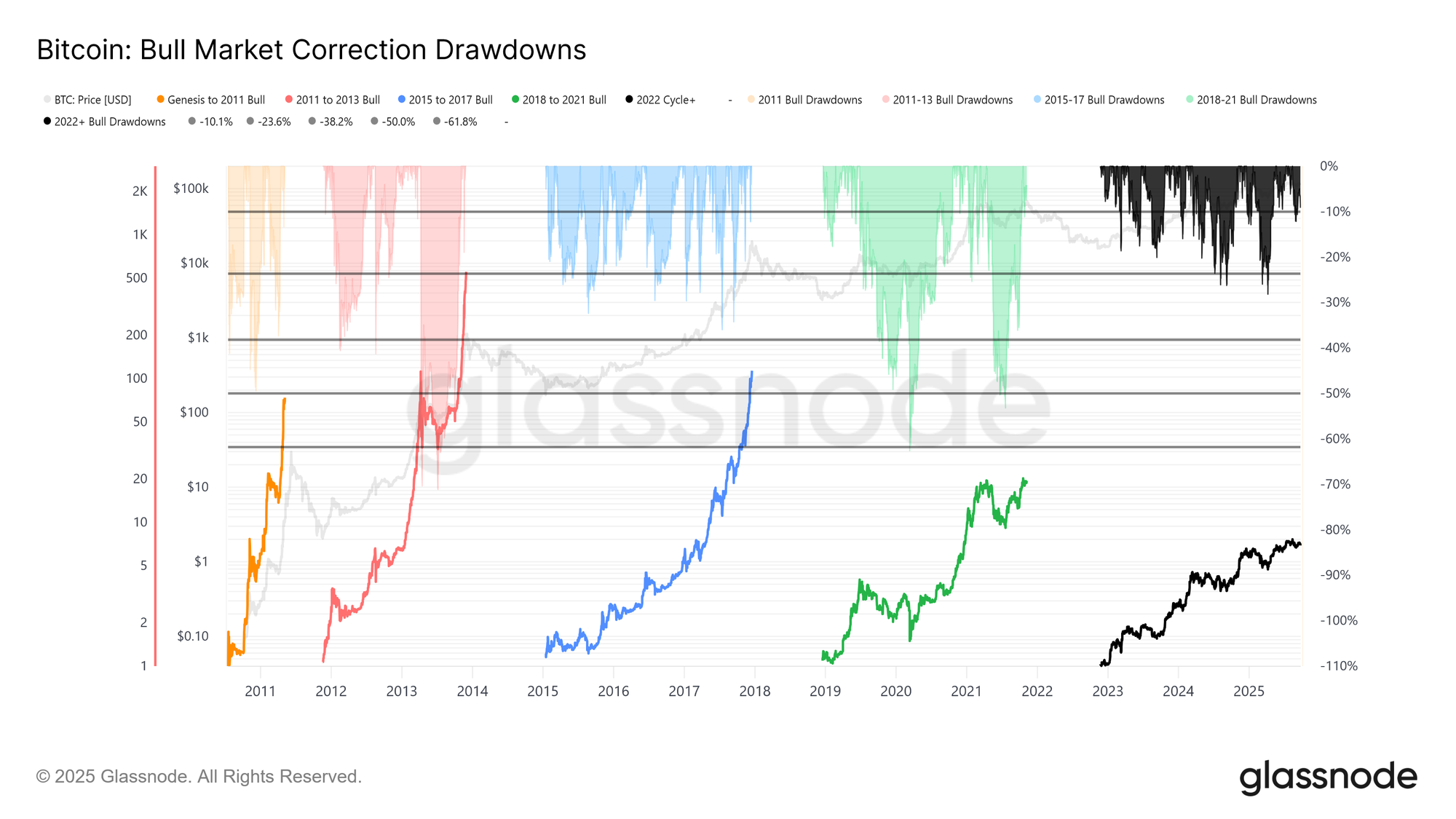
Bitcoin crashes to $108,000 as Ether hits 7-week low, with $1 million in longs liquidated
Source: Glassnode

This cycle has lasted around 1,030 days, just shy of the 1,060-day duration seen in the last two. On-chain data shows capital deployment has moved in three waves since November 2022, lifting Realized Cap to $1.06 trillion. Capital inflows are now at $678 billion, nearly twice the last cycle’s $383 billion.

This wave didn’t come all at once. Each time over 90% of moved coins were in profit, that signaled a top. The crypto just backed away from its third such spike. Long-term holders have sold 3.4 million BTC, already more than they did in past cycles.

ETF flows, which helped soak up that supply earlier in the year, fell off a cliff. Around the FOMC, long-term holders were unloading at a rate of 122,000 BTC per month, while ETF net inflows dropped from 2,600 BTC/day to nearly zero. That created a weak environment, as selling pressure rose and new demand dried up.

Futures and options exposed the market’s fragility

Spot markets cracked first. As Bitcoin dropped, trading volume exploded, and thin order books couldn’t handle the flow. That pushed the price under $113,000 and triggered a sharp flush in futures. Open interest dropped from $44.8 billion to $42.7 billion, forcing over-leveraged traders to exit and magnifying the fall.

Heatmaps from Coinglass showed major liquidation clusters between $114,000 and $112,000, clearing out leveraged longs. That created a short-term floor near $111,800, where the short-term holder’s cost basis now sits.

But price remains unstable. Risk levels still hover around $117,000, and without stronger buying, prices could swing even more. In the options market, volatility surged before the FOMC and then cooled once the rate cut was confirmed.
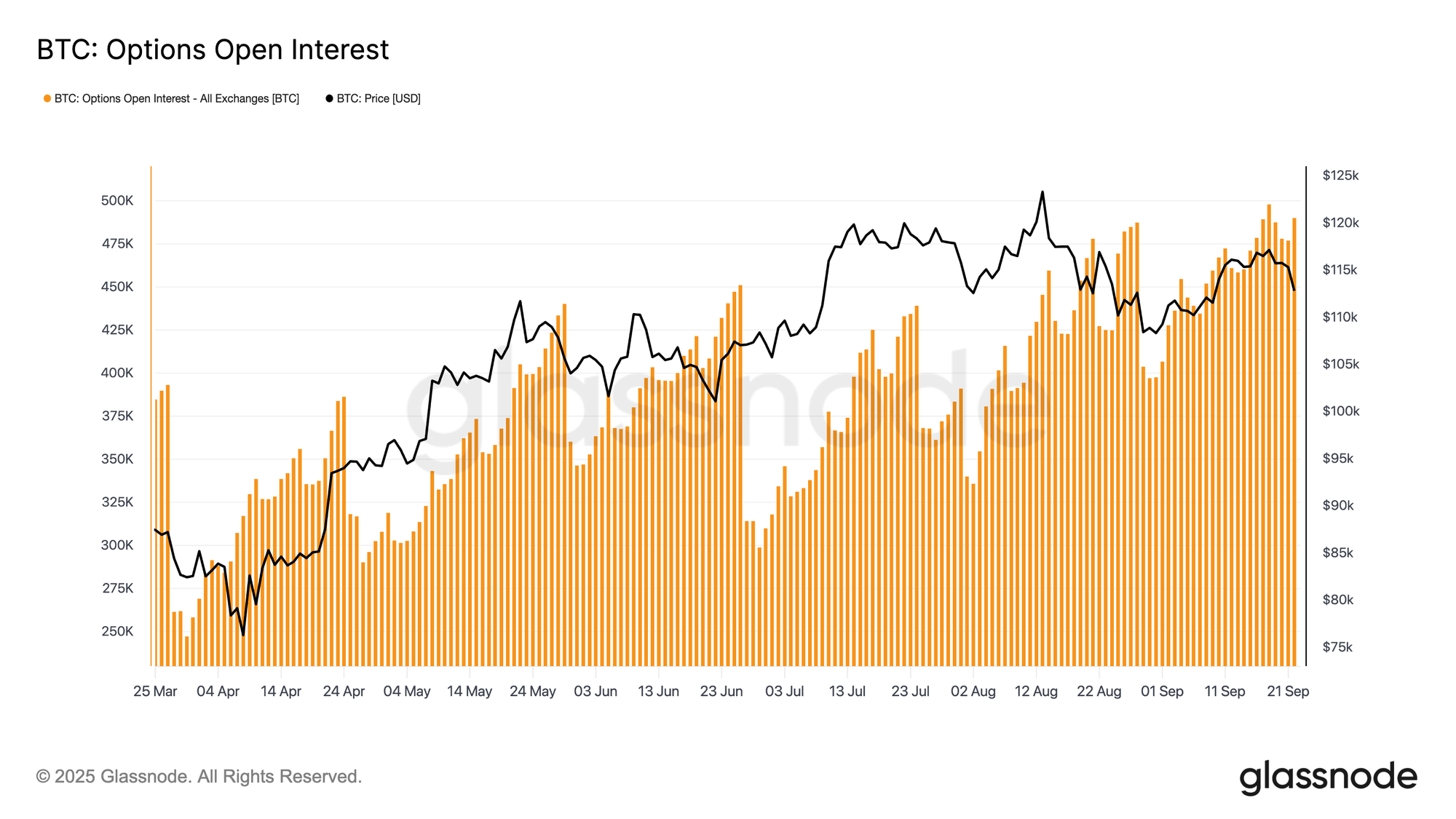
Bitcoin crashes to $108,000 as Ether hits 7-week low, with $1 million in longs liquidated

That didn’t last. A Sunday futures crash reignited the fear trade. One-week implied volatility jumped, and pressure spread to longer contracts. On Friday, 1W skew spiked from 1.5% to 17%, showing that traders scrambled for downside protection.

That rush was real. Two days later, the biggest liquidation since 2021 hit the market. The put/call volume ratio dropped after that, as traders cashed out their puts and moved to cheaper calls. Still, Skew data shows the market is still tilted toward more puts, keeping protection expensive and upside cheap.

Total options open interest is still near record highs. Most of that will reset after Friday morning’s expiry. Until then, dealers are pinned in a peak gamma zone, forced to hedge every tiny move.

KEY Difference Wire: the secret tool crypto projects use to get guaranteed media coverage

Disclaimer: For information purposes only. Past performance is not indicative of future results.
placeholder
The Fed will sit still on October 28 — but 100 of 100 economists now expect a December hikeA Reuters poll run October 16-20 found 94 of 100 economists expecting the Fed to hold at 3.75-4.00% on October 28 — and all 100 expecting a hike in December, against less than half a month earlier. The market is close to the same price, with CME FedWatch at roughly 17% for October and 82.8% for December. With the Fed in blackout since October 17, here are the five dates that decide the rest of the year, what each one is priced for, and the two directions each can take.
Author  Irene Q.
Oct 22, Thu
A Reuters poll run October 16-20 found 94 of 100 economists expecting the Fed to hold at 3.75-4.00% on October 28 — and all 100 expecting a hike in December, against less than half a month earlier. The market is close to the same price, with CME FedWatch at roughly 17% for October and 82.8% for December. With the Fed in blackout since October 17, here are the five dates that decide the rest of the year, what each one is priced for, and the two directions each can take.
placeholder
Big Tech's $800 billion AI bill faces its first real test — free cash flow is the judgeAlphabet and Microsoft report after the close on October 28, Amazon on October 29, with hyperscaler AI capex running near $800 billion a year. Meta's negative free cash flow and 9.40% drop on October 22 was the warning; this week's prints decide whether cloud growth and backlog can pay for the buildout. Here are the consensus numbers, the free-cash-flow table and the two-sided test.
Author  Irene Q.
Oct 26, Mon
Alphabet and Microsoft report after the close on October 28, Amazon on October 29, with hyperscaler AI capex running near $800 billion a year. Meta's negative free cash flow and 9.40% drop on October 22 was the warning; this week's prints decide whether cloud growth and backlog can pay for the buildout. Here are the consensus numbers, the free-cash-flow table and the two-sided test.
placeholder
Anthropic files for a $2 trillion IPO — the $80.7 billion loss is the decoy, the $450 billion compute bill is the riskAnthropic publicly filed its S-1 on October 26, revealing $16.29 billion of first-half revenue (+1,304% year over year) and a $80.7 billion net loss — of which $72.4 billion is a non-cash convertible-note charge. The real number is the $450 billion of signed, mostly non-cancelable compute commitments. Here is what the filing says, why NVDA, ARM and MU are the tradeable read-through, and the conditions that decide whether the AI trade passes its first public valuation test.
Author  Irene Q.
Oct 27, Tue
Anthropic publicly filed its S-1 on October 26, revealing $16.29 billion of first-half revenue (+1,304% year over year) and a $80.7 billion net loss — of which $72.4 billion is a non-cash convertible-note charge. The real number is the $450 billion of signed, mostly non-cancelable compute commitments. Here is what the filing says, why NVDA, ARM and MU are the tradeable read-through, and the conditions that decide whether the AI trade passes its first public valuation test.
placeholder
Fed October Rate Decision Preview: Rate Hike Pause Has Become Consensus, How Will US Stocks, Dollar, and Gold React?The Federal Reserve will announce its October interest rate decision at 14:00 Eastern Time on October 28, and Fed Chair Warsh will hold a press conference at 14:30. Markets currently wide
Author  TradingKey
Oct 27, Tue
The Federal Reserve will announce its October interest rate decision at 14:00 Eastern Time on October 28, and Fed Chair Warsh will hold a press conference at 14:30. Markets currently wide
placeholder
Brent's $115 front month sits $4.6 above January — the $14 spread to WTI is the supply-risk premiumDecember Brent trades at $115.29 while January is $110.71, a $4.58 backwardation. The December Brent-WTI spread is $14.2, versus a $3-5 normal. That gap, not the headline, is where the Middle East supply risk is priced. Here is what the curve says, why the December contract's expiry on October 30 will mechanically cut the headline by $4.6, and the 108.81 neckline that decides the next move.
Author  Irene Q.
21 hours ago
December Brent trades at $115.29 while January is $110.71, a $4.58 backwardation. The December Brent-WTI spread is $14.2, versus a $3-5 normal. That gap, not the headline, is where the Middle East supply risk is priced. Here is what the curve says, why the December contract's expiry on October 30 will mechanically cut the headline by $4.6, and the 108.81 neckline that decides the next move.
goTop
quote