

Has Tether’s USDT Stablecoin Become the Dollar Bolivia Actually Trusts?

Source Beincrypto

Tether’s USDT has surged to a market capitalization of $172.279 billion, according to DefiLlama data, further cementing its position as the world’s largest stablecoin.

The milestone comes as Japanese carmakers Toyota and Yamaha, alongside China’s BYD, began accepting USDT payments in Bolivia.

USDT Adoption Accelerates in Bolivia

Tether CEO Paolo Ardoino highlighted the development, framing it as a turning point for mainstream stablecoin adoption.

Ardoino positioned USDT as the digital dollar for hundreds of millions in the emerging markets, highlighting the currency’s growing ubiquity beyond crypto-native circles.

He also acknowledged the surge in USDT market cap, with data on DefiLlama corroborating the outlook and showing that Tether accounts for 58.8% of total stablecoin market value.
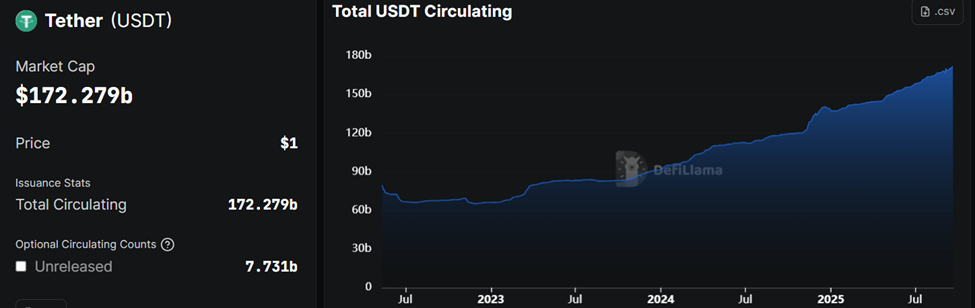
Tether (USDT) Market CapTether (USDT) Market Cap. Source: DefiLlama

The timing is significant, coming only months after Bolivia’s central bank (BCB) recently reported that crypto transactions in the country soared to $430 million in the 12 months since lifting its blanket ban on digital assets in 2024.

“In one year, operations in virtual assets grew by more than % and reached $430 million,” the BCB shared in a June post.

That figure represents a 630% year-over-year (YoY) surge, with the first half of 2025 alone recording $294 million in crypto payments, up from $46.5 million a year earlier. This is a jump of more than 530%.

The BCB sees crypto as an enabler to foreign currency transactions, including remittances, small purchases, and payments.

The country’s growing adoption comes as digital assets benefit micro and small business owners across various sectors, with new developments stretching perks to the automobile industry.

Bolivian legislator Mariela Baldivieso of the Comunidad Ciudadana party recently highlighted crypto’s potential as an enabler to Latin America’s economic foundation.

She explained more closely that Bolivia’s crypto adoption puts the country among the top five adopters in Latin America, citing progressive policy reforms.

Bolivia’s Macroeconomic Backdrop Explains the Momentum

Meanwhile, Bolivia’s macroeconomic outlook adds credence to the growing adoption. The country in South America is grappling with severe dollar shortages, 40-year-high inflation, and long fuel queues as foreign reserves dwindle.

The boliviano has lost nearly half its value on the black market this year, forcing households and businesses to seek stable alternatives.

While the government maintains an artificially steady official rate, the widening gap has pushed many into crypto rails, particularly stablecoins like USDT.

Economists, however, caution against interpreting the surge as evidence of long-term stability.

“This (crypto uptick) isn’t a sign of stability…It’s more a reflection of the deteriorating purchasing power of households,” Reuters reported recently, citing former central bank head Jose Gabriel Espinoza.

Still, Tether sees the trend as validation. Ardoino noted that USDT brings digital dollar savings to the world.

He also noted the addition of 2.9x more new $1+ holders than all other stablecoins combined over the past three months.

The integration of USDT into mainstream commerce in Bolivia mirrors how fast stablecoins are embedding into everyday economic life across emerging markets.

Nevertheless, while Latin America adds to the list of Tether’s growing footprint, the stablecoin issuer draws the line in Europe.

MiCA (Markets in Crypto Assets) is the main impediment, with the Tether executive refusing to adjust the firm’s principles to meet regulation.

“When MiCA becomes safer for consumers and stablecoin issuers, then we might reconsider,” Ardoino said in a post.

Meanwhile, industry peers and market competitors like Circle, which issues USDC stablecoin, leverage this edge.

Featuring among 14 stablecoin issuers formally classified as e-money tokens or EMT issuers, Circle received MiCA licenses earlier in the year.

This allows the firm to “passport” services across 30 EEA countries without needing separate approvals in each jurisdiction.

Disclaimer: For information purposes only. Past performance is not indicative of future results.
placeholder
Gold Price Analysis Today | Forex Gold Analysis | XAU/USD Analysis - November 11, 2026Get the latest gold price analysis, forex gold insights, and XAU/USD analysis for November 11, 2026. Read on for the details.
Author  Mitrade
Nov 11, Wed
Get the latest gold price analysis, forex gold insights, and XAU/USD analysis for November 11, 2026. Read on for the details.
placeholder
Nvidia slid 7.7% after hours while AMD and Broadcom rose — the AI trade changed hands, it didn't breakNvidia closed Wednesday at 173.73, up 2.87%, then fell as much as 8.1% to 159.44 after reports that its board was preparing for a possible leadership change. The same session, the Philadelphia Semiconductor Index rose 5.7% with all 30 components higher, CoreWeave jumped 24.7% on 168% revenue growth, and Micron added 11.9%. If AI demand were being repriced, AMD and Broadcom would not be bid. This is a governance discount on one name, and 204.54 — the 200-day average — is the level that settles it.
Author  Irene Q.
Nov 12, Thu
Nvidia closed Wednesday at 173.73, up 2.87%, then fell as much as 8.1% to 159.44 after reports that its board was preparing for a possible leadership change. The same session, the Philadelphia Semiconductor Index rose 5.7% with all 30 components higher, CoreWeave jumped 24.7% on 168% revenue growth, and Micron added 11.9%. If AI demand were being repriced, AMD and Broadcom would not be bid. This is a governance discount on one name, and 204.54 — the 200-day average — is the level that settles it.
placeholder
US October PPI Preview: Fed Rate Hike Expectations Rise, PPI May Be Key Variable; How Will US Stocks, Dollar, and Gold Move?On Friday (Nov. 13) Eastern Time, the U.S. will release the October Producer Price Index (PPI). Following the October CPI once again exceeding expectations, the market will look to the PP
Author  TradingKey
Nov 12, Thu
On Friday (Nov. 13) Eastern Time, the U.S. will release the October Producer Price Index (PPI). Following the October CPI once again exceeding expectations, the market will look to the PP
placeholder
Gold hit a one-year low while central banks bought 321 tonnes — the sellers were never the ones you thinkSpot gold closed at 3,876 on Thursday, down 2.8% and its lowest close in more than a year, with an intraday low near 3,852. The dollar is at a 19-month high of 103.21 and the 10-year yield is at 5.10%, so the price move is easy to explain. What is harder to explain is who sold: central banks bought 321 tonnes in Q3, the PBoC added for a 24th straight month, ETF holdings are near a record 4,256 tonnes, and roughly 95% of the futures selling came from non-reportable and sovereign-type accounts rather than hedge funds. This piece separates the two books that have to balance.
Author  Irene Q.
Yesterday 02: 40
Spot gold closed at 3,876 on Thursday, down 2.8% and its lowest close in more than a year, with an intraday low near 3,852. The dollar is at a 19-month high of 103.21 and the 10-year yield is at 5.10%, so the price move is easy to explain. What is harder to explain is who sold: central banks bought 321 tonnes in Q3, the PBoC added for a 24th straight month, ETF holdings are near a record 4,256 tonnes, and roughly 95% of the futures selling came from non-reportable and sovereign-type accounts rather than hedge funds. This piece separates the two books that have to balance.
placeholder
Brent rose 3.3% and US crude stocks built 4.66 million barrels in the same weekBrent January settled at 95.82, up 3.3%, and WTI at 88.74, up 2.55%, after the US signalled it would not pursue a deal with Iran and attacks on Gulf shipping continued. In the same week, EIA data showed US crude inventories rising 4.657 million barrels against expectations of a 1.1 million draw, with gasoline up another 1.799 million. OPEC output also rebounded 1.96 million barrels a day to 27.16 million in October, led by Saudi Arabia at 10.56 million. This piece separates the geopolitical premium from the physical balance and lays out where each side of the trade is anchored.
Author  Irene Q.
Yesterday 03: 06
Brent January settled at 95.82, up 3.3%, and WTI at 88.74, up 2.55%, after the US signalled it would not pursue a deal with Iran and attacks on Gulf shipping continued. In the same week, EIA data showed US crude inventories rising 4.657 million barrels against expectations of a 1.1 million draw, with gasoline up another 1.799 million. OPEC output also rebounded 1.96 million barrels a day to 27.16 million in October, led by Saudi Arabia at 10.56 million. This piece separates the geopolitical premium from the physical balance and lays out where each side of the trade is anchored.
goTop
quote