

Bitcoin And Crypto Market To Crash? Analyst’s August-September Prediction

Source Newsbtc

According to a new technical analysis, Bitcoin (BTC) and the broader crypto market could be mirroring historical post-halving cycle patterns. While the market has previously rallied through July and August, historical fractals point to a potential crash in September, followed by a push into a cycle peak later in the year. 

September Proves Risky For Bitcoin And Crypto Market 

A recent X social media post by crypto analyst Benjamin Cowen has highlighted a recurring pattern in Bitcoin’s price action that could have significant implications for the market over the coming months. His analysis shows that Bitcoin has consistently followed a post-halving cycle that exhibits distinct seasonal price movements, particularly around July, August, and September.

The chart shared by Cowen illustrates that in previous cycles, Bitcoin has often rallied in July and August, fueling optimism and strong market sentiment. However, each time this has been followed by a September crash, leading to a reset before the final push toward the cycle top, which usually arrives in the last quarter of the year. 
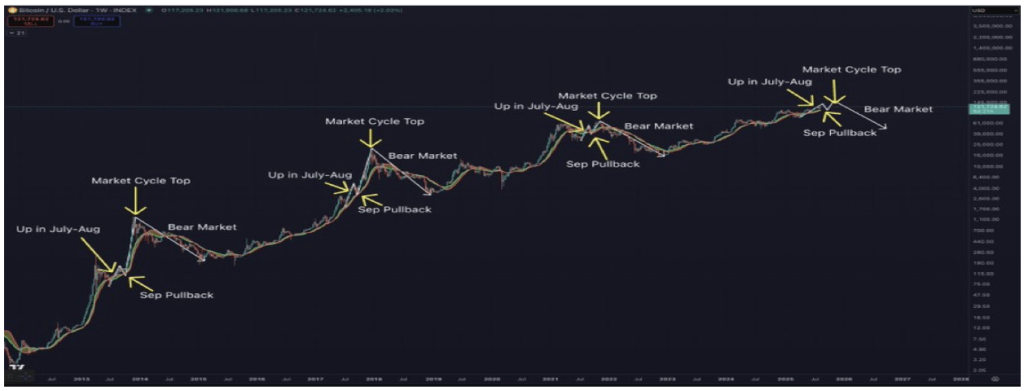
According to the analysis, this repeating structure is not unique to a single cycle but has appeared across multiple past cycles, giving weight to the expert’s argument that history could be repeating. In 2013, 2017, and 2021, Bitcoin’s price behavior followed this pattern almost identically, showing strength in mid-summer and weakness in September. 

After a final rally to a peak, each of these cycles was eventually followed by an extended bear market phase, during which valuations corrected sharply from their highs. Based on Cowen’s report, the current cycle appears to be unfolding the same way, as Bitcoin already displayed strength in July and August this year, sparking concerns that a September pullback could be approaching. 

BTC Cycles Suggest Market Still Has Room To Grow

A new technical analysis by crypto market expert TechDev also reveals a recurring pattern in Bitcoin’s long-term price cycles, arguing that, contrary to popular belief, the current market may still be far from its peak. The analysis, supported by a historical chart of BTC’s performance, shows that every market top has consistently occurred around 14 months after a specific cyclical signal. 

The chart outlines multiple Bitcoin cycles dating back to 2011, with tops and bottoms clearly marked with green and red indicators. Each upward run is followed by a significant correction and then a recovery accumulation phase. The data also revealed that each cycle top often aligned with a measured time frame of approximately 420 days. 
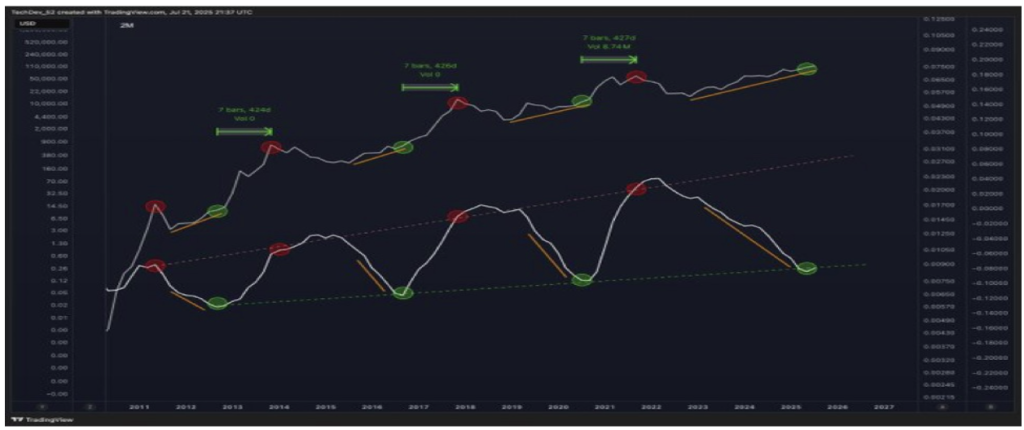
Based on this model, current projections show that Bitcoin still has room to run. The most recent green marker on the chart signals that the market could already be transitioning out of its corrective phase. If historical patterns hold, this could mean the market is entering a prolonged growth window rather than nearing exhaustion. 

Featured image from Unsplash, chart from TradingView

Disclaimer: For information purposes only. Past performance is not indicative of future results.
placeholder
Ethereum Drops Below $2,000 After Plunging Over 20% in a Month as Odds of $1,500 Retest SurgeEthereum Plunges Over 20% in a Month, Risking a Retest of $1,500 After Losing the $2,000 Defense Line.On November 13, Ethereum (ETH) plunged more than 5%, officially falling below the key
Author  TradingKey
10 hours ago
Ethereum Plunges Over 20% in a Month, Risking a Retest of $1,500 After Losing the $2,000 Defense Line.On November 13, Ethereum (ETH) plunged more than 5%, officially falling below the key
placeholder
Gold Price Forecast: Gold Tumbles Below $3,900 as Trump Says No Need for Iran Deal; Can October PPI Spur a Rebound? As of the Asian session on Friday (November 13), gold prices (XAUUSD) rebounded intraday following Thursday's sharp decline, trading near $3,910. Previously, gold tumbled 2.76% on Thursda
Author  TradingKey
12 hours ago
As of the Asian session on Friday (November 13), gold prices (XAUUSD) rebounded intraday following Thursday's sharp decline, trading near $3,910. Previously, gold tumbled 2.76% on Thursda
placeholder
Brent rose 3.3% and US crude stocks built 4.66 million barrels in the same weekBrent January settled at 95.82, up 3.3%, and WTI at 88.74, up 2.55%, after the US signalled it would not pursue a deal with Iran and attacks on Gulf shipping continued. In the same week, EIA data showed US crude inventories rising 4.657 million barrels against expectations of a 1.1 million draw, with gasoline up another 1.799 million. OPEC output also rebounded 1.96 million barrels a day to 27.16 million in October, led by Saudi Arabia at 10.56 million. This piece separates the geopolitical premium from the physical balance and lays out where each side of the trade is anchored.
Author  Irene Q.
15 hours ago
Brent January settled at 95.82, up 3.3%, and WTI at 88.74, up 2.55%, after the US signalled it would not pursue a deal with Iran and attacks on Gulf shipping continued. In the same week, EIA data showed US crude inventories rising 4.657 million barrels against expectations of a 1.1 million draw, with gasoline up another 1.799 million. OPEC output also rebounded 1.96 million barrels a day to 27.16 million in October, led by Saudi Arabia at 10.56 million. This piece separates the geopolitical premium from the physical balance and lays out where each side of the trade is anchored.
placeholder
Gold hit a one-year low while central banks bought 321 tonnes — the sellers were never the ones you thinkSpot gold closed at 3,876 on Thursday, down 2.8% and its lowest close in more than a year, with an intraday low near 3,852. The dollar is at a 19-month high of 103.21 and the 10-year yield is at 5.10%, so the price move is easy to explain. What is harder to explain is who sold: central banks bought 321 tonnes in Q3, the PBoC added for a 24th straight month, ETF holdings are near a record 4,256 tonnes, and roughly 95% of the futures selling came from non-reportable and sovereign-type accounts rather than hedge funds. This piece separates the two books that have to balance.
Author  Irene Q.
16 hours ago
Spot gold closed at 3,876 on Thursday, down 2.8% and its lowest close in more than a year, with an intraday low near 3,852. The dollar is at a 19-month high of 103.21 and the 10-year yield is at 5.10%, so the price move is easy to explain. What is harder to explain is who sold: central banks bought 321 tonnes in Q3, the PBoC added for a 24th straight month, ETF holdings are near a record 4,256 tonnes, and roughly 95% of the futures selling came from non-reportable and sovereign-type accounts rather than hedge funds. This piece separates the two books that have to balance.
placeholder
Today’s Market Recap: Nvidia Drops Over 4% After Jensen Huang Resigns, AMD and Broadcom Both Rise Over 5% On November 12, the three major U.S. stock indices closed slightly lower. Nvidia announced that Jensen Huang had stepped down immediately as CEO and director, draggi
Author  TradingKey
17 hours ago
On November 12, the three major U.S. stock indices closed slightly lower. Nvidia announced that Jensen Huang had stepped down immediately as CEO and director, draggi
goTop
quote