




Microsoft Stock Just Did Something It Hasn't Done in 1 Year. Here's What May Happen Next.
Key Points
Microsoft is a company that’s winning in the high-growth artificial intelligence market.
The company’s cloud revenue soared in the double-digits in the recent quarter.
- 10 stocks we like better than Microsoft ›
Microsoft (NASDAQ: MSFT) is one of the major players in an industry poised to deliver explosive growth in the coming years: artificial intelligence (AI). In fact, this tech giant has already been benefiting from AI as it offers something customers need a lot of these days -- capacity for AI workloads.
In recent quarters, this has resulted in growth for Microsoft Azure, the company's cloud business, as it offers AI infrastructure. And in the company's latest quarterly earnings report, delivered just this week, this positive message continued. Microsoft Azure and other cloud revenue surged 39% in the period, and chief executive officer Satya Nadella said, "we are only at the beginning phases of AI diffusion." So there may be a lot more growth to come.
Where to invest $1,000 right now? Our analyst team just revealed what they believe are the 10 best stocks to buy right now. Continue »
Meanwhile, Microsoft's stock hasn't reflected this optimism in recent weeks -- in fact, it recently did something it hasn't done in a year. Let's check it out and see what may happen next.

Image source: Getty Images.
Fundamentals vs technical analysis
First, it's important to note that there are various ways to look at a stock's performance and consider what's ahead. One of those is by looking at fundamentals such as earnings reports and financial health. Another is technical analysis, which considers certain price, volume, and other trading patterns and how they've impacted performance in the past.
Considering fundamentals is the best way for investors to understand whether a stock is a solid long-term bet. But every once in a while, you may also look at a technical analysis pattern for an idea of what a stock might do in the days or weeks to come.
And this brings me to the move Microsoft recently made. The stock formed a death cross, something that happens when its short-term moving average crosses under its long-term moving average. The last time Microsoft stock did this was last spring.
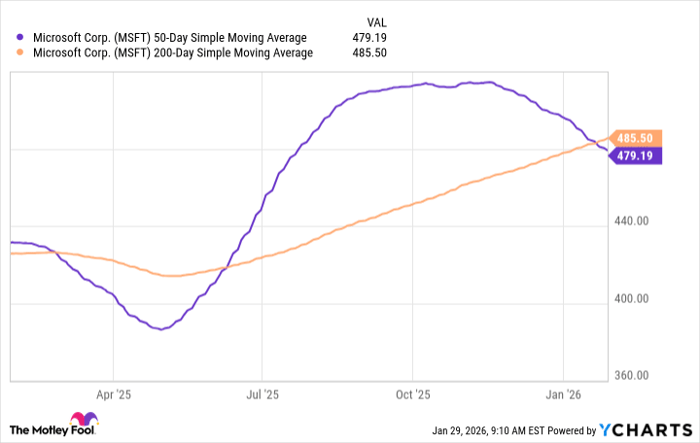
MSFT 50-Day Simple Moving Average data by YCharts
A bearish pattern
Generally, when this happens, it suggests a bearish pattern, and that means additional declines may follow. Now, does this mean you should avoid Microsoft stock? Not at all. In fact, you may even use this as a buying opportunity, considering the tech giant's solid long-term outlook. By investing on the dip, you'll get in on the stock at a lower valuation.
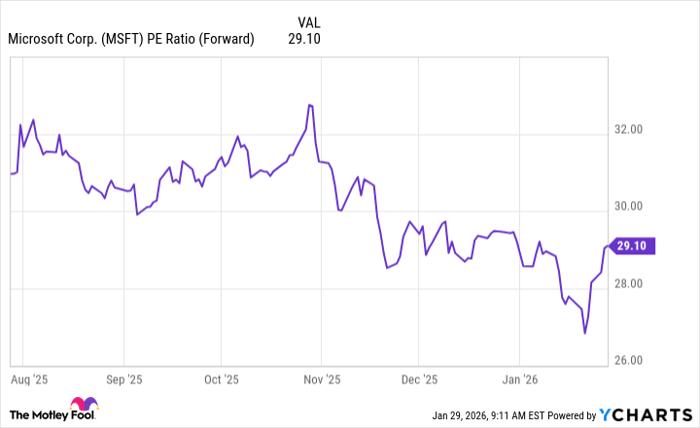
MSFT PE Ratio (Forward) data by YCharts
It's also important to point out that a technical pattern such as this one may easily be interrupted by positive news from the company or industry. And the declines following a death cross aren't necessarily long-lasting.
All of this means that this technical analysis move that may look ominous actually represents a good time to get in on a quality long-term market giant -- and this time it's potential AI winner, Microsoft.
Should you buy stock in Microsoft right now?
Before you buy stock in Microsoft, consider this:
The Motley Fool Stock Advisor analyst team just identified what they believe are the 10 best stocks for investors to buy now… and Microsoft wasn’t one of them. The 10 stocks that made the cut could produce monster returns in the coming years.
Consider when Netflix made this list on December 17, 2004... if you invested $1,000 at the time of our recommendation, you’d have $456,457!* Or when Nvidia made this list on April 15, 2005... if you invested $1,000 at the time of our recommendation, you’d have $1,174,057!*
Now, it’s worth noting Stock Advisor’s total average return is 950% — a market-crushing outperformance compared to 197% for the S&P 500. Don't miss the latest top 10 list, available with Stock Advisor, and join an investing community built by individual investors for individual investors.
See the 10 stocks »
*Stock Advisor returns as of January 29, 2026.
Adria Cimino has no position in any of the stocks mentioned. The Motley Fool has positions in and recommends Microsoft. The Motley Fool has a disclosure policy.
Recommended Articles


