

Sharp Pullback in Gold Prices: No Need for Overconcern

Source Tradingkey

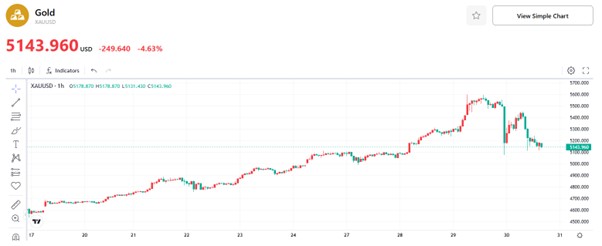
From January 29 to 30, the gold market witnessed a highly volatile rollercoaster movement. The gold price surged initially, edging close to the record high of $5,600 per ounce; yet following the sharp rally, it retreated rapidly in quick succession. As of the present moment, the spot gold price is quoted at $5,143.96 per ounce.

The sharp pullback in gold prices stems from the combined effects of multiple core factors: first, the gold price had registered an excessively rapid gain in the prior period, with a cumulative surge of as much as 24.1% from January 1 to 29, prompting long positions to take profits at elevated levels; second, the Federal Reserve kept its benchmark interest rate unchanged at its January monetary policy meeting, a move that sent a hawkish policy signal and exerted downward pressure on gold prices; third, the sharp decline in the U.S. stock market triggered investors to sell off gold for liquidity withdrawal, ultimately leading to a panic sell-off in the market.

Nevertheless, we believe investors need not be overly alarmed by the recent slump in gold prices. This correction is essentially a technical pullback in the market, and the underlying uptrend of the gold market for 2026 remains fundamentally intact. This upward trajectory can be interpreted from the perspective of the demand side.

Figure: Gold Price (USD/oz, 1-Hour Chart)
Gold-Prices-c1c19ec3c81c4a53a5012fce1f37c2c3

Source: TradingKey

Looking back at 2025, geopolitical risks continued to escalate, the global economy operated with high uncertainty, and policy frictions among major economies intensified further. Driven by these multiple factors, capital flooded into the gold market on a large scale, underscoring gold’s value as a safe-haven asset and a target for diversified allocation. On January 29, 2026, the World Gold Council released its 2025 Global Gold Demand Trends Report, which showed that total global gold demand hit a record high of 5,002 tonnes in 2025. Among the key figures, global investment demand for gold surged to 2,175 tonnes, breaking the 2,000-tonne mark for the first time to reach a landmark new high; the annual net inflows into global gold ETFs stood at 801 tonnes, ranking as the second-largest annual increase in history.

At the same time, physical gold investment demand also registered a robust performance. In 2025, global demand for gold bars and coins reached 1,374 tonnes, corresponding to a value of approximately $154 billion, a 12-year high. Notably, the sustained gold purchases by central banks worldwide have emerged as a key pillar of gold demand. In 2025, global central banks and governmental institutions added a combined 863 tonnes of gold to their reserves, a volume significantly above the long-term average, which has become one of the core drivers fueling global gold demand.

Over an extended timeframe, the multipolar evolution of the international reserve asset system has pivoted to gold as its core driving factor since 2022. Following the outbreak of the Russia-Ukraine conflict, the US and Western countries imposed coordinated financial sanctions on Russia, exposing traditional foreign exchange reserve assets to severe security challenges. This external shock has directly accelerated the multipolarization of the international reserve asset system. By the end of the third quarter of 2025, the global share of gold in reserves had surged by 11.9 percentage points compared with the end of 2021, a rise that significantly outpaced the 8.9 percentage point decline in the US dollar’s reserve share over the same period. Meanwhile, the shares of the other five major reserve currencies all recorded varying degrees of drop. Notably, the size of global gold reserves has surpassed that of the euro to become the world’s second-largest international reserve asset after the US dollar since the fourth quarter of 2023. As of the end of the third quarter of 2025, the shares of the US dollar, gold and the euro—the three major reserve assets—stood at 42.3%, 25.7% and 15.1% respectively.

Looking forward, in 2026, the fundamental logic underpinning the long-term uptrend in the gold market remains intact. Uncertainties in the bond market this year, market expectations for Federal Reserve interest rate cuts, and the weak performance of the US dollar will serve as the core drivers sustaining the continued strength across all gold investment segments. Meanwhile, geopolitical factors will emerge as a key variable shaping gold investment in 2026, driving a broad-based rise in market risk premia; against the backdrop of growing fragmentation in the global landscape, risk premia have essentially no room for a downward move. As a full-cycle risk hedging instrument, gold boasts a distinct allocation advantage over fixed-income assets and is poised to keep attracting increased allocation demand from global investors in 2026 and beyond. Additionally, while global gold jewelry demand posted a somewhat lackluster performance in 2025, the scale of global gold jewelry consumption is expected to maintain a steady trajectory in 2026 as the global economic recovery, particularly that of China’s economy, gathers momentum. Overall, underpinned by the resonance of multiple demand drivers—including gold ETF allocations, global central bank gold purchases, physical investment by the private sector and gold jewelry consumption—total global gold demand is projected to remain robust in 2026, and the broader trend for gold prices is highly likely to be characterized by a bias toward gains rather than declines.


Disclaimer: For information purposes only. Past performance is not indicative of future results.
placeholder
Bitcoin To Anchor America Party—’Fiat Is Hopeless,’ Says Elon MuskMusk Pitches Bitcoin As Pillar Of America Party
Author  Bitcoinist
Jul 07, 2025
Musk Pitches Bitcoin As Pillar Of America Party
placeholder
Bitcoin briefly loses 2025 gains as crypto plunges over the weekend.Bitcoin experienced a sharp decline this weekend, briefly erasing its 2025 gains and dipping below its year-opening value of $93,507. The cryptocurrency fell to a low of $93,029 on Sunday, representing a 25% drop from its all-time high in October. Although it has rebounded slightly to around $94,209, the pressures on the market remain significant. The downturn occurred despite the reopening of the U.S. government on Thursday, which many had hoped would provide essential support for crypto markets. This year initially appeared promising for cryptocurrencies, particularly after the inauguration of President Donald Trump, who has established the most pro-crypto administration thus far. However, ongoing political tensions—including Trump's tariff strategies and the recent government shutdown, lasting a historic 43 days—have contributed to several rapid price pullbacks for Bitcoin throughout the year. Market dynamics are also being influenced by Bitcoin whales—investors holding large amounts of Bitcoin—who have been offloading portions of their assets, consequently stalling price rallies even as positive regulatory developments emerge. Despite these sell-offs, analysts from Glassnode argue that this behavior aligns with typical patterns seen among long-term investors during the concluding stages of bull markets, suggesting it is not indicative of a mass exodus. Notably, Bitcoin is not alone in its struggles, as Ethereum and Solana have also recorded declines of 7.95% and 28.3%, respectively, since the start of the year, while numerous altcoins have faced even steeper losses. Looking ahead, questions linger regarding the viability of the four-year cycle thesis, particularly given the increasing institutional support and regulatory frameworks now in place in the crypto landscape. Matt Hougan, chief investment officer at Bitwise, remains optimistic, suggesting a potential Bitcoin resurgence in 2026 driven by the “debasement trade” thesis and a broader trend toward increased adoption of stablecoins, tokenization, and decentralized finance. Hougan emphasized the soundness of the underlying fundamentals, pointing to a positive outlook for the sector in the longer term.
Author  Mitrade
Nov 17, 2025
Bitcoin experienced a sharp decline this weekend, briefly erasing its 2025 gains and dipping below its year-opening value of $93,507. The cryptocurrency fell to a low of $93,029 on Sunday, representing a 25% drop from its all-time high in October. Although it has rebounded slightly to around $94,209, the pressures on the market remain significant. The downturn occurred despite the reopening of the U.S. government on Thursday, which many had hoped would provide essential support for crypto markets. This year initially appeared promising for cryptocurrencies, particularly after the inauguration of President Donald Trump, who has established the most pro-crypto administration thus far. However, ongoing political tensions—including Trump's tariff strategies and the recent government shutdown, lasting a historic 43 days—have contributed to several rapid price pullbacks for Bitcoin throughout the year. Market dynamics are also being influenced by Bitcoin whales—investors holding large amounts of Bitcoin—who have been offloading portions of their assets, consequently stalling price rallies even as positive regulatory developments emerge. Despite these sell-offs, analysts from Glassnode argue that this behavior aligns with typical patterns seen among long-term investors during the concluding stages of bull markets, suggesting it is not indicative of a mass exodus. Notably, Bitcoin is not alone in its struggles, as Ethereum and Solana have also recorded declines of 7.95% and 28.3%, respectively, since the start of the year, while numerous altcoins have faced even steeper losses. Looking ahead, questions linger regarding the viability of the four-year cycle thesis, particularly given the increasing institutional support and regulatory frameworks now in place in the crypto landscape. Matt Hougan, chief investment officer at Bitwise, remains optimistic, suggesting a potential Bitcoin resurgence in 2026 driven by the “debasement trade” thesis and a broader trend toward increased adoption of stablecoins, tokenization, and decentralized finance. Hougan emphasized the soundness of the underlying fundamentals, pointing to a positive outlook for the sector in the longer term.
placeholder
Gold Price Forecast: XAU/USD opens lower around $4,450 on fears of widening Iran conflictsGold price (XAU/USD) opens over 1% lower to near $4,445.00 on Monday, as oil prices have rallied further on fears of further widening of conflicts in the Middle East. WTI Oil price is up almost 3% above $102.50 in the opening trade, increasing fears of higher inflation expectations globally.
Author  FXStreet
Mar 30, Mon
Gold price (XAU/USD) opens over 1% lower to near $4,445.00 on Monday, as oil prices have rallied further on fears of further widening of conflicts in the Middle East. WTI Oil price is up almost 3% above $102.50 in the opening trade, increasing fears of higher inflation expectations globally.
placeholder
Silver Price Forecast: XAG/USD falls to near $72.00 amid fading safe-haven demandSilver price (XAG/USD) continues to lose ground after registering tiny losses in the previous day, trading around $72.90 during the Asian hours on Thursday. The safe-haven demand for the precious metal fades amid rising optimism over Middle East peace.
Author  FXStreet
Yesterday 08: 19
Silver price (XAG/USD) continues to lose ground after registering tiny losses in the previous day, trading around $72.90 during the Asian hours on Thursday. The safe-haven demand for the precious metal fades amid rising optimism over Middle East peace.
placeholder
Gold retreats sharply from two-week top/$4,800 as Trump’s Iran comments boost USDGold (XAU/USD) witnessed an intraday turnaround from the $4,800 mark, or a fresh two-week high set earlier this Thursday, and for now, seems to have snapped a four-day winning streak amid resurgent US Dollar (USD) demand.
Author  FXStreet
Yesterday 07: 03
Gold (XAU/USD) witnessed an intraday turnaround from the $4,800 mark, or a fresh two-week high set earlier this Thursday, and for now, seems to have snapped a four-day winning streak amid resurgent US Dollar (USD) demand.
goTop
quote