


Gold steadies as US Dollar stabilizes, dovish Fed bets rise after soft NFP report
- Gold trades flat above $3,350 as the US Dollar stabilizes on Monday.
- The soft July NFP report has heightened market bets on a potential interest rate cut in September.
- Fears of political interference grow after US President Donald Trump fires BLS Commissioner Erika McEntarfer.
Gold (XAU/USD) kicks off the week on a cautious note, trading flat on Monday, as the US Dollar (USD) stabilizes in the aftermath of Friday’s disappointing Nonfarm Payrolls (NFP) report. At the time of writing, the yellow metal is hovering near $3,370 during European trading hours, with traders largely remaining on the sidelines amid fragile sentiment.
July’s jobs report delivered a clear downside surprise. The data has meaningfully increased the likelihood of a rate cut at the Federal Reserve’s (Fed) next monetary policy meeting in September — a shift in sentiment after markets had recently scaled back expectations following last week’s Fed decision to hold interest rates steady.
Despite the renewed dovish tilt in rate cut expectations, Gold’s upside remains limited for now. US Treasury yields have stabilized after Friday’s sharp decline, acting as a headwind and capping bullish momentum in the non-yielding metal.
However, growing concerns over political interference are adding a layer of caution to the market mood. US President Donald Trump abruptly fired Bureau of Labor Statistics (BLS) Commissioner Erika McEntarfer on Friday. Trump accused the BLS head of falsifying employment data after the July jobs report showed a steep slowdown in hiring and sharp downward revisions to previous months, all without providing any evidence.
President Donald Trump questioned the credibility of the latest jobs report, alleging that the figures were produced by a "Biden appointee" in an effort to make him and Republicans look bad. The move has sparked widespread criticism from economists and former officials, raising concerns over the credibility of future US economic data and the independence of core institutions. This political uncertainty is adding a layer of caution to the broader market tone and is helping to limit Gold’s downside for now.
Market movers: Fed Kugler exit, dismal NFP drive dovish Fed bets
- Late Friday, Fed Governor Adriana Kugler announced her resignation, effective August 8, several months before her term was set to end. The early departure paves the way for US President Trump to exert greater influence over the Fed’s policy direction, reinforcing his recent pressure campaign and public criticism aimed at pushing for earlier and deeper interest rate cuts.
- The US President is expected to name replacements for both Fed Governor Adriana Kugler and the recently dismissed BLS Commissioner by the end of this week. The appointments could prove pivotal, with Kugler’s successor potentially in line to become the next Fed Chair once Powell’s term ends, offering President Trump a key opportunity to reshape the central bank with a more dovish tilt ahead of the September policy meeting.
- The US Dollar Index (DXY), which tracks the value of the Greenback against a basket of six major currencies, is hovering around 98.78, stabilizing after falling over 1.30% on Friday.
- The yield on the 10-year US Treasury rose to 4.23%, while the 30-year climbed to 4.83% on Monday, partially recovering after Friday’s plunge to near one-month lows following the soft employment report. The rebound reflects a modest reassessment of the Fed’s rate path as markets balance soft labor data with cautious Fed guidance and lingering inflation concerns.
- The July NFP report showed the US economy added just 73,000 jobs, falling well short of the 110,000 expected, marking the weakest print of the year. To add to the disappointment, prior months were revised sharply lower, with May and June payrolls slashed by a combined 258,000 jobs. Notably, the Unemployment Rate edged up to 4.2%, in line with expectations.
- According to the CME FedWatch Tool, markets are now pricing in a 77% probability of a rate cut at the Federal Reserve’s September policy meeting, up sharply from 37% prior to the NFP release. Reuters further reports that markets are assigning nearly a 90% chance of easing next month, with just under 60 basis points of cuts priced in by December, implying two quarter-point cuts and a 40% chance of a third.
- Looking ahead, the US economic calendar is relatively light this week, though several second-tier data releases and Fed speeches could influence sentiment. Monday features Factory Orders and Loan Officer Survey, followed by S&P Global Composite and ISM Services PMIs on Tuesday. Several Fed officials are also set to speak this week. On Wednesday, Boston Fed President Susan Collins and Fed Governor Lisa Cook are scheduled to speak. That will be followed by remarks from San Francisco Fed President Mary Daly and Atlanta Fed President Raphael Bostic on Thursday. St. Louis Fed President Alberto Musalem is set to speak on Friday. We’ll also get the usual weekly Jobless Claims on Thursday, and the University of Michigan’s 1-year and 5-year Consumer Inflation Expectations data on Friday.
Technical analysis: XAU/USD steadies above 50-day MA, eyes $3,400 next
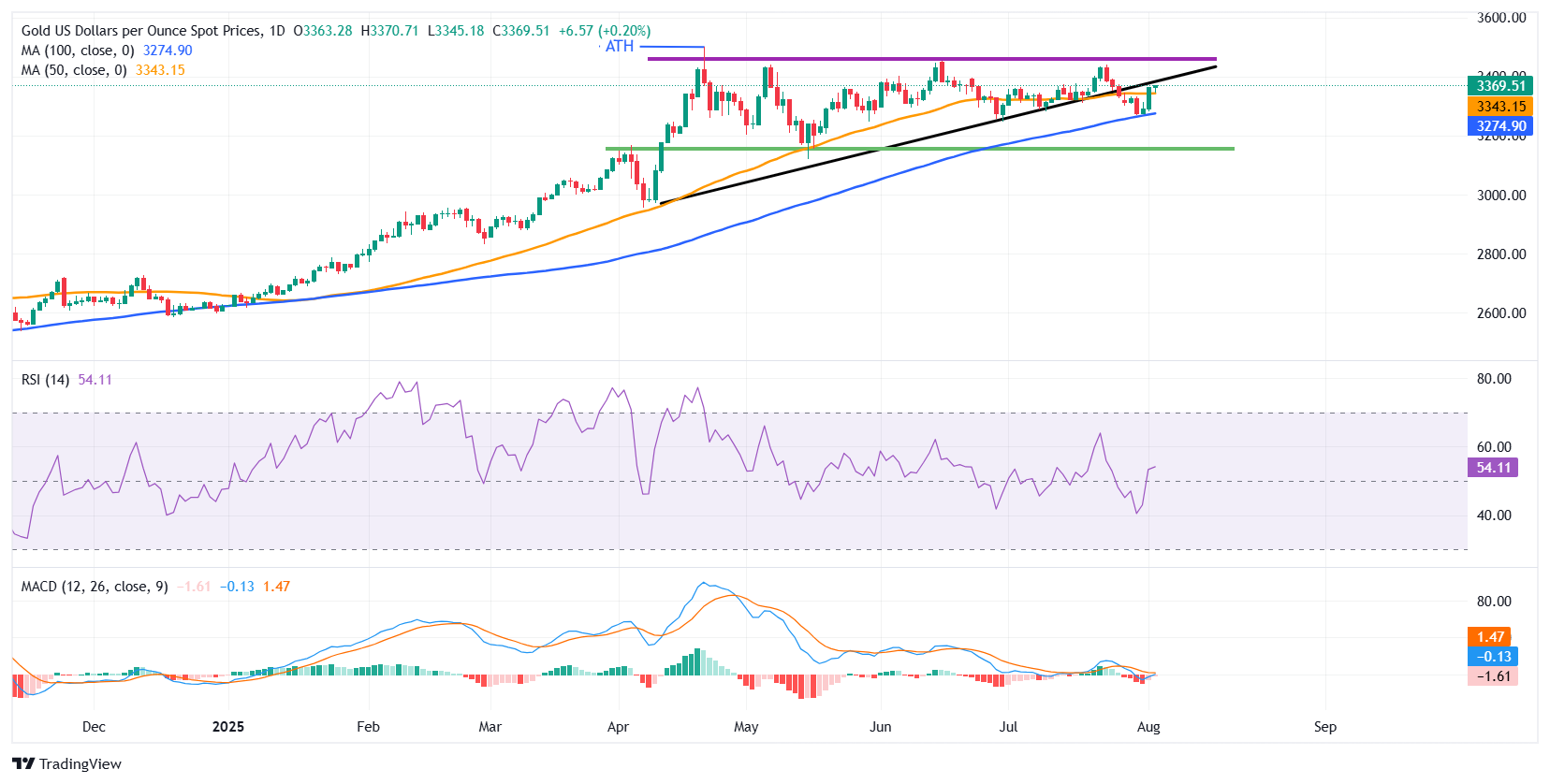
Gold (XAU/USD) is struggling to extend its recovery after last week’s bounce, with price action hovering near $3,370 at the time of writing. Last week, Gold broke below an ascending triangle pattern and briefly touched a one-month low. However, the downside lacked momentum, and prices found support just above the 100-day Simple Moving Average (SMA), signaling that bears are not yet in full control. As of now, the metal is hovering just above the 50-day SMA, which now serves as immediate support, followed by the 100-day SMA. A sustained move lower could open the door toward $3,275 and even $3,200.
The Relative Strength Index (RSI) is neutral around 53, indicating a lack of strong momentum in either direction. Meanwhile, the Moving Average Convergence Divergence (MACD) indicator remains below the zero line, though the histogram is showing early signs of flattening, hinting at reduced bearish pressure for now.
If bulls manage to reclaim the broken triangle base and push above $3,370, a retest of the upper boundary near $3,450 could be on the cards, bringing the all-time highs back into focus.
Gold FAQs
Gold has played a key role in human’s history as it has been widely used as a store of value and medium of exchange. Currently, apart from its shine and usage for jewelry, the precious metal is widely seen as a safe-haven asset, meaning that it is considered a good investment during turbulent times. Gold is also widely seen as a hedge against inflation and against depreciating currencies as it doesn’t rely on any specific issuer or government.
Central banks are the biggest Gold holders. In their aim to support their currencies in turbulent times, central banks tend to diversify their reserves and buy Gold to improve the perceived strength of the economy and the currency. High Gold reserves can be a source of trust for a country’s solvency. Central banks added 1,136 tonnes of Gold worth around $70 billion to their reserves in 2022, according to data from the World Gold Council. This is the highest yearly purchase since records began. Central banks from emerging economies such as China, India and Turkey are quickly increasing their Gold reserves.
Gold has an inverse correlation with the US Dollar and US Treasuries, which are both major reserve and safe-haven assets. When the Dollar depreciates, Gold tends to rise, enabling investors and central banks to diversify their assets in turbulent times. Gold is also inversely correlated with risk assets. A rally in the stock market tends to weaken Gold price, while sell-offs in riskier markets tend to favor the precious metal.
The price can move due to a wide range of factors. Geopolitical instability or fears of a deep recession can quickly make Gold price escalate due to its safe-haven status. As a yield-less asset, Gold tends to rise with lower interest rates, while higher cost of money usually weighs down on the yellow metal. Still, most moves depend on how the US Dollar (USD) behaves as the asset is priced in dollars (XAU/USD). A strong Dollar tends to keep the price of Gold controlled, whereas a weaker Dollar is likely to push Gold prices up.
Recommended Articles


