


Australian Dollar moves little as traders adopt caution ahead of US labor data
- The Australian Dollar could depreciate due to market caution ahead of US Nonfarm Payrolls release on Thursday.
- The AUD receives downward pressure from increased risk aversion amid the US-China trade situation.
- US Initial Jobless Claims rose to 219K the previous week, against the expected 213K and 208K prior.
The Australian Dollar (AUD) remains weak against the US Dollar (USD) for the second consecutive day on Friday. The AUD/USD pair faces additional downward pressure due to risk-off sentiment fueled by escalating US-China trade tensions.
China, Australia’s key trading partner, retaliated against the new 10% US tariff that took effect on Tuesday. However, on Monday afternoon, US President Donald Trump stated that he would likely speak with China within 24 hours. Trump also warned, “If we can't reach a deal with China, the tariffs will be very, very substantial.” Despite this, no further updates have emerged.
Markets now price a 95% probability of a Reserve Bank of Australia (RBA) rate cut from 4.35% to 4.10% in February, further weakening the AUD’s resilience. The RBA has kept the Official Cash Rate (OCR) at 4.35% since November 2023, emphasizing that inflation must “sustainably” return to its 2%-3% target range before considering any policy easing.
Australian Dollar could decline amid market caution ahead of US jobs report
- The US Dollar Index (DXY), which measures the US Dollar’s value against six major currencies, rises to near 107.70 at the time of writing. The Greenback could receive support as sentiment turns cautious ahead of a key US jobs report. Traders brace for Friday’s US Nonfarm Payrolls (NFP) data, which is expected to shape the Federal Reserve’s (Fed) monetary policy direction.
- US Initial Jobless Claims rose to 219K for the week ending January 31, as reported by the US Department of Labor (DoL) on Thursday. This print surpasses initial estimates of 213K and was higher than the previous week's revised tally of 208K (from 207K).
- The US ISM Services PMI eased to 52.8 in January from 54.0 (revised from 54.1) in December. This reading came in below the market consensus of 54.3.
- Federal Reserve Bank of Dallas President Lorie Logan made headlines late Thursday, stating that while inflation progress has been significant, the US labor market remains too strong for the Fed to consider rate cuts in the near future. Logan also acknowledged that even if inflation reaches the 2% target, it may not be sufficient on its own to prompt a rate reduction.
- On Thursday, Federal Reserve Vice Chair Philip Jefferson expressed his satisfaction with keeping the Fed Funds rate at its current level, stating that he would assess the overall impact of Trump's policies before making further decisions. He also emphasized that the Fed's rate remains restrictive for the economy, even with a 100-basis-point decline.
- President Trump has agreed to a 30-day suspension of the proposed 25% tariffs on Canadian and Mexican imports. This decision comes after Canadian Prime Minister Justin Trudeau and Mexican President Claudia Sheinbaum committed to enhancing border security measures to address concerns over illegal immigration and drug trafficking.
- China’s Commerce Ministry announced that it will impose a 15% tariff on US coal and liquefied natural gas (LNG) imports, along with an additional 10% tariff on crude Oil, farm equipment, and certain automobiles. Additionally, to "safeguard national security interests," China is implementing export controls on tungsten, tellurium, ruthenium, molybdenum, and related products.
- Australia's trade surplus fell to 5,085M in December, missing the expected 7,000M and down from the previous surplus of 6,792M. Exports increased by 1.1% MoM, slowing from November's 4.2% rise, while imports surged 5.9% MoM, up from 1.4% in the prior month.
- Australia’s Judo Bank Composite PMI climbed to 51.1 in January from 50.2 in December, reflecting modest growth in private sector activity. Meanwhile, the Judo Bank Services PMI rose to 51.2 from 50.8, marking the twelfth consecutive month of expansion in the services sector. Although growth was moderate, it was the strongest since August.
Australian Dollar remains steady below 0.6300, initial support appears at nine-day EMA
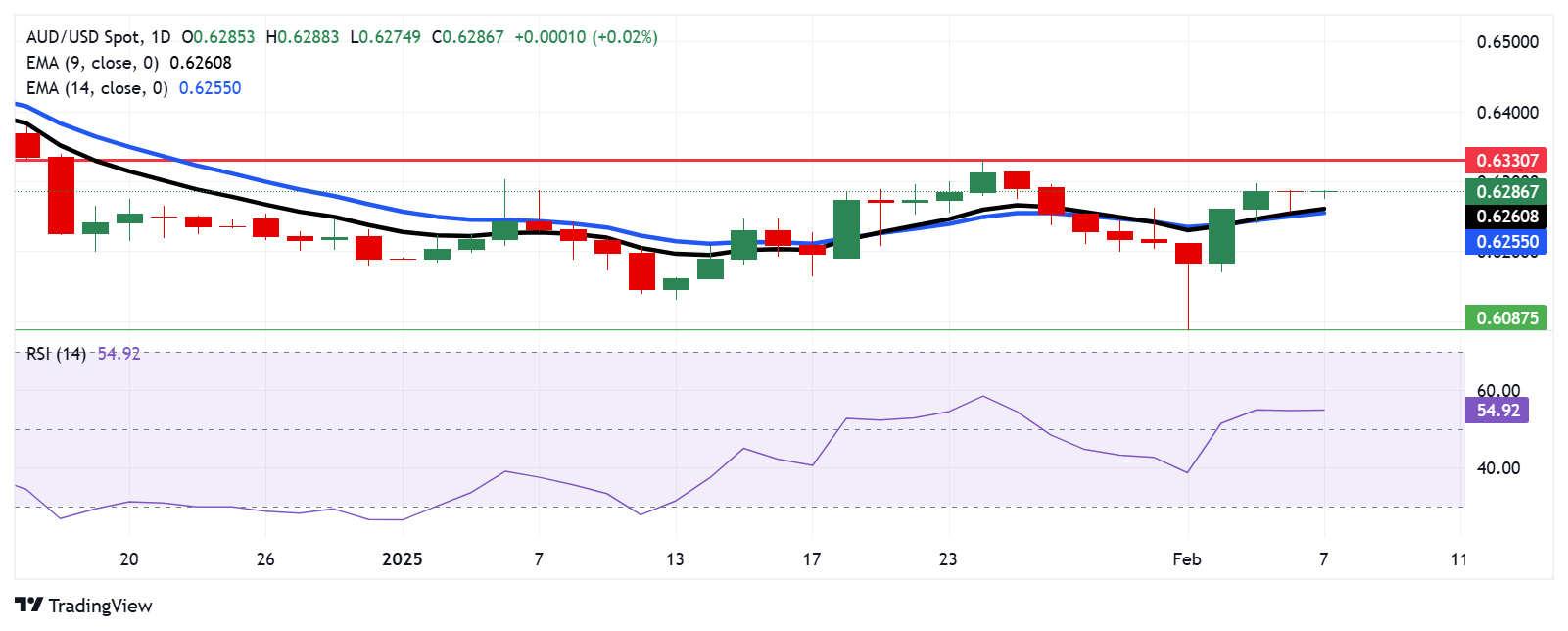
AUD/USD hovers near 0.6290 on Friday, maintaining position above the nine- and 14-day Exponential Moving Averages (EMAs) on the daily chart, signaling stronger short-term bullish momentum. Additionally, the 14-day Relative Strength Index (RSI) remains above the 50 level, reinforcing the bullish trend.
On the upside, the AUD/USD pair could test the seven-week high of 0.6330, last reached on January 24.
Immediate support lies at the nine-day EMA near 0.6260, followed by the 14-day EMA at 0.6254. A break below these levels could weaken the bullish outlook, potentially driving the AUD/USD pair toward 0.6087—the lowest level since April 2020, recorded on February 3.
AUD/USD: Daily Chart
Australian Dollar PRICE Today
The table below shows the percentage change of Australian Dollar (AUD) against listed major currencies today. Australian Dollar was the strongest against the Swiss Franc.
| USD | EUR | GBP | JPY | CAD | AUD | NZD | CHF | |
|---|---|---|---|---|---|---|---|---|
| USD | 0.09% | 0.09% | 0.05% | 0.04% | -0.03% | -0.12% | 0.11% | |
| EUR | -0.09% | 0.00% | -0.06% | -0.04% | -0.12% | -0.20% | 0.01% | |
| GBP | -0.09% | -0.00% | -0.08% | -0.06% | -0.12% | -0.21% | 0.02% | |
| JPY | -0.05% | 0.06% | 0.08% | 0.00% | -0.07% | -0.18% | 0.05% | |
| CAD | -0.04% | 0.04% | 0.06% | -0.00% | -0.08% | -0.16% | 0.07% | |
| AUD | 0.03% | 0.12% | 0.12% | 0.07% | 0.08% | -0.09% | 0.14% | |
| NZD | 0.12% | 0.20% | 0.21% | 0.18% | 0.16% | 0.09% | 0.22% | |
| CHF | -0.11% | -0.01% | -0.02% | -0.05% | -0.07% | -0.14% | -0.22% |
The heat map shows percentage changes of major currencies against each other. The base currency is picked from the left column, while the quote currency is picked from the top row. For example, if you pick the Australian Dollar from the left column and move along the horizontal line to the US Dollar, the percentage change displayed in the box will represent AUD (base)/USD (quote).
Australian Dollar FAQs
One of the most significant factors for the Australian Dollar (AUD) is the level of interest rates set by the Reserve Bank of Australia (RBA). Because Australia is a resource-rich country another key driver is the price of its biggest export, Iron Ore. The health of the Chinese economy, its largest trading partner, is a factor, as well as inflation in Australia, its growth rate and Trade Balance. Market sentiment – whether investors are taking on more risky assets (risk-on) or seeking safe-havens (risk-off) – is also a factor, with risk-on positive for AUD.
The Reserve Bank of Australia (RBA) influences the Australian Dollar (AUD) by setting the level of interest rates that Australian banks can lend to each other. This influences the level of interest rates in the economy as a whole. The main goal of the RBA is to maintain a stable inflation rate of 2-3% by adjusting interest rates up or down. Relatively high interest rates compared to other major central banks support the AUD, and the opposite for relatively low. The RBA can also use quantitative easing and tightening to influence credit conditions, with the former AUD-negative and the latter AUD-positive.
China is Australia’s largest trading partner so the health of the Chinese economy is a major influence on the value of the Australian Dollar (AUD). When the Chinese economy is doing well it purchases more raw materials, goods and services from Australia, lifting demand for the AUD, and pushing up its value. The opposite is the case when the Chinese economy is not growing as fast as expected. Positive or negative surprises in Chinese growth data, therefore, often have a direct impact on the Australian Dollar and its pairs.
Iron Ore is Australia’s largest export, accounting for $118 billion a year according to data from 2021, with China as its primary destination. The price of Iron Ore, therefore, can be a driver of the Australian Dollar. Generally, if the price of Iron Ore rises, AUD also goes up, as aggregate demand for the currency increases. The opposite is the case if the price of Iron Ore falls. Higher Iron Ore prices also tend to result in a greater likelihood of a positive Trade Balance for Australia, which is also positive of the AUD.
The Trade Balance, which is the difference between what a country earns from its exports versus what it pays for its imports, is another factor that can influence the value of the Australian Dollar. If Australia produces highly sought after exports, then its currency will gain in value purely from the surplus demand created from foreign buyers seeking to purchase its exports versus what it spends to purchase imports. Therefore, a positive net Trade Balance strengthens the AUD, with the opposite effect if the Trade Balance is negative.
Recommended Articles


