


EUR/USD skates on thin ice with US inflation, ECB policy in focus
- EUR/USD remains below 1.1050 as investors turn cautious ahead of the US inflation for August and the ECB policy announcement.
- The ECB is expected to cut its key borrowing rates by 25 basis points (bps).
- US inflation data will influence market speculation for the Fed’s potential interest rate cut size.
EUR/USD struggles to gain ground near its weekly low of 1.1030 in Tuesday’s European session. The major currency pair remains under pressure as investors turn cautious ahead of the United States (US) Consumer Price Index (CPI) data for August and the European Central Bank’s interest rate policy, which will be published on Wednesday and announced on Thursday, respectively.
Investors will keenly focus on the US consumer inflation data as it is just a week before the Federal Reserve’s (Fed) monetary policy meeting. The inflation data will provide fresh cues about whether the Fed will start its policy-easing process gradually or aggressively. The importance of the inflation data in getting more insights about the magnitude of the Fed interest rate cut has increased significantly as the US Nonfarm Payrolls (NFP) data for August failed to make a clear case for the Fed’s likely interest rate cut size.
Earlier, market participants remained worried that the Fed could opt for a large interest rate cut in September due to a sharp slowdown in the US job growth, indicated by the US NFP report for July, which prompted fears for the economy entering a recession. However, Friday’s NFP report showed that the labor market health is not as bad as it appeared last month.
Economists expect the annual headline CPI to have grown at a slower pace of 2.6%, the lowest since March 2021, from July’s reading of 2.9%. The core inflation – which excludes volatile food and energy prices – is expected to have risen steadily by 3.2%. Both monthly headline and core inflation are projected to have increased by 0.2%.
Later this week, investors will focus on the US Producer Price Index (PPI) data for August, which will be published on Thursday.
Daily digest market movers: EUR/USD trades with caution as ECB policy takes centre stage
- EUR/USD trades cautiously as the Euro (EUR) exhibits a subdued performance, with investors focusing on the ECB’s interest rate policy. The ECB is widely anticipated to cut interest rates by 25 basis points (bps) on Thursday. This will be the second interest rate cut decision by the ECB in its current policy-easing cycle, which the bank started in June but left borrowing rates unchanged in July.
- Though investors seem confident about the ECB resuming its policy-easing process, market participants will majorly focus on the monetary policy statement and ECB President Christine Lagarde’s press conference to get cues about the likely policy action for the remainder of the year.
- Lagarde is expected to deliver a dovish interest rate guidance as the annual Harmonized Index of Consumer Prices (HICP) of the Eurozone’s largest nation, Germany, has returned to the bank’s target of 2% in August. Also, German economic growth is vulnerable due to the poor demand environment. The scenario of declining inflation and worsening economic conditions paves the way for an expansionary monetary policy stance.
- Currently, financial market participants expect that the ECB will cut interest rates one more time in the last quarter of this year.
Technical Analysis: EUR/USD trades below 1.1050
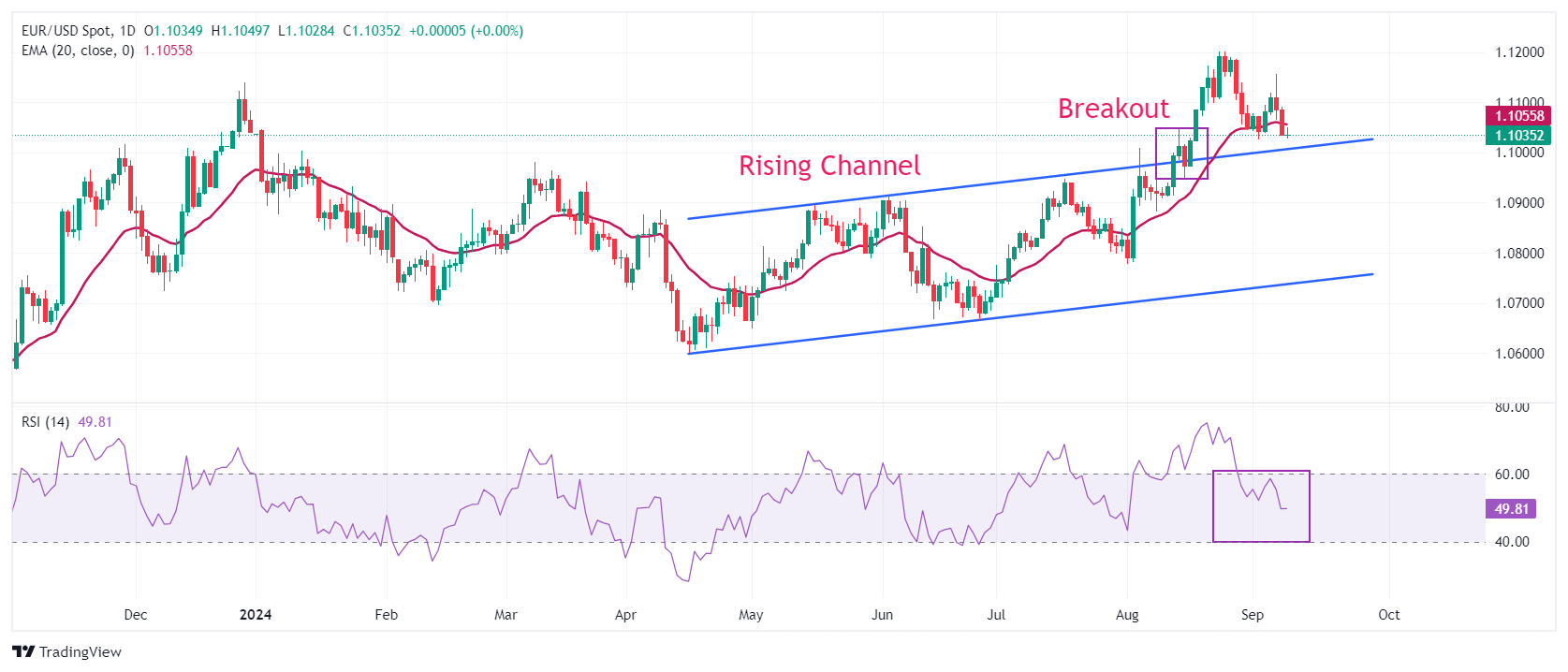
EUR/USD steadies below 1.1050 in Tuesday’s European trading hours. The major currency pair has come under pressure after failing to sustain above the crucial resistance of 1.1100. The near-term outlook of the shared currency pair is uncertain as it continues to trade below the 20-day Exponential Moving Average (EMA), which trades around 1.1060.
The 14-day Relative Strength Index (RSI) falls further to 50.00, suggesting a lack of momentum and a sideways trend.
The pair is expected to find support near the psychological level of 1.1000. On the upside, last week’s high of 1.1155 and the round-level resistance of 1.1200 will act as major barricades for the Euro bulls.
Euro FAQs
The Euro is the currency for the 20 European Union countries that belong to the Eurozone. It is the second most heavily traded currency in the world behind the US Dollar. In 2022, it accounted for 31% of all foreign exchange transactions, with an average daily turnover of over $2.2 trillion a day. EUR/USD is the most heavily traded currency pair in the world, accounting for an estimated 30% off all transactions, followed by EUR/JPY (4%), EUR/GBP (3%) and EUR/AUD (2%).
The European Central Bank (ECB) in Frankfurt, Germany, is the reserve bank for the Eurozone. The ECB sets interest rates and manages monetary policy. The ECB’s primary mandate is to maintain price stability, which means either controlling inflation or stimulating growth. Its primary tool is the raising or lowering of interest rates. Relatively high interest rates – or the expectation of higher rates – will usually benefit the Euro and vice versa. The ECB Governing Council makes monetary policy decisions at meetings held eight times a year. Decisions are made by heads of the Eurozone national banks and six permanent members, including the President of the ECB, Christine Lagarde.
Eurozone inflation data, measured by the Harmonized Index of Consumer Prices (HICP), is an important econometric for the Euro. If inflation rises more than expected, especially if above the ECB’s 2% target, it obliges the ECB to raise interest rates to bring it back under control. Relatively high interest rates compared to its counterparts will usually benefit the Euro, as it makes the region more attractive as a place for global investors to park their money.
Data releases gauge the health of the economy and can impact on the Euro. Indicators such as GDP, Manufacturing and Services PMIs, employment, and consumer sentiment surveys can all influence the direction of the single currency. A strong economy is good for the Euro. Not only does it attract more foreign investment but it may encourage the ECB to put up interest rates, which will directly strengthen the Euro. Otherwise, if economic data is weak, the Euro is likely to fall. Economic data for the four largest economies in the euro area (Germany, France, Italy and Spain) are especially significant, as they account for 75% of the Eurozone’s economy.
Another significant data release for the Euro is the Trade Balance. This indicator measures the difference between what a country earns from its exports and what it spends on imports over a given period. If a country produces highly sought after exports then its currency will gain in value purely from the extra demand created from foreign buyers seeking to purchase these goods. Therefore, a positive net Trade Balance strengthens a currency and vice versa for a negative balance.
Recommended Articles


