


Indian Rupee faces pressure from higher bond yields, FIIs outflow
- The Indian Rupee opens on a negative note against the US Dollar due to multiple headwinds.
- FIIs are trimming their stake in Indian stock markets due to higher bond yields.
- Analysts at MUFG expects the RBI to leave its Repo Rate steady on Wednesday.
The Indian Rupee (INR) opens lower against the US Dollar (USD) on Tuesday due to the continuous surge in global bond yields. The USD/INR pair rises to near 96.43, the highest level seen in over two months.
As of writing, 10-year United States (US) Treasury Yields are up 0.24% to near 5.32. On Monday, US bond yields posted a fresh two-decade high near 5.35%. Generally, higher bond yields lead to a risk-off environment, a scenario that diminishes the appeal of riskier assets, such as the Indian Rupee.
Apart from rallying bond yields, the continuous outflow of foreign funds from the Indian stock market is also weighing on the Indian currency.
In the first two trading days of October, Foreign Institutional Investors (FIIs) have offloaded their stake worth Rs. 14,183.36 crore.
What is rallying US bond yields?
Yields on US-backed securities are rallying significantly for months. Fears of persistent global inflationary pressures due to energy supply shocks induced by the Middle East war are supporting the rally.
The advance in the US Treasury Yields seems not taking a pause even as soft United States (US) Nonfarm Payrolls (NFP) data for September has forced traders to scale back hawkish Federal Reserve (Fed) interest rate expectations.
According to analysts at Societe Generale, though the softer US payrolls report has reinforced the recent pullback in expectations for near‑term Fed tightening, the bank stresses that it is “not a game changer for the hawkish predisposition of the Fed – inflation is the bogeyman.” In their view, the latest jobs print instead “justifies caution over cadence and quantity of future policy adjustments.
RBI’s policy announcement awaited
Going forward, the major trigger for the Indian Rupee will be the Reserve Bank of India’s (RBI) monetary policy announcement.
Analysts at MUFG/BTMU reiterate that they are “officially forecasting RBI to keep rates on hold,” but emphasize that “more importantly we have already been calling for the central bank to start its hiking cycle from December so ultimately we think it’s just a matter of time before policy rates move higher.” They “see a good chance RBI will also move its stance away from neutral to signal a tightening bias,” underscoring a shift in the policy signal even if the near-term decision is unchanged.
In terms of the projected magnitude, MUFG/BTMU note that “we have 50bps of rate hikes in our forecast profile, and have mentioned that there could be a risk of 75bps in total this cycle,” pointing to a backdrop where “growth is strong, liquidity is abundant, credit growth is picking up, fiscal policy is supportive, while higher commodity prices and adverse weather conditions lend inflation risk to the upside in India.” They add that “we are forecasting RBI to hike rates by 50bps this cycle with some risk of 75bps, although we note pricing in the rates market is quite rich already,” suggesting that markets may already be pricing in a relatively aggressive tightening path.
USD/INR Technical Analysis
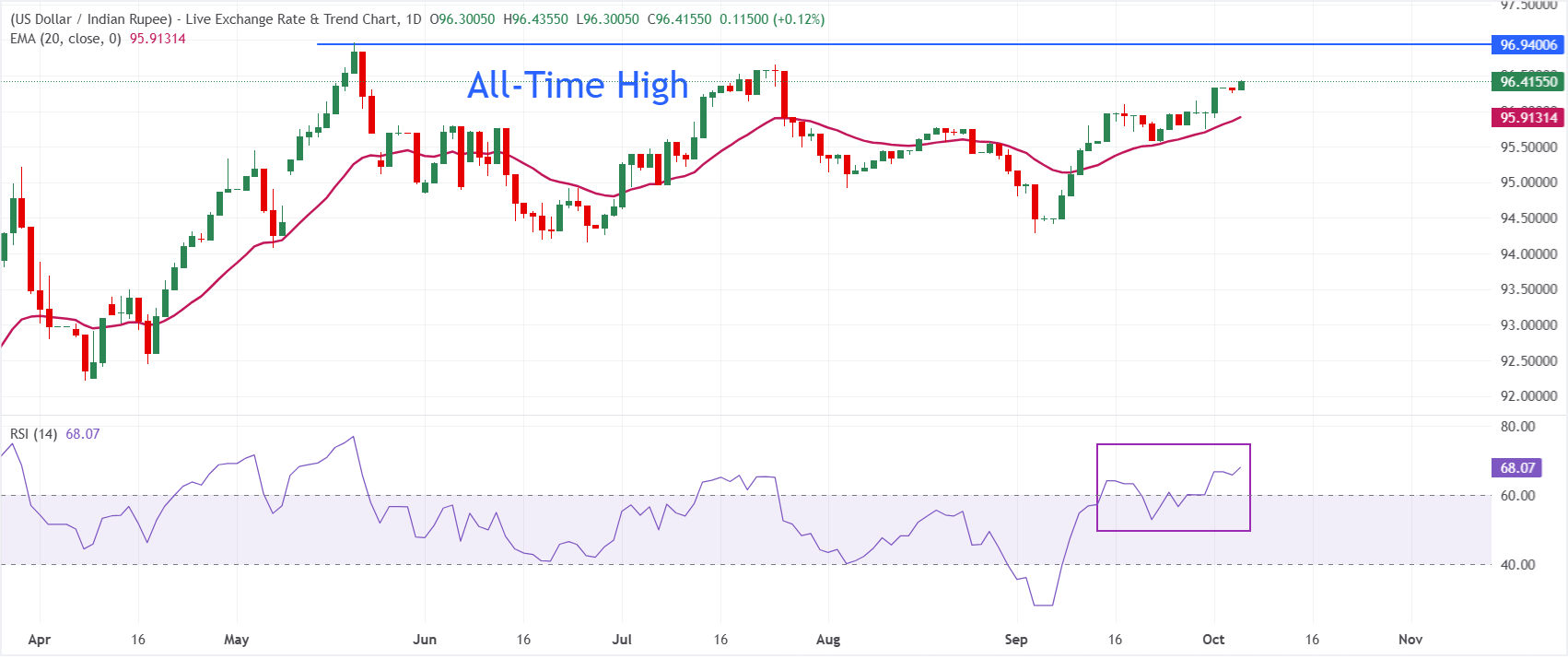
In the daily chart, USD/INR trades at 96.4155, extending its advance above the 20-period exponential moving average (EMA) at 95.9131 and keeping a near-term bullish bias intact. The pair is supported by this rising EMA, while the Relative Strength Index (14) at 68.07 hovers just under overbought territory, suggesting strong but increasingly stretched upside momentum.
On the downside, initial support is seen at the 20-period EMA around 95.91, where a pullback could attract fresh buying interest as long as the level holds. With no nearby technical resistance levels from the current dataset, further gains would likely be driven by momentum until new highs begin to establish fresh topside reference points.
(The technical analysis of this story was written with the help of an AI tool. Know more.)
Indian Rupee FAQs
The Indian Rupee (INR) is one of the most sensitive currencies to external factors. The price of Crude Oil (the country is highly dependent on imported Oil), the value of the US Dollar – most trade is conducted in USD – and the level of foreign investment, are all influential. Direct intervention by the Reserve Bank of India (RBI) in FX markets to keep the exchange rate stable, as well as the level of interest rates set by the RBI, are further major influencing factors on the Rupee.
The Reserve Bank of India (RBI) actively intervenes in forex markets to maintain a stable exchange rate, to help facilitate trade. In addition, the RBI tries to maintain the inflation rate at its 4% target by adjusting interest rates. Higher interest rates usually strengthen the Rupee. This is due to the role of the ‘carry trade’ in which investors borrow in countries with lower interest rates so as to place their money in countries’ offering relatively higher interest rates and profit from the difference.
Macroeconomic factors that influence the value of the Rupee include inflation, interest rates, the economic growth rate (GDP), the balance of trade, and inflows from foreign investment. A higher growth rate can lead to more overseas investment, pushing up demand for the Rupee. A less negative balance of trade will eventually lead to a stronger Rupee. Higher interest rates, especially real rates (interest rates less inflation) are also positive for the Rupee. A risk-on environment can lead to greater inflows of Foreign Direct and Indirect Investment (FDI and FII), which also benefit the Rupee.
Higher inflation, particularly, if it is comparatively higher than India’s peers, is generally negative for the currency as it reflects devaluation through oversupply. Inflation also increases the cost of exports, leading to more Rupees being sold to purchase foreign imports, which is Rupee-negative. At the same time, higher inflation usually leads to the Reserve Bank of India (RBI) raising interest rates and this can be positive for the Rupee, due to increased demand from international investors. The opposite effect is true of lower inflation.
Recommended Articles


