


Mexican Peso bottoms out as Obrador says Peso is backed by “strong economy”
- The Mexican Peso bottoms out after falling to 18-month lows midweek.
- President Obrador hits back at critics and speculators, defending his judicial reforms.
- USD/MXN pulls back from 18.99 peak but continues trading with a bullish tone.
The Mexican Peso (MXN) seesaws between tepid gains and losses on Thursday after bottoming out at an 18-month low due to politically-inspired market jitters.
Traders are selling the Peso on concerns about the impact of a controversial package of reforms the newly elected left-leaning coalition government, Sigamos Haciendo Historia (SHH), is seeking to pass and enshrine in the constitution.
The proposal to reform the judiciary is making markets particularly anxious apparently because it would see judges elected by popular vote rather than appointment. Critics say the reforms would compromise the independence of the judiciary, frightening off foreign investors; supporters argue it will eradicate endemic corruption and attract more investment.
At the time of writing, a single US Dollar (USD) buys 18.77 Mexican Pesos (compared to circa 17.00 just prior to the election). EUR/MXN, meanwhile, is trading at 20.29 and GBP/MXN at 24.03.
Mexican Peso to stay strong because of the economy, says Obrador
The Mexican Peso bottomed out at a one-and-a-half-year low on Wednesday as President Andres Manuel Lopez Obrador (AMLO) hit back at critics of his policies during a press conference.
“They don’t like it (the reforms) and so they are applying pressure to gauge whether there is fear in the markets,” said AMLO during his daily broadcast. “Our economy is very strong, thankfully. So how long are they going to keep stoking concerns – in the television, in the radio, in the newspaper columns of financial experts? And they know how to move the markets. But today the Peso has recovered 1% against the US Dollar because we have a strong economy and healthy public finances,” he added.
Obrador argued that Mexico’s strong economy was due precisely because of the government’s war on corruption.
He went on to say that the Peso’s fall was due to speculators not investors, and that real investors would welcome his reforms because they wanted a “real” government whilst speculators wanted a “bowlegged” government – “It is the latter who don’t want reforms to clean a corrupt judiciary,” he added.
When asked at what point the depreciation of the Peso would begin to concern him, AMLO said there was no problem with the Peso. Rather, the corrupt elites were stirring market sentiment in an attempt to blackmail the government into ditching its reforms so they could hang onto their power and privileges, he added.
Obrador then pointed at a graphic behind him showing the changes in the value of the Peso under the last six Presidents. His administration was the only one under which the Mexican Peso had risen and not fallen in value.
When asked how soon it would be before the reforms to the judiciary would be passed, AMLO said, given their importance, “September”. Mexico’s congress is expected to convene on September 1, which would give López Obrador a one-month window to push through reforms before retiring.
To the argument that there would not be a clear separation of powers in the case where judges were elected, AMLO countered, “On the contrary, there would be more separation, since the appointment of judges would not depend on a minority but the population at large.”
The Peso, in particular, bounced against the US Dollar (USD) as it was aided by USD weakness. The release of cooler-than-expected US inflation data on Wednesday in the form of the Consumer Price Index (CPI), increased the chances the US Federal Reserve (Fed) will cut interest rates in September. Lower interest rates are negative for the Dollar as they attract less foreign capital inflows.
Technical Analysis: USD/MXN almost peaks at 19.00 and rolls over
USD/MXN pulls back in the last 24 hours after peaking at 18.99. Despite falling to the 18.70s, it continues trading with a bullish bias on Thursday.
USD/MXN is in a short and intermediate term uptrend after decisively breaking above key resistance at 18.49 (October 2023 high).
USD/MXN Daily Chart
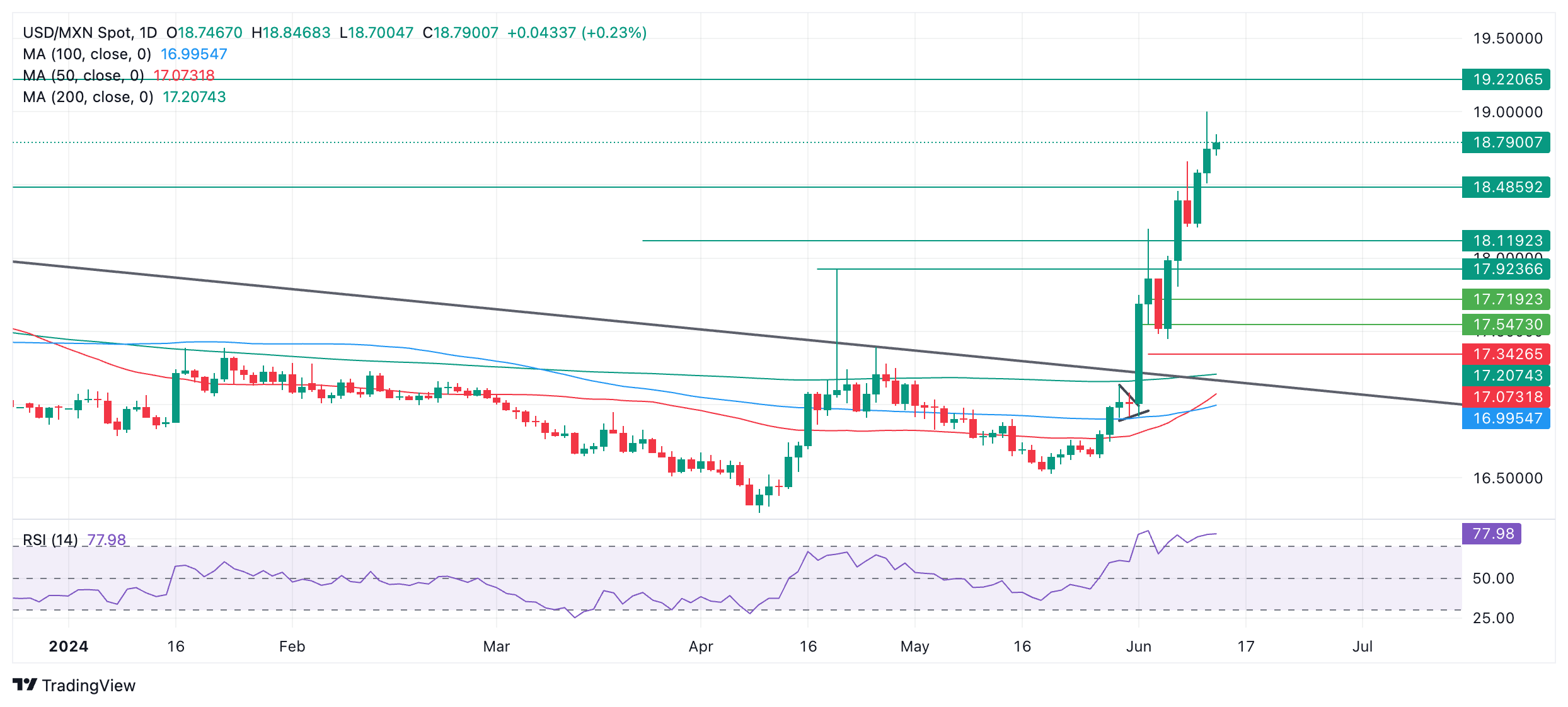
Given “the trend is your friend,” the odds favor a continuation higher in the short term, with the next target potentially situated at 19.22 (March 2023 high).
The Relative Strength Index (RSI) is in the overbought zone, however, suggesting traders should not add to their long positions. It also increases the possibility of a pullback developing, although the established uptrend is likely to eventually resume.
The direction of the long-term trend is in doubt after the break above the October 2023 high. Previous to that, it was down.
Economic Indicator
Consumer Price Index (YoY)
Inflationary or deflationary tendencies are measured by periodically summing the prices of a basket of representative goods and services and presenting the data as The Consumer Price Index (CPI). CPI data is compiled on a monthly basis and released by the US Department of Labor Statistics. The YoY reading compares the prices of goods in the reference month to the same month a year earlier.The CPI is a key indicator to measure inflation and changes in purchasing trends. Generally speaking, a high reading is seen as bullish for the US Dollar (USD), while a low reading is seen as bearish.
Read more.Last release: Wed Jun 12, 2024 12:30
Frequency: Monthly
Actual: 3.3%
Consensus: 3.4%
Previous: 3.4%
Source: US Bureau of Labor Statistics
The US Federal Reserve has a dual mandate of maintaining price stability and maximum employment. According to such mandate, inflation should be at around 2% YoY and has become the weakest pillar of the central bank’s directive ever since the world suffered a pandemic, which extends to these days. Price pressures keep rising amid supply-chain issues and bottlenecks, with the Consumer Price Index (CPI) hanging at multi-decade highs. The Fed has already taken measures to tame inflation and is expected to maintain an aggressive stance in the foreseeable future.
Recommended Articles


