


Indian Rupee starts weak negatively as oil prices extend gains
- The Indian Rupee declines against the US Dollar due to multiple headwinds.
- A fresh surge in oil prices and consistent FII outflow are hurting the Indian Rupee.
- Iranian military continues to attack energy tankers attempting transit through the Strait of Hormuz.
The Indian Rupee (INR) opens on a weak note against the US Dollar (USD) at the start of the week. The USD/INR pair jumps to near 96.46 as a fresh surge in oil prices and the consistent outflow of foreign funds from the Indian stock market are hurting the Indian currency.
In the opening trade, the MCX Crude Oil contract expiring on July 20 is 2.6% higher at around Rs. 8,150, the highest level seen in over a month.
Currencies from economies, such as India, which rely heavily on oil imports to meet their energy needs, tend to underperform in a high-oil-price environment.
Oil prices surge on continued US-Iran aggression
The continuous exchange of attacks between the United States (US) and Iran after the collapse of the ceasefire has pushed oil prices higher, disrupting the overall energy supply. Latest reports from Iran have shown that they are consistently attacking oil tankers attempting to transit the Strait of Hormuz, a vital passage to almost one-fifth of the global energy supply.
Iran's Islamic Revolutionary Guard Corps (IRGC) said that two oil tankers were blown up after attempting to transit the southern route of the Strait of Hormuz. The Iranian military stated that the passage will not be safe for petrochemical products or 'single drop of oil and gas' transit as long as US actions in the region continue.
Meanwhile, US Central Command (CENTCOM) confirmed late Sunday that it had concluded a ninth straight night of strikes against Iran, clarifying that the latest aggression was in retaliation to the killing of at least three American service members. Earlier in the day, US President Donald Trump also confirmed that the latest US strikes on Iran were being carried out in honor of US service members killed in recent days.
FIIs remain net sellers for fifth trading day
Foreign Institutional Investors (FIIs) have turned out to be net sellers in the past few trading days. Surging oil prices due to renewed Middle East conflicts appear to have dented the sentiment of overseas investors toward the Indian stock market again.
Last week, FIIs remained net sellers on all trading days and offloaded their stake worth Rs. 9,119.76 crore.
US Dollar weakens after positive opening
The US Dollar gives back its opening gains and turns lower as investors remain confident that the Federal Reserve (Fed) will hold interest rates steady in the policy meeting later this month. At press time, the US Dollar Index (DXY), which gauges the Greenback’s value against six major currencies, trades slightly lower to near 100.70.
The CME FedWatch tool, the odds of the Fed leaving interest rates unchanged in the July meeting are 85.6%, up from 65.8% recorded last week. Soft US Consumer Price Index (CPI) data for June led traders to reconsider Fed interest rate hike expectations.
Technical Analysis: USD/INR holds firmly above 20-day EMA
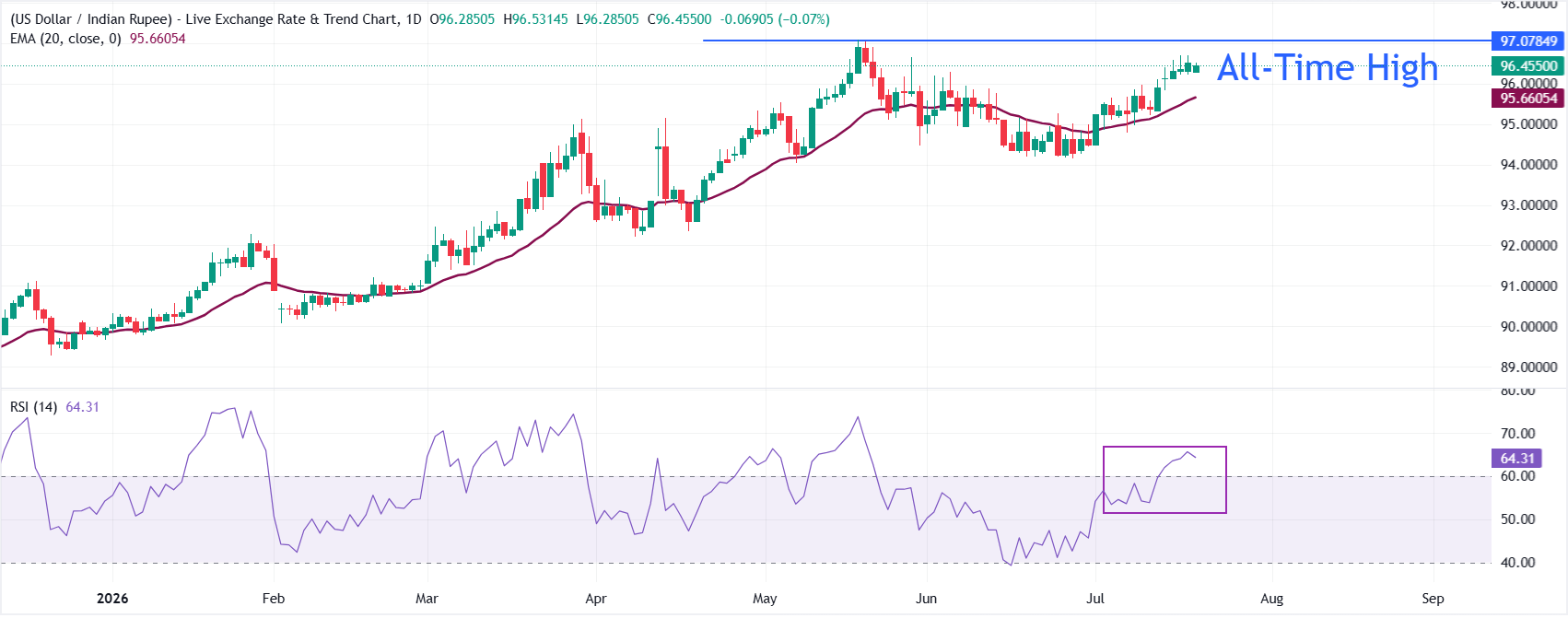
USD/INR trades higher at around 96.44, holding a bullish near-term bias as spot trades above the 20-day exponential moving average (EMA) at 95.6596, keeping the recent advance technically supported.
The Relative Strength Index (RSI) at 64.13 stays in positive territory but below overbought, suggesting upward momentum remains constructive without signaling exhaustion yet.
On the downside, initial support is located at the 20-day EMA near 95.66, where a break would hint at a deeper corrective phase toward prior price congestion levels not visible in the current indicator set. Looking up, the pair aims to revisit the all-time high around 97.10
(The technical analysis of this story was written with the help of an AI tool. Know more.)
Indian Rupee FAQs
The Indian Rupee (INR) is one of the most sensitive currencies to external factors. The price of Crude Oil (the country is highly dependent on imported Oil), the value of the US Dollar – most trade is conducted in USD – and the level of foreign investment, are all influential. Direct intervention by the Reserve Bank of India (RBI) in FX markets to keep the exchange rate stable, as well as the level of interest rates set by the RBI, are further major influencing factors on the Rupee.
The Reserve Bank of India (RBI) actively intervenes in forex markets to maintain a stable exchange rate, to help facilitate trade. In addition, the RBI tries to maintain the inflation rate at its 4% target by adjusting interest rates. Higher interest rates usually strengthen the Rupee. This is due to the role of the ‘carry trade’ in which investors borrow in countries with lower interest rates so as to place their money in countries’ offering relatively higher interest rates and profit from the difference.
Macroeconomic factors that influence the value of the Rupee include inflation, interest rates, the economic growth rate (GDP), the balance of trade, and inflows from foreign investment. A higher growth rate can lead to more overseas investment, pushing up demand for the Rupee. A less negative balance of trade will eventually lead to a stronger Rupee. Higher interest rates, especially real rates (interest rates less inflation) are also positive for the Rupee. A risk-on environment can lead to greater inflows of Foreign Direct and Indirect Investment (FDI and FII), which also benefit the Rupee.
Higher inflation, particularly, if it is comparatively higher than India’s peers, is generally negative for the currency as it reflects devaluation through oversupply. Inflation also increases the cost of exports, leading to more Rupees being sold to purchase foreign imports, which is Rupee-negative. At the same time, higher inflation usually leads to the Reserve Bank of India (RBI) raising interest rates and this can be positive for the Rupee, due to increased demand from international investors. The opposite effect is true of lower inflation.
Recommended Articles


