


Mexican Peso’s days in the sun are over, say analysts
- The Mexican Peso is at risk of reversing its long-term uptrend.
- Several analysts say MXN has peaked and is on the way down.
- Negative fundamentals include the Mexican and US presidential elections and a narrowing MXN-supportive interest-rate differential.
The Mexican Peso (MXN) backs off a cliff on Thursday, trading down over half a percent in its key pairs, as investors unwind their long bets due to multiple risk factors on the horizon.
The Mexican presidential elections on Sunday, the US presidential elections in November, and a growing shift in US interest-rate expectations are all weighing on the Peso, which is vulnerable to reversing its long-term uptrend, according to analysts.
USD/MXN is exchanging hands at 17.06 at the time of writing, EUR/MXN is trading at 18.46 and GBP/MXN at 21.69.
Mexican Peso subject to a growing number of risk factors
The Mexican Peso trades lower this week as investors close their long bets ahead of potentially market-moving events bleeping on the radar in the near and medium-term.
The Mexican presidential election on Sunday is likely to result in the election of Claudia Shienbaum of the Morena party, who leads by 20% in the polls. She’ll take over from her predecessor Andres Manuel Lopez Obrador (AMLO), also of Morena.
Shienbaum is likely to continue the generous social-welfare programme that made AMLO popular and has pledged to increase the minimum wage by circa 11%. This is likely to boost consumer spending, a key driver of growth in recent quarters, but could make it difficult for the Bank of Mexico (Banxico) to bring down inflation, says Kimberley Sperrfechter, Emerging Markets Economist at Capital Economics.
“A victory for Claudia Sheinbaum in Mexico’s election on Sunday is likely to see a continuation of Amlo’s generous social policies – which will also make Banxico’s fight against inflation harder,” says Sperrfechter.
Threat of being trumped
A clear and present danger for the Mexican Peso is the possibility of Donald Trump’s reelection in November. The US and Mexican trade agreement (USMCA) is up for review in 2026, and there is a risk Trump, if re-elected, might reintroduce tariffs on Mexican goods. Such a move would also hamper Mexico’s near-shoring prospects.
For this reason, Sperrfechter thinks that the Peso’s “period of outperformance has largely run its course” and expects the currency to substantially weaken to $19-$20 during the next president’s tenure.
Mexican Peso’s interest-rate advantage gap to close – Rabobank
The Mexican Peso’s long-term uptrend has been supported by the high interest rates (11.0%) in Mexico, which in turn attract foreign investor inflows.
Banxico lowered interest rates by 0.25% in March and is expected to cut them again in June, however, according to analysts at Rabobank, closing the interest-rate differential with counterparts.
“We maintain the view that we are at the peak of MXN strength and will see a move back above 16.8 in the coming months as the rate differential converges,” Rabobank said in a note on May 28.
The Mexican Peso could experience weakness against the US Dollar (USD) in particular as interest-rate expectations in the US undergo ossification. Whilst at the beginning of 2024 the Federal Reserve (Fed) was confident it would be able to cut interest rates three times in 2024, with the first rate cut potentially coming in June, these expectations have been radically delayed because of stubbornly high inflation.
On Tuesday, Minneapolis Fed President Neel Kashkari surprised markets when he said Fed officials hadn’t disregarded even hiking interest rates, while adding that if they did cut borrowing costs, it would be twice toward the end of 2024.
USD traders are now keenly awaiting the US Personal Consumption Expenditures (PCE) data for April, set to be released on Friday, for the latest snapshot of US inflation. If it comes out higher-than-expected, it could further weaken the Peso against the US Dollar.
In Mexico, meanwhile, Thursday sees the release of the unemployment data which is forecast to show a rise in the Unemployment Rate to 2.6% in April from 2.3% previously.
Technical Analysis: USD/MXN short-term uptrend extends
USD/MXN – or the number of Pesos that can be bought with one US Dollar – surges above the psychological 17.00 level, reinforcing the short-term bullish uptrend and favoring long positions over shorts.
USD/MXN 4-hour Chart
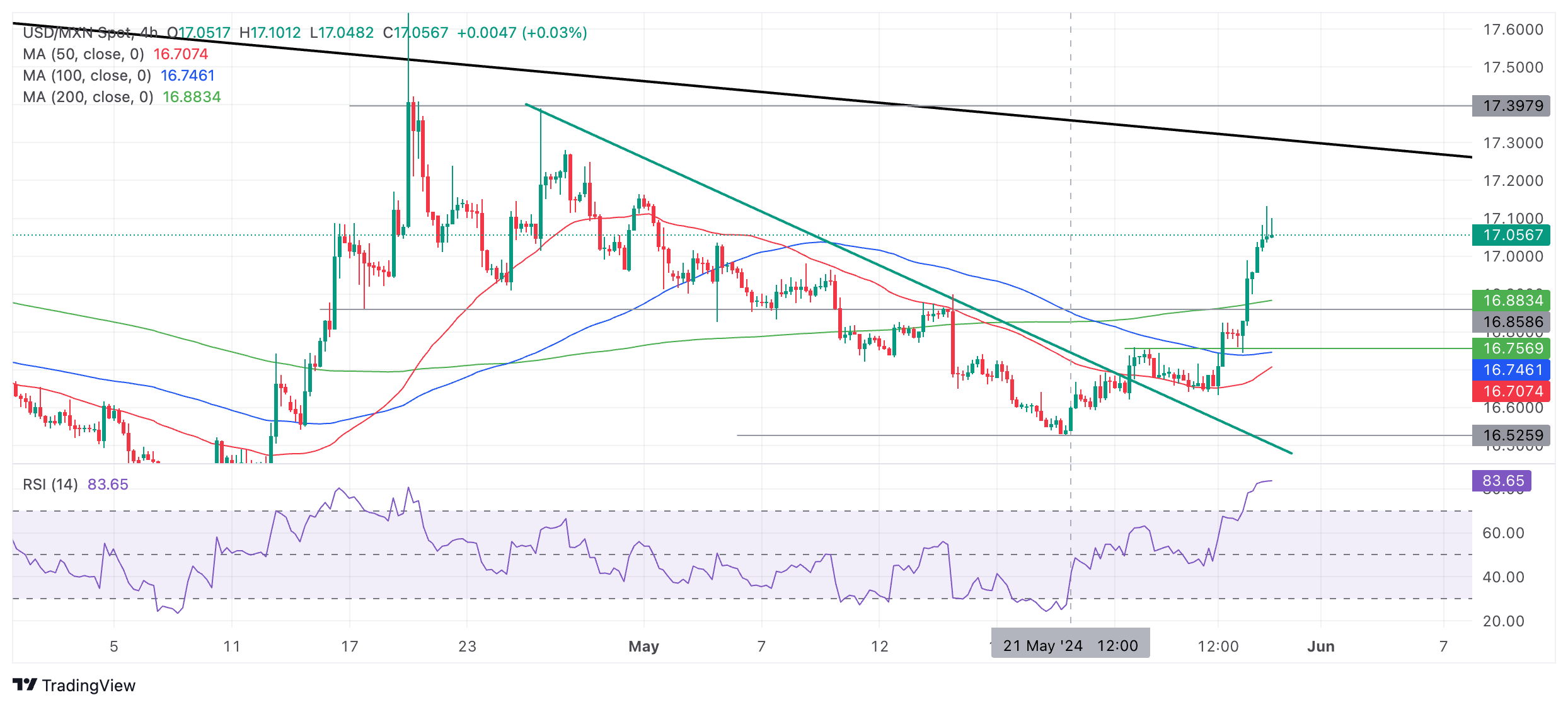
USD/MXN has surpassed the bullish target at 16.85 (previous range lows) and now sets its sights on the major trendline (black) at circa 17.25. A break above the 17.13 day’s highs would probably confirm an extension north towards the target.
The Relative Strength Index (RSI) momentum indicator has entered the overbought zone, suggesting a risk of a pullback. When RSI enters overbought conditions, it is a signal to long-holders not to add to their positions. If RSI exists overbought and falls below 70 again on a closing basis, it will be a signal to close longs and open shorts as a deeper correction is probably unfolding.
The medium and long-term trends remain bearish, maintaining a risk that the pair could capitulate and continue lower. However, a decisive break above the major trendline would solidify the bullish case and indicate a reversal of the medium-term trend to an uptrend.
A decisive break would be one accompanied by a long green bar that closed near its high or three consecutive green bars in a row.
Economic Indicator
Jobless Rate
The Jobless Rate released by INEGI is the number of unemployed workers compared to all the active workers in the economy. If the number rises, it indicates a lack of expansion within the Mexican labor market and thus a weakening in the economy. Normally, a decrease in the figure is seen as positive (or bullish) for the Mexican Peso, while an increase is seen as negative (or bearish).
Read more.Next release: Thu May 30, 2024 12:00
Frequency: Monthly
Consensus: 2.6%
Previous: 2.3%
Source: National Institute of Statistics and Geography of Mexico
Recommended Articles


