


Pound Sterling refreshes five month low after weak UK employment data
- The Pound Sterling declines further after the UK ONS reported weaker-than-expected labor market data.
- Employers laid off workers in February, exhibiting the negative impact of higher UK interest rates.
- The market sentiment remains risk-off amid fears of an escalation in Middle East tensions.
The Pound Sterling (GBP) weakens in Tuesday’s London session after the United Kingdom Office for National Statistics (ONS) reported that labor market conditions have significantly cooled down in the three months ending February. The Unemployment Rate grew strongly to 4.2% and the overall labor market witnessed that 156K workers were laid-off.
The labor market data demonstrates uncertainty over the economic outlook, which could force Bank of England (BoE) policymakers to start reducing interest rates earlier than previously expected. Job-seekers and current employees compromise with salary hikes when labor market conditions cool down, which results in slower wage growth that allows high inflation to return to its desired target sustainably.
More volatility is anticipated in the Pound Sterling as the UK ONS will report the consumer and producer inflation data for March, which will be published on Wednesday. The headline Consumer Price Index (CPI) is estimated to rise 3.1%, slower than the prior reading of 3.4%. The core CPI, which strips off volatile food and energy prices, is forecasted to rise 4.1%, slower than 4.5% in February. An expected decline in the inflation data would increase speculation for the BoE beginning to reduce interest rates from the August meeting.
Daily digest market movers: Pound Sterling falls further amid multiple headwinds
- The Pound Sterling extends its downside to 1.2410 as the United Kingdom ONS has reported weak labor market data. The ILO Unemployment Rate for the three months ending February rose sharply to 4.2% from expectations of 4.0% and the prior reading of 4.0% (revised from 3.9%). In February, employers fired 156K workers, higher than the prior reading of 89K, upwardly revised from 21K.
- In March, Claimant Count Change, which indicates the change in number of individuals claiming jobless benefits, was lower at 10.9K vs. expectations of 17.2K and the prior reading of 4.1K (revised from 16.8K).
- In the three months ending February, Average Earnings including bonuses rose steadily by 5.6%, beating the consensus of 5.5%. In the same period, Average Earnings excluding bonuses slowed to 6.0% against the former reading of 6.1%.
- Weak labor demand clearly shows the consequences of interest rates remaining higher by the Bank of England (BoE). The rising jobless rates and poor labor demand exhibit a vulnerable economic outlook, which could force the BoE to pivot to rate cuts sooner than expected.
- The market sentiment remains risk-averse amid fears of further escalation in Middle East tensions and deepening uncertainty about when the Federal Reserve will start reducing interest rates. Eventually, strong demand for safe-haven assets has pushed the US Dollar Index (DXY) to 106.30.
- The Israeli military said it would respond to Iran’s attack in their territory that happened on April 13 in which the latter launched hundreds of missiles and drones. This has deepened fears of war spreading beyond Gaza in the Middle East region.
- United States robust Retail Sales data, combined with strong labor demand and higher consumer price inflation in March have strengthened the argument that Fed policymakers could delay rate cuts later this year.
- San Francisco Fed Bank President Mary Daly said on Friday that there is absolutely no urgency to start reducing interest rates. Daly added that there is still more work to do to make sure that inflation is on course to return to the desired rate of 2%. She emphasized keeping interest rates restrictive for a longer period.
Technical Analysis: Pound Sterling sees downside toward 1.2400
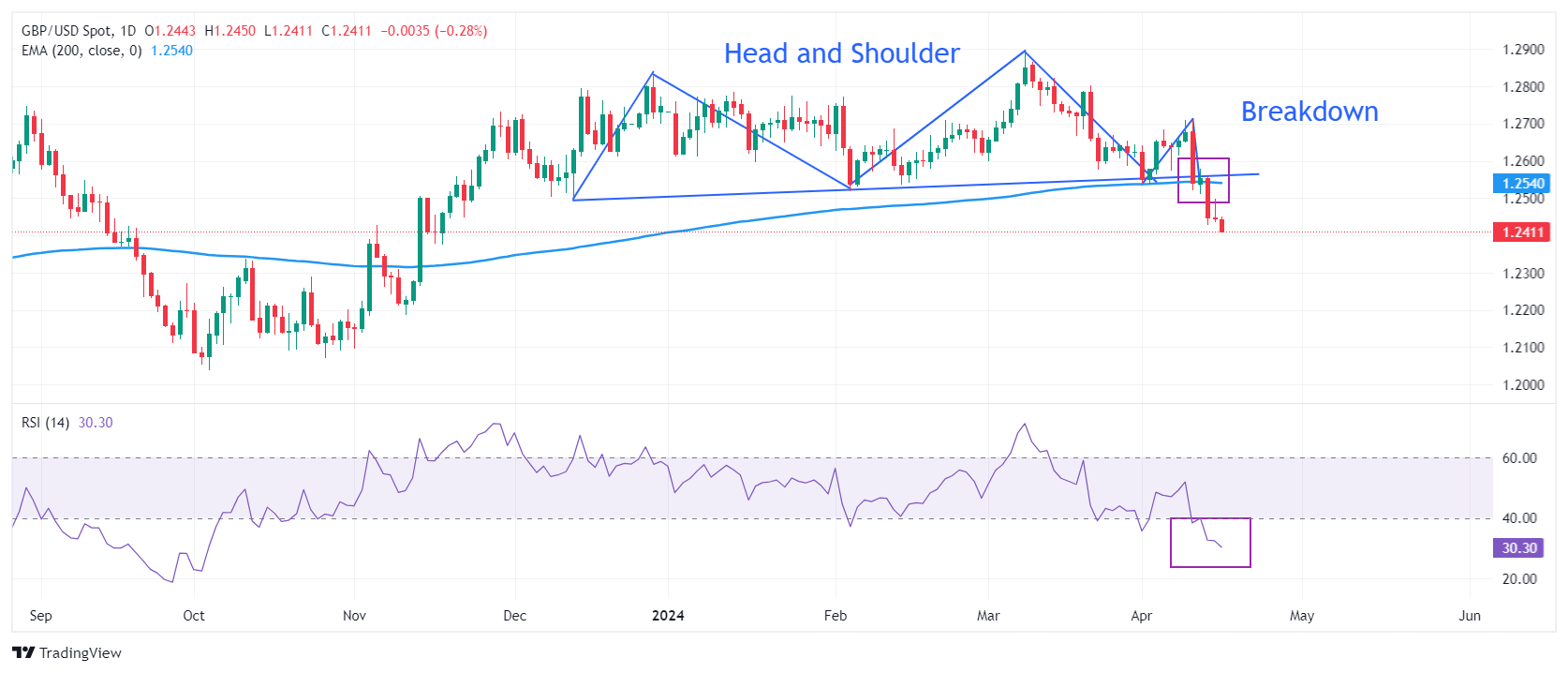
The Pound Sterling declines further to 1.2410 after extending its losing spell for the third trading session on Tuesday. The GBP/USD pair is expected to extend its downside to the round-level support at 1.2400. The Cable remains on the backfoot after a breakdown of the Head and Shoulder chart pattern, which exhibits a bearish reversal. The neckline of the aforementioned chart pattern is plotted from December 8 low near 1.2500.
The long-term outlook turns bearish as the Cable drops below the 200-day Exponential Moving Average (EMA), which trades around 1.2540.
The 14-period Relative Strength Index (RSI) shifts into the bearish range of 20.00-40.00, suggesting an active bearish momentum.
Pound Sterling FAQs
The Pound Sterling (GBP) is the oldest currency in the world (886 AD) and the official currency of the United Kingdom. It is the fourth most traded unit for foreign exchange (FX) in the world, accounting for 12% of all transactions, averaging $630 billion a day, according to 2022 data. Its key trading pairs are GBP/USD, aka ‘Cable’, which accounts for 11% of FX, GBP/JPY, or the ‘Dragon’ as it is known by traders (3%), and EUR/GBP (2%). The Pound Sterling is issued by the Bank of England (BoE).
The single most important factor influencing the value of the Pound Sterling is monetary policy decided by the Bank of England. The BoE bases its decisions on whether it has achieved its primary goal of “price stability” – a steady inflation rate of around 2%. Its primary tool for achieving this is the adjustment of interest rates. When inflation is too high, the BoE will try to rein it in by raising interest rates, making it more expensive for people and businesses to access credit. This is generally positive for GBP, as higher interest rates make the UK a more attractive place for global investors to park their money. When inflation falls too low it is a sign economic growth is slowing. In this scenario, the BoE will consider lowering interest rates to cheapen credit so businesses will borrow more to invest in growth-generating projects.
Data releases gauge the health of the economy and can impact the value of the Pound Sterling. Indicators such as GDP, Manufacturing and Services PMIs, and employment can all influence the direction of the GBP. A strong economy is good for Sterling. Not only does it attract more foreign investment but it may encourage the BoE to put up interest rates, which will directly strengthen GBP. Otherwise, if economic data is weak, the Pound Sterling is likely to fall.
Another significant data release for the Pound Sterling is the Trade Balance. This indicator measures the difference between what a country earns from its exports and what it spends on imports over a given period. If a country produces highly sought-after exports, its currency will benefit purely from the extra demand created from foreign buyers seeking to purchase these goods. Therefore, a positive net Trade Balance strengthens a currency and vice versa for a negative balance.
Recommended Articles


