


EUR/USD ticks up from three-month lows as US Dollar eases
- The Euro picks up from 1.1500 lows as the US Dollar takes a breather.
- Investors' cautious mood and dwindling hopes of Fed cuts continue to underpin the US Dollar.
- ECB President Christine Lagarde is expected to speak later on Tuesday.
EUR/USD is trading with marginal gains on Tuesday, changing hands at 1.1525 at the time of writing after hitting fresh three-month lows earlier on the day. The pair, however, remains vulnerable, following a nearly 1.3% sell-off in the last four trading days, as the US Dollar (USD) surged following a "hawkish cut" by the Federal Reserve (Fed) last week.
On Monday, the US Dollar continued strengthening, unfazed by downbeat manufacturing activity data in the United States (US). October's ISM Manufacturing Purchasing Managers' Index (PMI) showed that the sector's economic activity contracted for the eighth consecutive month, weighed by a decline in orders and highlighting low employment levels.
In addition, Federal Reserve (Fed) policymakers reiterated their division on the path forward, with San Francisco Fed President Mary Daly and Chicago Fed President Austan Golsbee showing a cautious stance, while Governor Stephen Miran said that current policy is too restrictive.
In the Eurozone economic calendar, European Central Bank (ECB) President Christine Lagarde will speak later in the day, although she is unlikely to say anything new on monetary policy. In the US, the government shutdown will deprive markets of the US JOLTS Job Openings and Factory Orders data for September, while investors will be looking to Wednesday's ADP Employment Change release for October for further insight into the labour market trends.
Euro Price Today
The table below shows the percentage change of Euro (EUR) against listed major currencies today. Euro was the strongest against the New Zealand Dollar.
| USD | EUR | GBP | JPY | CAD | AUD | NZD | CHF | |
|---|---|---|---|---|---|---|---|---|
| USD | -0.05% | 0.12% | -0.40% | 0.11% | 0.42% | 0.44% | -0.08% | |
| EUR | 0.05% | 0.17% | -0.35% | 0.16% | 0.47% | 0.49% | -0.03% | |
| GBP | -0.12% | -0.17% | -0.52% | -0.01% | 0.30% | 0.31% | -0.20% | |
| JPY | 0.40% | 0.35% | 0.52% | 0.51% | 0.82% | 0.83% | 0.31% | |
| CAD | -0.11% | -0.16% | 0.01% | -0.51% | 0.31% | 0.32% | -0.19% | |
| AUD | -0.42% | -0.47% | -0.30% | -0.82% | -0.31% | 0.01% | -0.50% | |
| NZD | -0.44% | -0.49% | -0.31% | -0.83% | -0.32% | -0.01% | -0.52% | |
| CHF | 0.08% | 0.03% | 0.20% | -0.31% | 0.19% | 0.50% | 0.52% |
The heat map shows percentage changes of major currencies against each other. The base currency is picked from the left column, while the quote currency is picked from the top row. For example, if you pick the Euro from the left column and move along the horizontal line to the US Dollar, the percentage change displayed in the box will represent EUR (base)/USD (quote).
Daily digest market movers: The US Dollar stands tall in cautious markets
- The US Dollar Index (DXY) is pulling back from highs, but downside attempts remain limited so far, as a moderate risk-aversion and receding bets that the Federal Reserve will cut rates further in December have offset the negative impact from downbeat manufacturing activity figures.
- On Monday, October's ISM Manufacturing PMI declined to 48.7 from September's 49.1 reading, falling short of market expectations of a mild improvement to 49.5. The New Orders Index improved to 49.4 from 48.9 in September, and the Employment sub-index rose to 46.0 from 45.3. In both cases, showing contraction at levels below 50.0.
- San Francisco Fed President, Mary Daly, defended October's rate cut, but she expressed concerns about the high inflationary levels and highlighted the need to keep policy "moderately restrictive."
- Chicago Fed President, Austan Goolsbee, was more concerned about inflation than the labor market and defended the need to keep interest rates in a position where they help to combat the higher price pressures.
- On the other side of the spectrum, US President Donald Trump's latest pick to the committee, Stephen Miran, affirmed that the current monetary policy is too restrictive and that he will continue advocating for rate cuts.
- Futures markets, however, have reduced the chances of a rate cut in December to 67% from above 90% one week ago, which is keeping US Treasury yields and the US Dollar steady near highs.
- In Europe, Eurozone HCOB Manufacturing PMI figures confirmed the preliminary estimations that the sector's activity improved to a standstill, at 50.0, up from September's 49.8 reading.
Technical Analysis: EUR/USD, attempting to bounce up from 1.1500 support
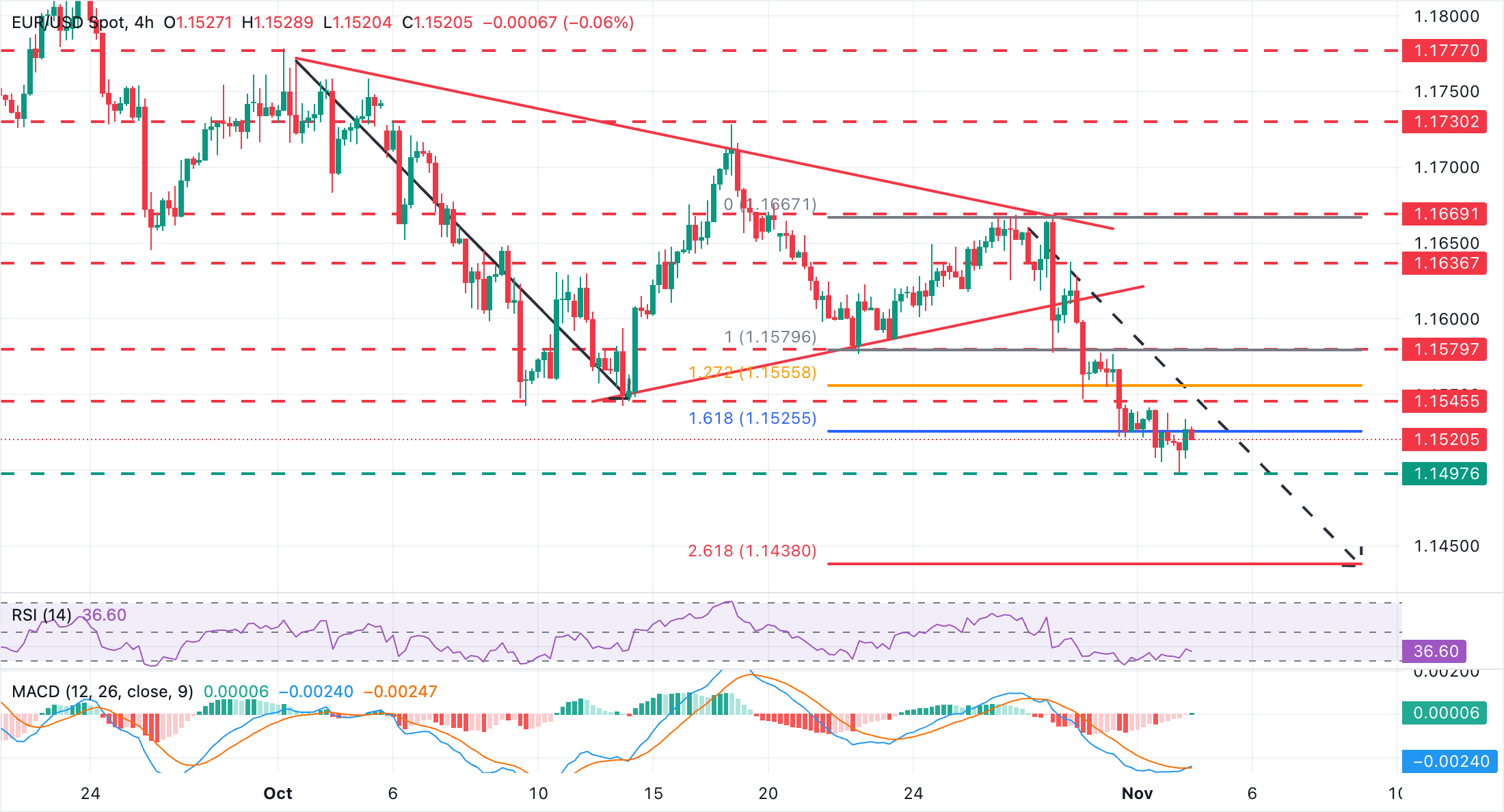
The EUR/USD is correcting higher after finding some support at the 1.1500 area, which coincides with the US Dollar Index trading at the 100.00 psychological level. The 4-hour Relative Strength Index (RSI) indicator remains within negative territory below the key 50.00 level, but the Moving Average Convergence Divergence (MACD) is about to perform a bullish cross.
In this context, the pair might see some recovery on Tuesday, although the scope seems limited. The previous support area near 1.1545 (October 14, 30 lows) is likely to challenge bulls ahead of the October 22 and 23 lows at 1.1580. Further up, the October 30 high, near 1.1635, emerges as the next target.
To the downside, Tuesday's low near 1.1500 is the immediate support. A further decline beyond that level would open the path towards the 261.8% Fibonacci retracement of the late October rally, near 1.140, ahead of the August trough, near 1.1390.
Euro FAQs
The Euro is the currency for the 20 European Union countries that belong to the Eurozone. It is the second most heavily traded currency in the world behind the US Dollar. In 2022, it accounted for 31% of all foreign exchange transactions, with an average daily turnover of over $2.2 trillion a day. EUR/USD is the most heavily traded currency pair in the world, accounting for an estimated 30% off all transactions, followed by EUR/JPY (4%), EUR/GBP (3%) and EUR/AUD (2%).
The European Central Bank (ECB) in Frankfurt, Germany, is the reserve bank for the Eurozone. The ECB sets interest rates and manages monetary policy. The ECB’s primary mandate is to maintain price stability, which means either controlling inflation or stimulating growth. Its primary tool is the raising or lowering of interest rates. Relatively high interest rates – or the expectation of higher rates – will usually benefit the Euro and vice versa. The ECB Governing Council makes monetary policy decisions at meetings held eight times a year. Decisions are made by heads of the Eurozone national banks and six permanent members, including the President of the ECB, Christine Lagarde.
Eurozone inflation data, measured by the Harmonized Index of Consumer Prices (HICP), is an important econometric for the Euro. If inflation rises more than expected, especially if above the ECB’s 2% target, it obliges the ECB to raise interest rates to bring it back under control. Relatively high interest rates compared to its counterparts will usually benefit the Euro, as it makes the region more attractive as a place for global investors to park their money.
Data releases gauge the health of the economy and can impact on the Euro. Indicators such as GDP, Manufacturing and Services PMIs, employment, and consumer sentiment surveys can all influence the direction of the single currency. A strong economy is good for the Euro. Not only does it attract more foreign investment but it may encourage the ECB to put up interest rates, which will directly strengthen the Euro. Otherwise, if economic data is weak, the Euro is likely to fall. Economic data for the four largest economies in the euro area (Germany, France, Italy and Spain) are especially significant, as they account for 75% of the Eurozone’s economy.
Another significant data release for the Euro is the Trade Balance. This indicator measures the difference between what a country earns from its exports and what it spends on imports over a given period. If a country produces highly sought after exports then its currency will gain in value purely from the extra demand created from foreign buyers seeking to purchase these goods. Therefore, a positive net Trade Balance strengthens a currency and vice versa for a negative balance.
,
Recommended Articles


