


NZD/USD (NZDUSD) Is down 0.52% on Jul 23: Why It Happened
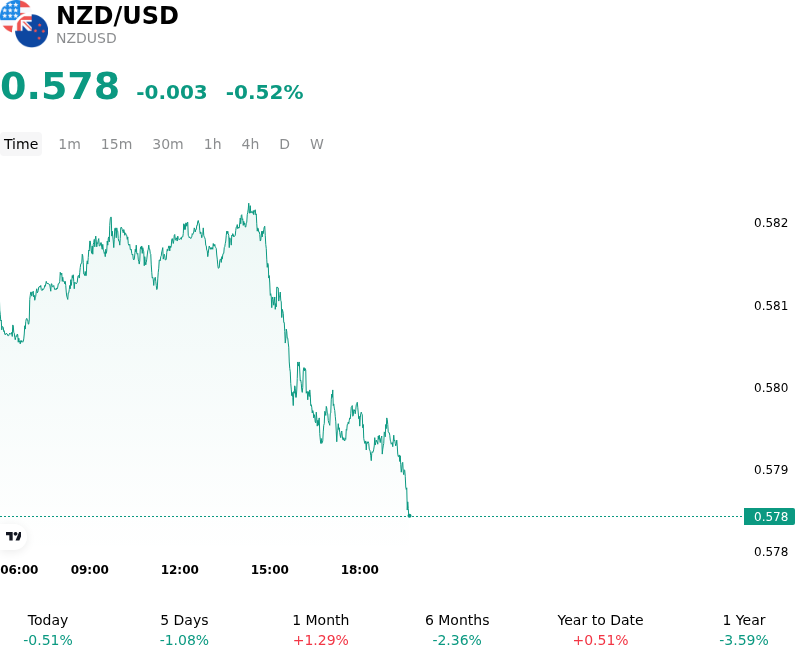
NZD/USD (NZDUSD) is down 0.52% at Jul 23 07:40(ET), now at $0.57841, with a 7-day down of 0.98%.
What is driving NZD/USD (NZDUSD)’s stock price down today?
The downward pressure on the New Zealand dollar against the US dollar is primarily driven by a broadening divergence in monetary policy expectations, exacerbated by a shift in global risk sentiment. While the Reserve Bank of New Zealand has signaled a more accommodative stance in response to cooling domestic inflationary pressures and sluggish consumption, the US Federal Reserve remains focused on the resilience of the American labor market. Recent data indicating lower-than-expected initial jobless claims in the United States has reinforced the narrative of persistent labor tightness, providing a significant tailwind for the greenback as markets price in a more gradual easing cycle for the FOMC.
The widening interest rate differential between US Treasuries and New Zealand government bonds has triggered capital outflows from the higher-beta Kiwi dollar. Investors are increasingly favoring the liquidity and yield profile of the US dollar as uncertainty regarding the global growth outlook persists. This transition is further fueled by lackluster economic indicators from China, New Zealand’s largest trading partner, where industrial activity continues to underperform expectations. The resulting decrease in demand for commodity-linked currencies has left the New Zealand dollar vulnerable to selling pressure, as the outlook for New Zealand's export sector remains clouded.
Technical factors and institutional positioning have also played a role in the intraday move. As the pair breached key psychological support levels, a reduction in long-NZD positions by macro funds accelerated the downward momentum. The broader market environment remains characterized by risk aversion, as volatility in global equity markets and ongoing geopolitical uncertainties prompt a rotation into safe-haven assets. Consequently, the US dollar’s role as a primary reserve currency has allowed it to outperform the pro-cyclical New Zealand dollar during this period of heightened market sensitivity.
Looking ahead, the trajectory of the currency pair will likely depend on upcoming central bank communications and further signals regarding the global manufacturing cycle. If US economic resilience continues to defy expectations while New Zealand’s domestic demand remains stagnant, the downward trend in the exchange rate may persist. Investors remain focused on whether the RBNZ will be forced to accelerate its easing cycle to support growth, a move that would likely continue to weigh on the NZDUSD pair in the near term.
Technical Analysis of NZD/USD (NZDUSD)
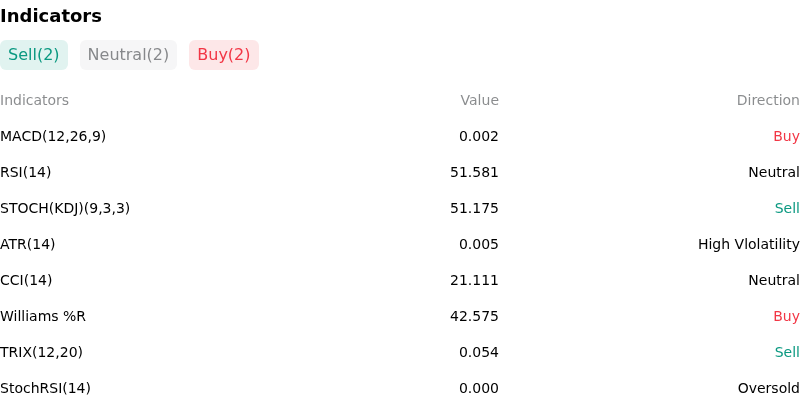
Technically, NZD/USD (NZDUSD) shows a MACD (12,26,9) value of 0.002, indicating a buy signal. The RSI at 51.581 suggests neutral condition and the Williams %R at 42.575 suggests buy condition. Please monitor closely.
More details about NZD/USD (NZDUSD)
Recent Events and Risks:
- RBNZ Dovish Policy Shift: Growing expectations for a premature pivot by the Reserve Bank of New Zealand, fueled by recent data showing a contraction in domestic manufacturing and cooling wage growth, have increased downside pressure on the NZD.
- China Growth Concerns: Persistent weakness in Chinese retail and property sectors, highlighted by recent economic updates, continues to weigh on the New Zealand Dollar due to the country’s high export dependency on the Chinese market.
- US Dollar Yield Dominance: Recent hawkish rhetoric from Federal Reserve officials and resilient US services sector data have reinforced the "higher-for-longer" rate narrative, driving the USD higher and squeezing the NZDUSD yield spread.
- Global Risk Aversion: A recent spike in geopolitical uncertainty and volatility in global equity markets has triggered a "risk-off" environment, favoring the safe-haven US Dollar over high-beta commodity currencies like the Kiwi.
Recommended Articles


