

Solana (SOLUSD) Is down 1.46% on Jul 12: Key Drivers to Watch

Source Tradingkey

Solana (SOLUSD) is down 1.46% at Jul 12 00:00(ET), now at $76.04, with a 7-day down of 5.03%.
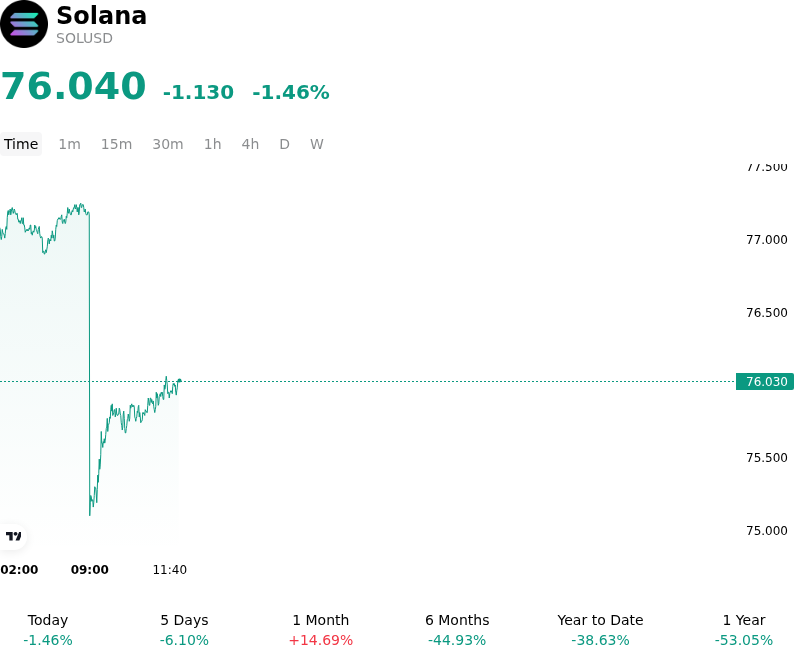
SummaryOverview

What is driving Solana (SOLUSD)’s stock price down today?

Solana’s recent price action reflects a broader de-risking phase across the digital asset landscape as market participants recalibrate expectations ahead of upcoming Federal Reserve communications. A modest strengthening of the US Dollar and a marginal rise in the 10-year Treasury yield have dampened appetite for high-beta Layer-1 assets. Institutional investors appear to be taking a defensive posture, leading to a temporary slowdown in capital inflows into spot Solana ETFs. This cooling of institutional demand has removed a key support pillar that had previously sustained the asset's upward trajectory, leading to a reduction in exposure among large-scale allocators.

On-chain metrics suggest a consolidation phase following a period of intense network activity. While Solana continues to lead in retail DEX volume and active address counts, a slight decline in new project launches and a stabilization in total value locked have prompted short-term traders to lock in profits. This profit-taking is particularly evident among participants who entered positions during the recent surge in decentralized physical infrastructure network activity on the blockchain. The absence of a fresh fundamental catalyst in the immediate term has allowed the market to drift lower as liquidity shifts toward more defensive crypto-assets or remains on the sidelines in stablecoins.

In the derivatives market, a modest flush of over-leveraged long positions has contributed to the downward pressure. Perpetual swap funding rates, which had reached elevated levels during the prior week, have begun to neutralize, signaling a more balanced but cautious sentiment. This reset in positioning is a standard reaction to technical resistance and creates intraday volatility as cascading liquidations are triggered. Furthermore, lingering uncertainty regarding the regulatory classification of staking-as-a-service providers continues to weigh on the sentiment for major proof-of-stake networks, leading some institutional desks to trim their exposure until further clarity is provided by the SEC.

Despite the current retracement, the structural narrative for Solana remains centered on its throughput advantages and growing enterprise adoption. However, investors remain highly sensitive to global liquidity conditions and potential shifts in the macroeconomic backdrop. The primary risks monitored by the desk include a potential hawkish pivot from central banks and any signs of network performance issues that could challenge the ecosystem's value proposition. For now, the price movement appears to be an orderly technical correction driven by broader market sentiment and liquidity repricing rather than a fundamental degradation of the Solana network.

Technical Analysis of Solana (SOLUSD)

Technically, Solana (SOLUSD) shows a MACD (12,26,9) value of -0.078, indicating a neutral signal. The RSI at 51.076 suggests neutral condition and the Williams %R at 48.947 suggests neutral condition. Please monitor closely.
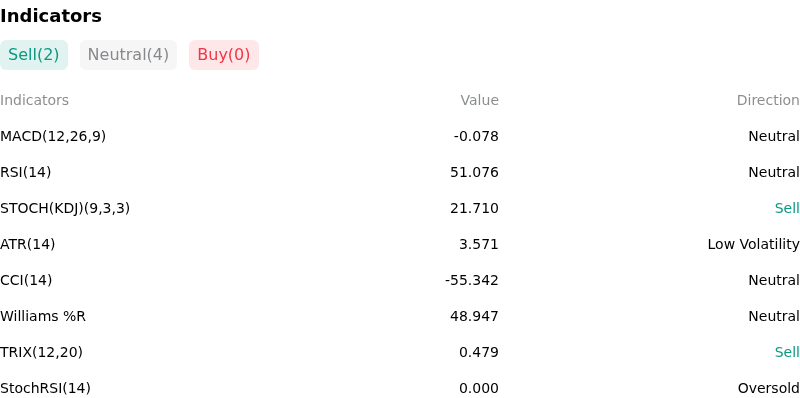
IndicatorAnalysis

More details about Solana (SOLUSD)

Recent Events and Risks:

  • ETF Regulatory Hurdles: Despite recent spot ETF filings by major asset managers, the SEC’s historical classification of SOL as an unregistered security remains a significant legal barrier, posing a risk of "buy the rumor, sell the news" reversals or outright rejections that could trigger sharp downside volatility.
  • Concentrated Whale Selling Pressure: On-chain data indicates a notable increase in SOL transfers from long-term staking contracts to centralized exchanges, suggesting that large-scale holders may be positioning for profit-taking or hedging against broader market uncertainty, which adds immediate resistance to price recovery.
  • Leverage Unwind Vulnerability: Solana’s open interest in the perpetual futures market has reached elevated levels with skewed positive funding rates, creating a crowded long trade that is highly susceptible to a liquidation cascade if the price breaches key support levels near $140.
  • Network Performance and MEV Risks: Sustained high trading volumes on Solana-based decentralized exchanges have led to increased Maximum Extractable Value (MEV) bot competition and periodic spikes in transaction failure rates, which threatens to dampen investor sentiment and reduce the network's perceived reliability during high-volatility events.
Disclaimer: For information purposes only. Past performance is not indicative of future results.
placeholder
Bitcoin CME gaps at $35,000, $27,000 and $21,000, which one gets filled first?Prioritize filling the $27,000 gap and even try higher.
Author  FXStreet
Aug 22, 2023
Prioritize filling the $27,000 gap and even try higher.
placeholder
Coinbase launches futures on new index tied to Apple, Microsoft, Nvidia, Tesla, and BlackRockCoinbase is launching a new futures contract that will track the price of both U.S. tech stocks and crypto ETFs in a single product.
Author  Cryptopolitan
Sep 03, 2025
Coinbase is launching a new futures contract that will track the price of both U.S. tech stocks and crypto ETFs in a single product.
placeholder
Bitcoin briefly loses 2025 gains as crypto plunges over the weekend.Bitcoin experienced a sharp decline this weekend, briefly erasing its 2025 gains and dipping below its year-opening value of $93,507. The cryptocurrency fell to a low of $93,029 on Sunday, representing a 25% drop from its all-time high in October. Although it has rebounded slightly to around $94,209, the pressures on the market remain significant. The downturn occurred despite the reopening of the U.S. government on Thursday, which many had hoped would provide essential support for crypto markets. This year initially appeared promising for cryptocurrencies, particularly after the inauguration of President Donald Trump, who has established the most pro-crypto administration thus far. However, ongoing political tensions—including Trump's tariff strategies and the recent government shutdown, lasting a historic 43 days—have contributed to several rapid price pullbacks for Bitcoin throughout the year. Market dynamics are also being influenced by Bitcoin whales—investors holding large amounts of Bitcoin—who have been offloading portions of their assets, consequently stalling price rallies even as positive regulatory developments emerge. Despite these sell-offs, analysts from Glassnode argue that this behavior aligns with typical patterns seen among long-term investors during the concluding stages of bull markets, suggesting it is not indicative of a mass exodus. Notably, Bitcoin is not alone in its struggles, as Ethereum and Solana have also recorded declines of 7.95% and 28.3%, respectively, since the start of the year, while numerous altcoins have faced even steeper losses. Looking ahead, questions linger regarding the viability of the four-year cycle thesis, particularly given the increasing institutional support and regulatory frameworks now in place in the crypto landscape. Matt Hougan, chief investment officer at Bitwise, remains optimistic, suggesting a potential Bitcoin resurgence in 2026 driven by the “debasement trade” thesis and a broader trend toward increased adoption of stablecoins, tokenization, and decentralized finance. Hougan emphasized the soundness of the underlying fundamentals, pointing to a positive outlook for the sector in the longer term.
Author  Mitrade
Nov 17, 2025
Bitcoin experienced a sharp decline this weekend, briefly erasing its 2025 gains and dipping below its year-opening value of $93,507. The cryptocurrency fell to a low of $93,029 on Sunday, representing a 25% drop from its all-time high in October. Although it has rebounded slightly to around $94,209, the pressures on the market remain significant. The downturn occurred despite the reopening of the U.S. government on Thursday, which many had hoped would provide essential support for crypto markets. This year initially appeared promising for cryptocurrencies, particularly after the inauguration of President Donald Trump, who has established the most pro-crypto administration thus far. However, ongoing political tensions—including Trump's tariff strategies and the recent government shutdown, lasting a historic 43 days—have contributed to several rapid price pullbacks for Bitcoin throughout the year. Market dynamics are also being influenced by Bitcoin whales—investors holding large amounts of Bitcoin—who have been offloading portions of their assets, consequently stalling price rallies even as positive regulatory developments emerge. Despite these sell-offs, analysts from Glassnode argue that this behavior aligns with typical patterns seen among long-term investors during the concluding stages of bull markets, suggesting it is not indicative of a mass exodus. Notably, Bitcoin is not alone in its struggles, as Ethereum and Solana have also recorded declines of 7.95% and 28.3%, respectively, since the start of the year, while numerous altcoins have faced even steeper losses. Looking ahead, questions linger regarding the viability of the four-year cycle thesis, particularly given the increasing institutional support and regulatory frameworks now in place in the crypto landscape. Matt Hougan, chief investment officer at Bitwise, remains optimistic, suggesting a potential Bitcoin resurgence in 2026 driven by the “debasement trade” thesis and a broader trend toward increased adoption of stablecoins, tokenization, and decentralized finance. Hougan emphasized the soundness of the underlying fundamentals, pointing to a positive outlook for the sector in the longer term.
placeholder
Gold rises to weekly high as US, Iran reach peace dealGold price (XAU/USD) rises to a weekly high during the Asian trading hours on Monday. The precious metal rebounds after the United States (US) and Iran had reached a deal to end their conflict, easing concerns about inflation and higher interest rates.
Author  FXStreet
Jun 15, Mon
Gold price (XAU/USD) rises to a weekly high during the Asian trading hours on Monday. The precious metal rebounds after the United States (US) and Iran had reached a deal to end their conflict, easing concerns about inflation and higher interest rates.
placeholder
Gold recovers above $4,100 as traders assess US-Iran conflict Gold price (XAU/USD) rebounds to around $4,120 during the early Asian session on Friday. The precious metal edges higher as traders weigh a resumption of war in the Middle East.
Author  FXStreet
Jul 10, Fri
Gold price (XAU/USD) rebounds to around $4,120 during the early Asian session on Friday. The precious metal edges higher as traders weigh a resumption of war in the Middle East.
goTop
quote