

Aluminium (ALUMINIUM) Is down by 2.02% on Jul 10: Is the Demand Outlook Changing?

Source Tradingkey

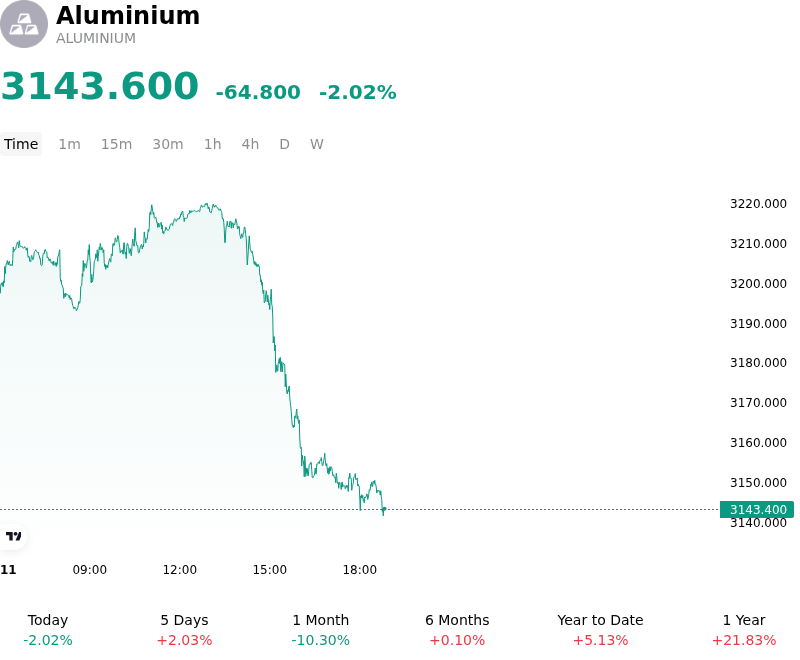
Aluminium (ALUMINIUM) is down 2.02% at Jul 10 06:50(ET), now at $3143.6, with a 7-day up of 2.46%.
SummaryOverview

What is driving Aluminium (ALUMINIUM)’s stock price down today?

The downward pressure on aluminum prices is primarily driven by a combination of deteriorating demand signals from China and a significant influx of stocks into London Metal Exchange registered warehouses. Recent manufacturing Purchasing Managers Index data from major Asian economies has underscored a contraction in industrial activity, particularly within the automotive and construction sectors, which are the primary consumers of the metal. This cooling demand outlook has prompted institutional investors to recalibrate their long positions, leading to accelerated technical selling as key support levels were breached.

Inventory dynamics have played a critical role in the session's volatility. A substantial delivery into exchange-monitored warehouses, particularly in Asian locations, has eased immediate concerns regarding physical tightness. This sudden increase in available supply suggests that the previous tightness in the spot market was transitory, shifting the forward curve into a deeper contango. Market participants are interpreting these inflows as a sign that surplus metal from primary smelters is failing to find end-user buyers, thereby forcing it into exchange storage.

On the macroeconomic front, a resurgent US dollar has created a significant headwind for the broader base metals complex. Expectations of a more restrictive monetary policy stance from the Federal Reserve, following persistent inflationary data, have bolstered the greenback, making dollar-denominated commodities more expensive for international buyers. This currency strength, coupled with rising real yields, has diminished the appeal of non-yielding assets, leading to broader capital outflows from industrial metal exchange-traded funds and speculative accounts.

Furthermore, falling energy costs in key smelting hubs have lowered the marginal cost of production, effectively lowering the price floor for the metal. As power prices stabilize or decline in Europe and parts of Asia, the supply-side constraints that previously supported higher prices have begun to dissipate. While geopolitical risks and potential trade barriers remain a long-term concern for global supply chains, the immediate focus of the market has shifted toward the reality of surplus production capacity meeting a softening global growth environment. This fundamental shift from a deficit-driven narrative to a surplus-risk environment continues to weigh on investor sentiment.

Technical Analysis of Aluminium (ALUMINIUM)

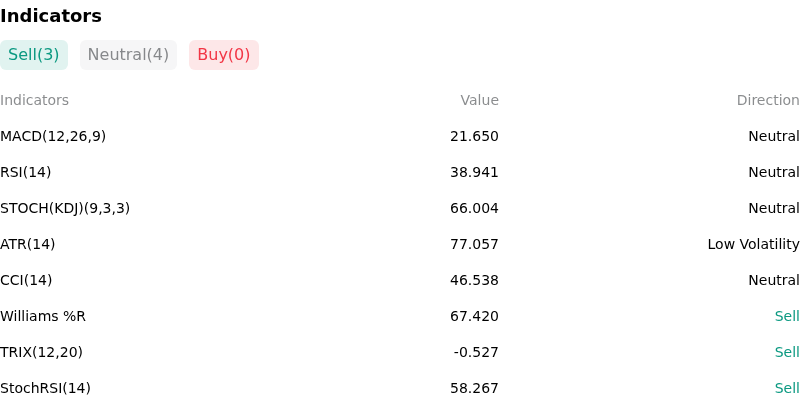
Technically, Aluminium (ALUMINIUM) shows a MACD (12,26,9) value of 21.650, indicating a neutral signal. The RSI at 38.941 suggests neutral condition and the Williams %R at 67.420 suggests sell condition. Please monitor closely.
IndicatorAnalysis

More details about Aluminium (ALUMINIUM)

Recent Events and Risks:

  • China Industrial Demand Weakness: Recent manufacturing activity data and a continued lack of aggressive property-sector stimulus in China have heightened concerns over sluggish domestic consumption, leading to a reduction in orders for primary aluminium and weighing heavily on Shanghai Futures Exchange (SHFE) sentiment.
  • Surge in LME On-Warrant Stocks: A significant increase in metal deliveries to London Metal Exchange warehouses over the last 48 hours has signaled a widening physical market surplus, triggering intraday selling as traders react to the sudden availability of prompt-date material and rising inventory levels in Asian ports.
  • U.S. Dollar Strength and Macro Pressure: Recent hawkish signals from central bank officials regarding persistent inflation have driven a rally in the U.S. Dollar Index, making aluminium more expensive for international buyers and forcing the liquidation of speculative long positions in the futures market.
  • Descending Energy Cost Support: A recent dip in regional natural gas and thermal coal prices has lowered the production cost floor for smelters in Europe and Asia, increasing the risk of higher global output levels and eroding the historical price support previously provided by high energy inputs.
Disclaimer: For information purposes only. Past performance is not indicative of future results.
placeholder
Bitcoin CME gaps at $35,000, $27,000 and $21,000, which one gets filled first?Prioritize filling the $27,000 gap and even try higher.
Author  FXStreet
Aug 22, 2023
Prioritize filling the $27,000 gap and even try higher.
placeholder
Pinduoduo Earnings Incoming: Morgan Stanley Sees Long-Term Profit Potential​Insights – On November 21, Chinese e-commerce giant Pinduoduo (PDD) will release its Q3 2024 earnings.
Author  Mitrade
Nov 20, 2024
​Insights – On November 21, Chinese e-commerce giant Pinduoduo (PDD) will release its Q3 2024 earnings.
placeholder
Elon Musk’s xAI and Neuralink Launch New Funding Rounds​Billionaire Elon Musk recently raised funds for his two high-profile tech companies, xAI and Neuralink.
Author  Insights
Jun 03, 2025
​Billionaire Elon Musk recently raised funds for his two high-profile tech companies, xAI and Neuralink.
placeholder
Bitcoin briefly loses 2025 gains as crypto plunges over the weekend.Bitcoin experienced a sharp decline this weekend, briefly erasing its 2025 gains and dipping below its year-opening value of $93,507. The cryptocurrency fell to a low of $93,029 on Sunday, representing a 25% drop from its all-time high in October. Although it has rebounded slightly to around $94,209, the pressures on the market remain significant. The downturn occurred despite the reopening of the U.S. government on Thursday, which many had hoped would provide essential support for crypto markets. This year initially appeared promising for cryptocurrencies, particularly after the inauguration of President Donald Trump, who has established the most pro-crypto administration thus far. However, ongoing political tensions—including Trump's tariff strategies and the recent government shutdown, lasting a historic 43 days—have contributed to several rapid price pullbacks for Bitcoin throughout the year. Market dynamics are also being influenced by Bitcoin whales—investors holding large amounts of Bitcoin—who have been offloading portions of their assets, consequently stalling price rallies even as positive regulatory developments emerge. Despite these sell-offs, analysts from Glassnode argue that this behavior aligns with typical patterns seen among long-term investors during the concluding stages of bull markets, suggesting it is not indicative of a mass exodus. Notably, Bitcoin is not alone in its struggles, as Ethereum and Solana have also recorded declines of 7.95% and 28.3%, respectively, since the start of the year, while numerous altcoins have faced even steeper losses. Looking ahead, questions linger regarding the viability of the four-year cycle thesis, particularly given the increasing institutional support and regulatory frameworks now in place in the crypto landscape. Matt Hougan, chief investment officer at Bitwise, remains optimistic, suggesting a potential Bitcoin resurgence in 2026 driven by the “debasement trade” thesis and a broader trend toward increased adoption of stablecoins, tokenization, and decentralized finance. Hougan emphasized the soundness of the underlying fundamentals, pointing to a positive outlook for the sector in the longer term.
Author  Mitrade
Nov 17, 2025
Bitcoin experienced a sharp decline this weekend, briefly erasing its 2025 gains and dipping below its year-opening value of $93,507. The cryptocurrency fell to a low of $93,029 on Sunday, representing a 25% drop from its all-time high in October. Although it has rebounded slightly to around $94,209, the pressures on the market remain significant. The downturn occurred despite the reopening of the U.S. government on Thursday, which many had hoped would provide essential support for crypto markets. This year initially appeared promising for cryptocurrencies, particularly after the inauguration of President Donald Trump, who has established the most pro-crypto administration thus far. However, ongoing political tensions—including Trump's tariff strategies and the recent government shutdown, lasting a historic 43 days—have contributed to several rapid price pullbacks for Bitcoin throughout the year. Market dynamics are also being influenced by Bitcoin whales—investors holding large amounts of Bitcoin—who have been offloading portions of their assets, consequently stalling price rallies even as positive regulatory developments emerge. Despite these sell-offs, analysts from Glassnode argue that this behavior aligns with typical patterns seen among long-term investors during the concluding stages of bull markets, suggesting it is not indicative of a mass exodus. Notably, Bitcoin is not alone in its struggles, as Ethereum and Solana have also recorded declines of 7.95% and 28.3%, respectively, since the start of the year, while numerous altcoins have faced even steeper losses. Looking ahead, questions linger regarding the viability of the four-year cycle thesis, particularly given the increasing institutional support and regulatory frameworks now in place in the crypto landscape. Matt Hougan, chief investment officer at Bitwise, remains optimistic, suggesting a potential Bitcoin resurgence in 2026 driven by the “debasement trade” thesis and a broader trend toward increased adoption of stablecoins, tokenization, and decentralized finance. Hougan emphasized the soundness of the underlying fundamentals, pointing to a positive outlook for the sector in the longer term.
placeholder
Gold declines as Trump scraps Iran memorandum, markets await Fed minutesGold (XAU/USD) trades around $4,050 on Wednesday, down 1.40% on the day at the time of writing, as investors favor the US Dollar (USD) following a fresh deterioration in tensions between the United States (US) and Iran.
Author  FXStreet
Jul 08, Wed
Gold (XAU/USD) trades around $4,050 on Wednesday, down 1.40% on the day at the time of writing, as investors favor the US Dollar (USD) following a fresh deterioration in tensions between the United States (US) and Iran.
goTop
quote